

Ä Compounds Containing Acyclic Nitrogen
129
39
40
Structurally, the closest relative of pahutoxin that has been isolated from a
marine source is the choline ester of 14-methylpentadec-4-enoic acid (37),
which Nakazawa (1959) isolated from an oyster. The choline ester of 37,
however, is apparently the cation of a complex salt, whose anion is a trisaccharide of the glycopeptide lactyl taurine of structure 38.
14
4
Me 2 CH—(CH 2 ) 8 —CH=CH—(CH 2 ) 2 —C0 2 H
37
H
- 0 3 S —(CH 2 ) 2 —N—CO— CH—CH 3
I
OR
38
R = trisaccharide
B. Compounds Containing Acyclic Nitrogen
Among the small number of compounds in this group that have so far
been isolated from marine organisms and that without a doubt are secondary
metabolites are only a few that are related to each other structurally. These
are neutral nitrogenous (amide or nitrile) derivatives of similarly substituted
acetic acids, perhaps biogenetically derived from a dibromotyrosine. All of
these compounds have been isolated from sponges (Porifera). They will be
discussed first, followed by a few other unrelated compounds.
2. DIBROMOTYROSIN-DERIVED COMPOUNDS
Burkholder and collaborators in their search for antibiotic substances in
marine organisms reported the isolation of four compounds from the sponges
Verongia fistularia and V. cauliformis (Sharma and Burkholder, 1967a;
Sharma et al, 1968). Two of the compounds contained bromine and were
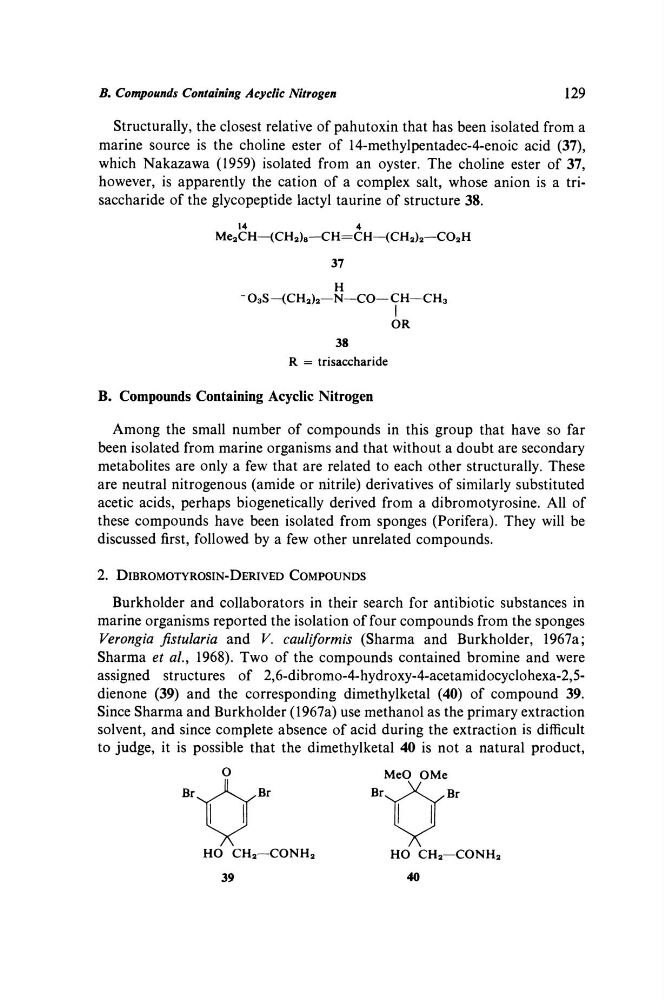
assigned structures of 2,6-dibromo-4-hydroxy-4-acetamidocyclohexa-2,5dienone (39) and the corresponding dimethylketal (40) of compound 39.
Since Sharma and Burkholder (1967a) use methanol as the primary extraction
solvent, and since complete absence of acid during the extraction is difficult
to judge, it is possible that the dimethylketal 40 is not a natural product,
Ο
MeO OMe
HO CH 2 —CONH 2
HO CH 2 —CONH 2
B. Compounds Containing Acyclic Nitrogen
129
Structurally, the closest relative of pahutoxin that has been isolated from a
marine source is the choline ester of 14-methylpentadec-4-enoic acid (37),
which Nakazawa (1959) isolated from an oyster. The choline ester of 37,
however, is apparently the cation of a complex salt, whose anion is a trisaccharide of the glycopeptide lactyl taurine of structure 38.
14
4
Me2CH-(CH2)a-CH=CH-(CH 2 )2-C02H
37
H
-OaS-(CH2)2-N-CO-CH-CHa
I
OR
38
R = trisaccharide
B. Compounds Containing Acyclic Nitrogen
Among the small number of compounds in this group that have so far
been isolated from marine organisms and that without a doubt are secondary
metabolites are only a few that are related to each other structurally. These
are neutral nitrogenous (amide or nitrile) derivatives of similarly substituted
acetic acids, perhaps biogenetically derived from a dibromotyrosine. All of
these compounds have been isolated from sponges (Porifera). They will be
discussed first, followed by a few other unrelated compounds.
2. DIBROMOTYROSIN-DERIVED COMPOUNDS
Burkholder and collaborators in their search for antibiotic substances in
marine organisms reported the isolation of four compounds from the sponges
Verongia fistularia and V. cauliformis (Sharma and Burkholder, 1967a;
Sharma et al., 1968). Two of the compounds contained bromine and were
assigned structures of 2,6-dibromo-4-hydroxy-4-acetamidocyclohexa-2,5dienone (39) and the corresponding dimethylketal (40) of compound 39.
Since Sharma and Burkholder (1967a) use methanol as the primary extraction
solvent, and since complete absence of acid during the extraction is difficult
to judge, it is possible that the dimethylketal 40 is not a natural product,
o
Br(rBr
HO CH 2 -CONH2
39
Br~eBr
HO CH2-CONH 2
40
129
39
40
Structurally, the closest relative of pahutoxin that has been isolated from a
marine source is the choline ester of 14-methylpentadec-4-enoic acid (37),
which Nakazawa (1959) isolated from an oyster. The choline ester of 37,
however, is apparently the cation of a complex salt, whose anion is a trisaccharide of the glycopeptide lactyl taurine of structure 38.
14
4
Me 2 CH—(CH 2 ) 8 —CH=CH—(CH 2 ) 2 —C0 2 H
37
H
- 0 3 S —(CH 2 ) 2 —N—CO— CH—CH 3
I
OR
38
R = trisaccharide
B. Compounds Containing Acyclic Nitrogen
Among the small number of compounds in this group that have so far
been isolated from marine organisms and that without a doubt are secondary
metabolites are only a few that are related to each other structurally. These
are neutral nitrogenous (amide or nitrile) derivatives of similarly substituted
acetic acids, perhaps biogenetically derived from a dibromotyrosine. All of
these compounds have been isolated from sponges (Porifera). They will be
discussed first, followed by a few other unrelated compounds.
2. DIBROMOTYROSIN-DERIVED COMPOUNDS
Burkholder and collaborators in their search for antibiotic substances in
marine organisms reported the isolation of four compounds from the sponges
Verongia fistularia and V. cauliformis (Sharma and Burkholder, 1967a;
Sharma et al, 1968). Two of the compounds contained bromine and were
assigned structures of 2,6-dibromo-4-hydroxy-4-acetamidocyclohexa-2,5dienone (39) and the corresponding dimethylketal (40) of compound 39.
Since Sharma and Burkholder (1967a) use methanol as the primary extraction
solvent, and since complete absence of acid during the extraction is difficult
to judge, it is possible that the dimethylketal 40 is not a natural product,
Ο
MeO OMe
HO CH 2 —CONH 2
HO CH 2 —CONH 2
B. Compounds Containing Acyclic Nitrogen
129
Structurally, the closest relative of pahutoxin that has been isolated from a
marine source is the choline ester of 14-methylpentadec-4-enoic acid (37),
which Nakazawa (1959) isolated from an oyster. The choline ester of 37,
however, is apparently the cation of a complex salt, whose anion is a trisaccharide of the glycopeptide lactyl taurine of structure 38.
14
4
Me2CH-(CH2)a-CH=CH-(CH 2 )2-C02H
37
H
-OaS-(CH2)2-N-CO-CH-CHa
I
OR
38
R = trisaccharide
B. Compounds Containing Acyclic Nitrogen
Among the small number of compounds in this group that have so far
been isolated from marine organisms and that without a doubt are secondary
metabolites are only a few that are related to each other structurally. These
are neutral nitrogenous (amide or nitrile) derivatives of similarly substituted
acetic acids, perhaps biogenetically derived from a dibromotyrosine. All of
these compounds have been isolated from sponges (Porifera). They will be
discussed first, followed by a few other unrelated compounds.
2. DIBROMOTYROSIN-DERIVED COMPOUNDS
Burkholder and collaborators in their search for antibiotic substances in
marine organisms reported the isolation of four compounds from the sponges
Verongia fistularia and V. cauliformis (Sharma and Burkholder, 1967a;
Sharma et al., 1968). Two of the compounds contained bromine and were
assigned structures of 2,6-dibromo-4-hydroxy-4-acetamidocyclohexa-2,5dienone (39) and the corresponding dimethylketal (40) of compound 39.
Since Sharma and Burkholder (1967a) use methanol as the primary extraction
solvent, and since complete absence of acid during the extraction is difficult
to judge, it is possible that the dimethylketal 40 is not a natural product,
o
Br(rBr
HO CH 2 -CONH2
39
Br~eBr
HO CH2-CONH 2
40