

128
4. Nitrogenous Compounds
glycosides of the holothurians (sea cucumbers; see Chapter 1) on the basis of
a similarity in foaming and hemolytic properties. Thomson (1964) named his
preparation ostracitoxin, while in the meantime Scheuer (1964) had reported
the isolation of a pure crystalline toxin that had been designated pahutoxin.
(Pahu is the Hawaiian word for the boxfish.)
As reported by Boylan and Scheuer (1967), the boxfish were caught by
net and were immediately placed in containers of distilled water, where
under stress of the changed environment they released copious quantities of a
mucous secretion. After this "milking" the boxfish were returned to the sea
and the aqueous toxic (capable of killing brackish-water mollies) solution was
rapidly extracted with 1-butanol, which after concentration and silicic acid
chromatography yielded an amorphous toxin. After passage through an
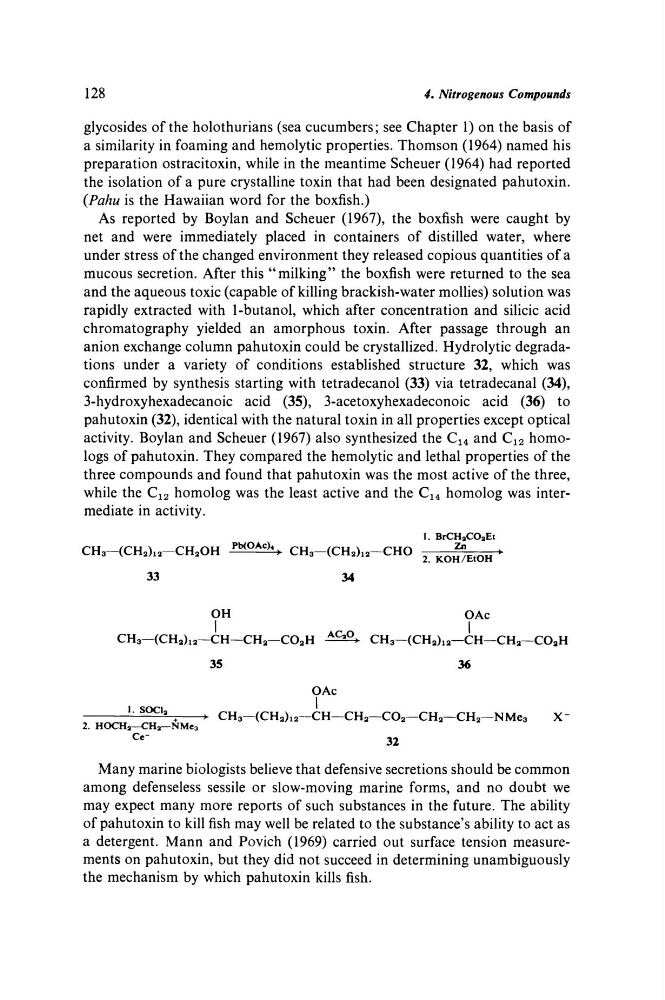
anion exchange column pahutoxin could be crystallized. Hydrolytic degradations under a variety of conditions established structure 32, which was
confirmed by synthesis starting with tetradecanol (33) via tetradecanal (34),
3-hydroxyhexadecanoic acid (35), 3-acetoxyhexadeconoic acid (36) to
pahutoxin (32), identical with the natural toxin in all properties except optical
activity. Boylan and Scheuer (1967) also synthesized the C 14 and C 12 homologs of pahutoxin. They compared the hemolytic and lethal properties of the
three compounds and found that pahutoxin was the most active of the three,
while the C 12 homolog was the least active and the C 14 homolog was intermediate in activity.
1. BrCH 2 CO a Et
CH 3 —(CH 2 ) 12 —CH 2 OH
p b ( Q A c ) 4
> CH 3 —(CH 2 ) 12 —CHO
^
2. KOH/EtOH
33
34
OH
OAc
CH 3 —(CH 2 ) 12 —CH—CH 2 —C0 2 H
CH 3 —(CH 2 ) 12 —CH—CH 2 —CO a H
35
36
OAc
soci a
CH 3 —(CH 2 ) 12 —CH—CH 2 —C0 2 —CH 2 —CH 2 —NMe 3
2. HOCH 2 —CH a —NMe 3
C e
"
32
Many marine biologists believe that defensive secretions should be common
among defenseless sessile or slow-moving marine forms, and no doubt we
may expect many more reports of such substances in the future. The ability
of pahutoxin to kill fish may well be related to the substance's ability to act as
a detergent. Mann and Povich (1969) carried out surface tension measurements on pahutoxin, but they did not succeed in determining unambiguously
the mechanism by which pahutoxin kills fish.
4. Nitrogenous Compounds
glycosides of the holothurians (sea cucumbers; see Chapter 1) on the basis of
a similarity in foaming and hemolytic properties. Thomson (1964) named his
preparation ostracitoxin, while in the meantime Scheuer (1964) had reported
the isolation of a pure crystalline toxin that had been designated pahutoxin.
(Pahu is the Hawaiian word for the boxfish.)
As reported by Boylan and Scheuer (1967), the boxfish were caught by
net and were immediately placed in containers of distilled water, where
under stress of the changed environment they released copious quantities of a
mucous secretion. After this "milking" the boxfish were returned to the sea
and the aqueous toxic (capable of killing brackish-water mollies) solution was
rapidly extracted with 1-butanol, which after concentration and silicic acid
chromatography yielded an amorphous toxin. After passage through an
anion exchange column pahutoxin could be crystallized. Hydrolytic degradations under a variety of conditions established structure 32, which was
confirmed by synthesis starting with tetradecanol (33) via tetradecanal (34),
3-hydroxyhexadecanoic acid (35), 3-acetoxyhexadeconoic acid (36) to
pahutoxin (32), identical with the natural toxin in all properties except optical
activity. Boylan and Scheuer (1967) also synthesized the C 14 and C 12 homologs of pahutoxin. They compared the hemolytic and lethal properties of the
three compounds and found that pahutoxin was the most active of the three,
while the C 12 homolog was the least active and the C 14 homolog was intermediate in activity.
1. BrCH 2 CO a Et
CH 3 —(CH 2 ) 12 —CH 2 OH
p b ( Q A c ) 4
> CH 3 —(CH 2 ) 12 —CHO
^
2. KOH/EtOH
33
34
OH
OAc
CH 3 —(CH 2 ) 12 —CH—CH 2 —C0 2 H
CH 3 —(CH 2 ) 12 —CH—CH 2 —CO a H
35
36
OAc
soci a
CH 3 —(CH 2 ) 12 —CH—CH 2 —C0 2 —CH 2 —CH 2 —NMe 3
2. HOCH 2 —CH a —NMe 3
C e
"
32
Many marine biologists believe that defensive secretions should be common
among defenseless sessile or slow-moving marine forms, and no doubt we
may expect many more reports of such substances in the future. The ability
of pahutoxin to kill fish may well be related to the substance's ability to act as
a detergent. Mann and Povich (1969) carried out surface tension measurements on pahutoxin, but they did not succeed in determining unambiguously
the mechanism by which pahutoxin kills fish.