

A, Simple Amines, Amino Acids, and Choline Derivatives
127
32
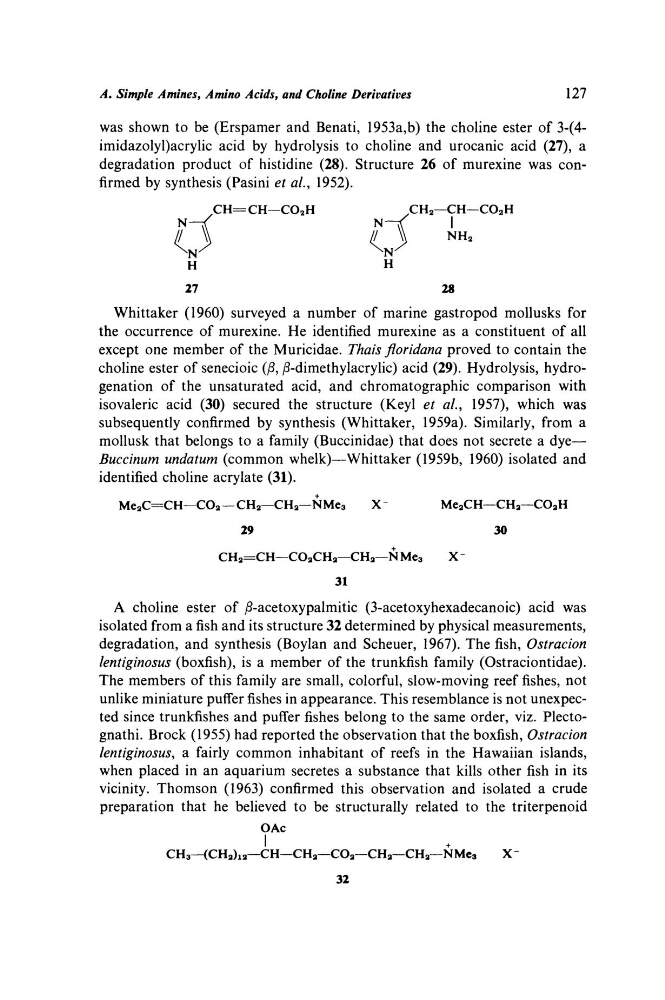
was shown to be (Erspamer and Benati, 1953a,b) the choline ester of 3-(4imidazolyl)acrylic acid by hydrolysis to choline and urocanic acid (27), a
degradation product of histidine (28). Structure 26 of murexine was confirmed by synthesis (Pasini et al., 1952).
CH= CH—C0 2 H
CH 2 —CH—CO a H
// \\
II \
NH 2
Η
Η
27
28
Whittaker (1960) surveyed a number of marine gastropod mollusks for
the occurrence of murexine. He identified murexine as a constituent of all
except one member of the Muricidae. Thais floridana proved to contain the
choline ester of senecioic (ß, ß-dimethylacrylic) acid (29). Hydrolysis, hydrogénation of the unsaturated acid, and chromatographic comparison with
isovaleric acid (30) secured the structure (Keyl et al., 1957), which was
subsequently confirmed by synthesis (Whittaker, 1959a). Similarly, from a
mollusk that belongs to a family (Buccinidae) that does not secrete a dye—
Buccinum undatum (common whelk)—Whittaker (1959b, 1960) isolated and
identified choline aery late (31).
Me 2 C=CH—C0 2 —CH 2 —CH 2 —Ν Me 3
X "
Me 2 CH—CH 2 —CO a H
29
30
CH 2 =CH—C0 2 CH 2 —CH 2 —Ν Me 3
X "
31
A choline ester of ß-acetoxypalmitic (3-acetoxyhexadecanoic) acid was
isolated from a fish and its structure 32 determined by physical measurements,
degradation, and synthesis (Boylan and Scheuer, 1967). The fish, Ostracion
lentiginosus (boxfish), is a member of the trunkfish family (Ostraciontidae).
The members of this family are small, colorful, slow-moving reef fishes, not
unlike miniature puffer fishes in appearance. This resemblance is not unexpected since trunkfishes and puffer fishes belong to the same order, viz. Plectognathi. Brock (1955) had reported the observation that the boxfish, Ostracion
lentiginosus, a fairly common inhabitant of reefs in the Hawaiian islands,
when placed in an aquarium secretes a substance that kills other fish in its
vicinity. Thomson (1963) confirmed this observation and isolated a crude
preparation that he believed to be structurally related to the triterpenoid
OAc
I
CH 3 —(CH A )IA—CH—CH 2 —CO a —CH 2 —CH 2 —NMe 3
X "
127
32
was shown to be (Erspamer and Benati, 1953a,b) the choline ester of 3-(4imidazolyl)acrylic acid by hydrolysis to choline and urocanic acid (27), a
degradation product of histidine (28). Structure 26 of murexine was confirmed by synthesis (Pasini et al., 1952).
CH= CH—C0 2 H
CH 2 —CH—CO a H
// \\
II \
NH 2
Η
Η
27
28
Whittaker (1960) surveyed a number of marine gastropod mollusks for
the occurrence of murexine. He identified murexine as a constituent of all
except one member of the Muricidae. Thais floridana proved to contain the
choline ester of senecioic (ß, ß-dimethylacrylic) acid (29). Hydrolysis, hydrogénation of the unsaturated acid, and chromatographic comparison with
isovaleric acid (30) secured the structure (Keyl et al., 1957), which was
subsequently confirmed by synthesis (Whittaker, 1959a). Similarly, from a
mollusk that belongs to a family (Buccinidae) that does not secrete a dye—
Buccinum undatum (common whelk)—Whittaker (1959b, 1960) isolated and
identified choline aery late (31).
Me 2 C=CH—C0 2 —CH 2 —CH 2 —Ν Me 3
X "
Me 2 CH—CH 2 —CO a H
29
30
CH 2 =CH—C0 2 CH 2 —CH 2 —Ν Me 3
X "
31
A choline ester of ß-acetoxypalmitic (3-acetoxyhexadecanoic) acid was
isolated from a fish and its structure 32 determined by physical measurements,
degradation, and synthesis (Boylan and Scheuer, 1967). The fish, Ostracion
lentiginosus (boxfish), is a member of the trunkfish family (Ostraciontidae).
The members of this family are small, colorful, slow-moving reef fishes, not
unlike miniature puffer fishes in appearance. This resemblance is not unexpected since trunkfishes and puffer fishes belong to the same order, viz. Plectognathi. Brock (1955) had reported the observation that the boxfish, Ostracion
lentiginosus, a fairly common inhabitant of reefs in the Hawaiian islands,
when placed in an aquarium secretes a substance that kills other fish in its
vicinity. Thomson (1963) confirmed this observation and isolated a crude
preparation that he believed to be structurally related to the triterpenoid
OAc
I
CH 3 —(CH A )IA—CH—CH 2 —CO a —CH 2 —CH 2 —NMe 3
X "