

126
4. Nitrogenous Compounds
26
Konosu et al. (1970), also in Hashimoto's group, have recently reported
the isolation of a new betaine, atrinine, from the adductor muscle of a
bivalve (Mollusca) Atrina pectinata japonica (fan mussel). On the basis of
spectral data, including nmr, the structure of atrinine hydrochloride was
shown to be trimethyl(2-carboxy-3-hydroxypropyl)ammonium chloride (22).
This novel betaine is isomeric with the well-known carnitine (23).
Me 3 N—CH 2 —CH—CH 2 OH
Cl ~
Me 3 N—CH 2 —CH—CH 2 —C0 2
I
I
C0 2 H
OH
22
23
3. CHOLINE DERIVATIVES
The widely occurring compound choline (24), the trimethylammonium
cation of ethanolamine, or its simplest ester, acetylcholine (25), which is an
important intermediate in many biochemical processes, most certainly have
no unique or even special place among marine natural products. However,
because of the bifunctionality of choline and because the reactive function is a
primary and therefore readily esterified alcohol, some of the choline esters
that have been isolated from marine sources may well have intrinsic significance or may even prove to be produced exclusively by marine organisms.
One of these choline esters in fact is not chemically, but biologically and
Me 3 N—CH 2 —CH 2 OH
X"
Me 3 N—CH 2 —CH 2 —Ο Ac
X
24
25
historically, related to what must be man's oldest economic marine natural
product, Tyrian purple (see Section C, this chapter). Briefly (for details vide
infra), the ancient dye Tyrian purple is produced by marine gastropod
mollusks of the family Muricidae. Physiological activity of extracts from the
dye-producing glands was discovered early in this century and was later
believed to arise from an acetylcholine-like substance. Erspamer (1948)
first isolated the substance from Murex trunculus in form of several crystalline
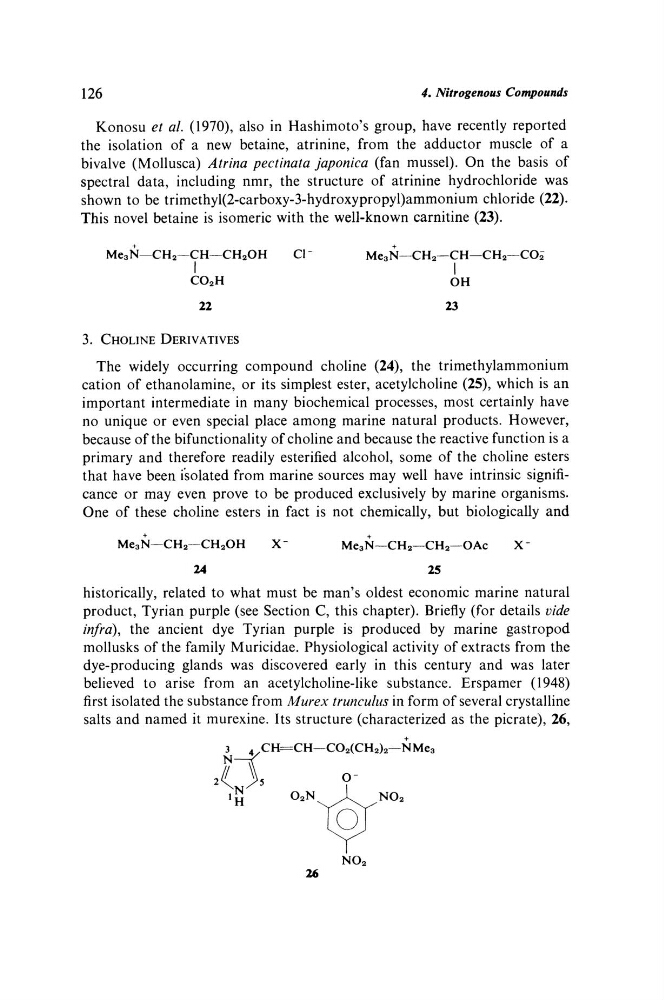
salts and named it murexine. Its structure (characterized as the picrate), 26,
3
4 CH=CH—C0 2 (CH 2 ) 2 —NMe 3
Ό· r
N0 2
4. Nitrogenous Compounds
26
Konosu et al. (1970), also in Hashimoto's group, have recently reported
the isolation of a new betaine, atrinine, from the adductor muscle of a
bivalve (Mollusca) Atrina pectinata japonica (fan mussel). On the basis of
spectral data, including nmr, the structure of atrinine hydrochloride was
shown to be trimethyl(2-carboxy-3-hydroxypropyl)ammonium chloride (22).
This novel betaine is isomeric with the well-known carnitine (23).
Me 3 N—CH 2 —CH—CH 2 OH
Cl ~
Me 3 N—CH 2 —CH—CH 2 —C0 2
I
I
C0 2 H
OH
22
23
3. CHOLINE DERIVATIVES
The widely occurring compound choline (24), the trimethylammonium
cation of ethanolamine, or its simplest ester, acetylcholine (25), which is an
important intermediate in many biochemical processes, most certainly have
no unique or even special place among marine natural products. However,
because of the bifunctionality of choline and because the reactive function is a
primary and therefore readily esterified alcohol, some of the choline esters
that have been isolated from marine sources may well have intrinsic significance or may even prove to be produced exclusively by marine organisms.
One of these choline esters in fact is not chemically, but biologically and
Me 3 N—CH 2 —CH 2 OH
X"
Me 3 N—CH 2 —CH 2 —Ο Ac
X
24
25
historically, related to what must be man's oldest economic marine natural
product, Tyrian purple (see Section C, this chapter). Briefly (for details vide
infra), the ancient dye Tyrian purple is produced by marine gastropod
mollusks of the family Muricidae. Physiological activity of extracts from the
dye-producing glands was discovered early in this century and was later
believed to arise from an acetylcholine-like substance. Erspamer (1948)
first isolated the substance from Murex trunculus in form of several crystalline
salts and named it murexine. Its structure (characterized as the picrate), 26,
3
4 CH=CH—C0 2 (CH 2 ) 2 —NMe 3
Ό· r
N0 2