

A. Simple Amines, Amino Acids, and Choline Derivatives
125
dioxide, guanidine, and y-aminobutyric acid, by permanganate oxidation to
guanylurea and succinic acid, and by barium hydroxide hydrolysis to yureidobutyric acid. Subsequently, Ito and Hashimoto (1966a) assigned the
trivial name gongrine to the new amino acid.
NH
Il H
H
H 2 N—C—Ν—CO—Ν—(CH 2 ) 3 —C0 2 H
18
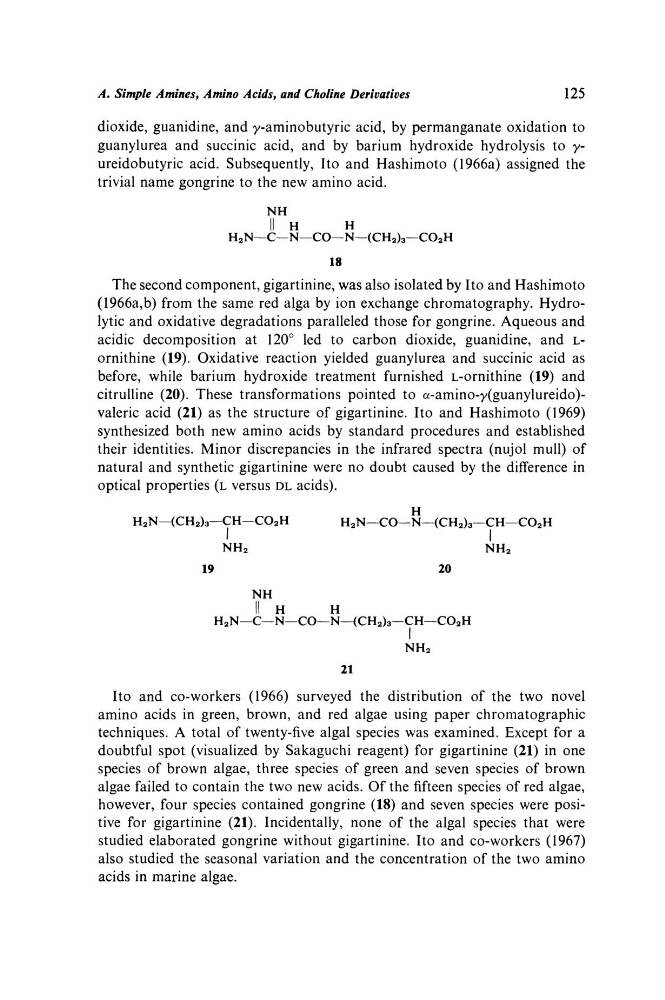
The second component, gigartinine, was also isolated by Ito and Hashimoto
(1966a,b) from the same red alga by ion exchange chromatography. Hydrolytic and oxidative degradations paralleled those for gongrine. Aqueous and
acidic decomposition at 120° led to carbon dioxide, guanidine, and Lornithine (19). Oxidative reaction yielded guanylurea and succinic acid as
before, while barium hydroxide treatment furnished L-ornithine (19) and
citrulline (20). These transformations pointed to a-amino-y(guanylureido)valeric acid (21) as the structure of gigartinine. Ito and Hashimoto (1969)
synthesized both new amino acids by standard procedures and established
their identities. Minor discrepancies in the infrared spectra (nujol mull) of
natural and synthetic gigartinine were no doubt caused by the difference in
optical properties (L versus DL acids).
H 2 N—(CH 2 ) 3 —CH—C0 2 H
H 2 N—CO—N—(CH 2 ) 3 —CH—C0 2 H
I
I
NH 2
NH 2
19
20
NH
Il Η
Η
H 2 N—C—Ν—CO—Ν—(CH 2 ) 3 —CH—C0 2 H
I
NH 2
21
Ito and co-workers (1966) surveyed the distribution of the two novel
amino acids in green, brown, and red algae using paper chromatographic
techniques. A total of twenty-five algal species was examined. Except for a
doubtful spot (visualized by Sakaguchi reagent) for gigartinine (21) in one
species of brown algae, three species of green and seven species of brown
algae failed to contain the two new acids. Of the fifteen species of red algae,
however, four species contained gongrine (18) and seven species were positive for gigartinine (21). Incidentally, none of the algal species that were
studied elaborated gongrine without gigartinine. Ito and co-workers (1967)
also studied the seasonal variation and the concentration of the two amino
acids in marine algae.
125
dioxide, guanidine, and y-aminobutyric acid, by permanganate oxidation to
guanylurea and succinic acid, and by barium hydroxide hydrolysis to yureidobutyric acid. Subsequently, Ito and Hashimoto (1966a) assigned the
trivial name gongrine to the new amino acid.
NH
Il H
H
H 2 N—C—Ν—CO—Ν—(CH 2 ) 3 —C0 2 H
18
The second component, gigartinine, was also isolated by Ito and Hashimoto
(1966a,b) from the same red alga by ion exchange chromatography. Hydrolytic and oxidative degradations paralleled those for gongrine. Aqueous and
acidic decomposition at 120° led to carbon dioxide, guanidine, and Lornithine (19). Oxidative reaction yielded guanylurea and succinic acid as
before, while barium hydroxide treatment furnished L-ornithine (19) and
citrulline (20). These transformations pointed to a-amino-y(guanylureido)valeric acid (21) as the structure of gigartinine. Ito and Hashimoto (1969)
synthesized both new amino acids by standard procedures and established
their identities. Minor discrepancies in the infrared spectra (nujol mull) of
natural and synthetic gigartinine were no doubt caused by the difference in
optical properties (L versus DL acids).
H 2 N—(CH 2 ) 3 —CH—C0 2 H
H 2 N—CO—N—(CH 2 ) 3 —CH—C0 2 H
I
I
NH 2
NH 2
19
20
NH
Il Η
Η
H 2 N—C—Ν—CO—Ν—(CH 2 ) 3 —CH—C0 2 H
I
NH 2
21
Ito and co-workers (1966) surveyed the distribution of the two novel
amino acids in green, brown, and red algae using paper chromatographic
techniques. A total of twenty-five algal species was examined. Except for a
doubtful spot (visualized by Sakaguchi reagent) for gigartinine (21) in one
species of brown algae, three species of green and seven species of brown
algae failed to contain the two new acids. Of the fifteen species of red algae,
however, four species contained gongrine (18) and seven species were positive for gigartinine (21). Incidentally, none of the algal species that were
studied elaborated gongrine without gigartinine. Ito and co-workers (1967)
also studied the seasonal variation and the concentration of the two amino
acids in marine algae.