

124
4, Nitrogenous Compounds
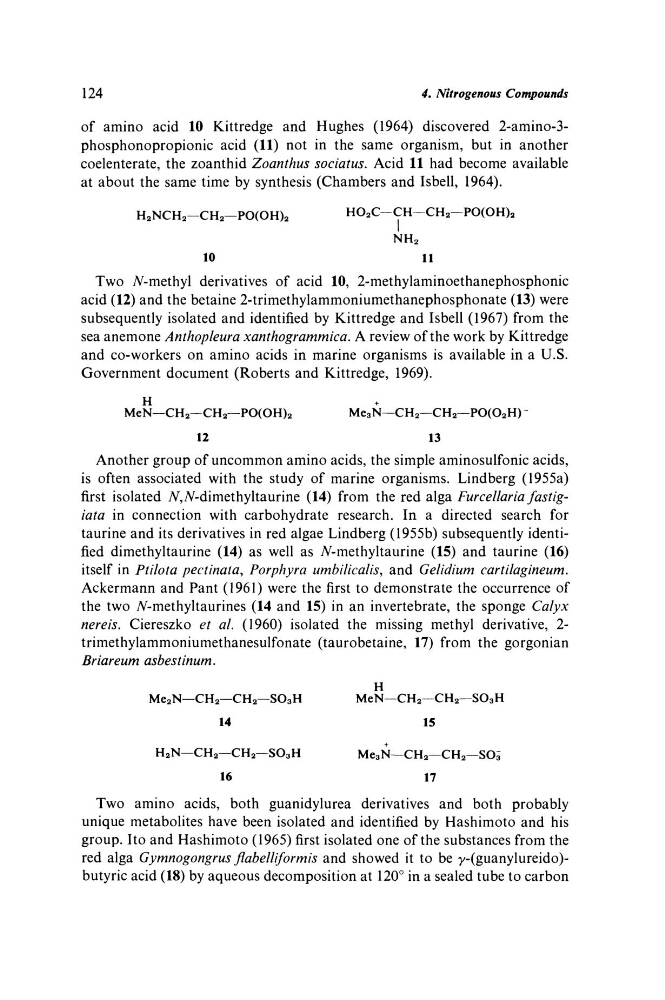
of amino acid 10 Kittredge and Hughes (1964) discovered 2-amino-3phosphonopropionic acid (11) not in the same organism, but in another
coelenterate, the zoanthid Zoanthus sociatus. Acid 11 had become available
at about the same time by synthesis (Chambers and Isbell, 1964).
H 2 NCH 2 -CH 2 -PO(OH) 2
H0 2 C-CH-CH 2 -PO(OH) 2
NH 2
10
11
Two TV-methyl derivatives of acid 10, 2-methylaminoethanephosphonic
acid (12) and the betaine 2-trimethylammoniumethanephosphonate (13) were
subsequently isolated and identified by Kittredge and Isbell (1967) from the
sea anemone Anthopleura xanthogrammica. A review of the work by Kittredge
and co-workers on amino acids in marine organisms is available in a U.S.
Government document (Roberts and Kittredge, 1969).
H
MeN—CH 2 —CH 2 —PO(OH) 2
Me 3 N—CH 2 —CH 2 —PO(0 2 H) -
12
13
Another group of uncommon amino acids, the simple aminosulfonic acids,
is often associated with the study of marine organisms. Lindberg (1955a)
first isolated A^N-dimethyltaurine (14) from the red alga Furcellaria fastigiata in connection with carbohydrate research. In a directed search for
taurine and its derivatives in red algae Lindberg (1955b) subsequently identified dimethyltaurine (14) as well as N-methyltaurine (15) and taurine (16)
itself in Ptilota pectinata, Porphyr a umbilicalis, and Gelidium
cartilagineum.
Ackermann and Pant (1961) were the first to demonstrate the occurrence of
the two 7V-methyltaurines (14 and 15) in an invertebrate, the sponge Calyx
nereis. Ciereszko et al. (1960) isolated the missing methyl derivative, 2trimethylammoniumethanesulfonate (taurobetaine, 17) from the gorgonian
Briareum asbestinum.
H
Me 2 N—CH 2 —CH 2 —S0 3 H
MeN—CH 2 —CH 2 —SO3H
14
15
H 2 N—CH 2 —CH 2 —SO3H
Me 3 N—CH 2 —CH 2 —SOâ
16
17
Two amino acids, both guanidylurea derivatives and both probably
unique metabolites have been isolated and identified by Hashimoto and his
group. Ito and Hashimoto (1965) first isolated one of the substances from the
red alga Gymnogongrus flabelliformis and showed it to be y-(guanylureido)butyric acid (18) by aqueous decomposition at 120° in a sealed tube to carbon
4, Nitrogenous Compounds
of amino acid 10 Kittredge and Hughes (1964) discovered 2-amino-3phosphonopropionic acid (11) not in the same organism, but in another
coelenterate, the zoanthid Zoanthus sociatus. Acid 11 had become available
at about the same time by synthesis (Chambers and Isbell, 1964).
H 2 NCH 2 -CH 2 -PO(OH) 2
H0 2 C-CH-CH 2 -PO(OH) 2
NH 2
10
11
Two TV-methyl derivatives of acid 10, 2-methylaminoethanephosphonic
acid (12) and the betaine 2-trimethylammoniumethanephosphonate (13) were
subsequently isolated and identified by Kittredge and Isbell (1967) from the
sea anemone Anthopleura xanthogrammica. A review of the work by Kittredge
and co-workers on amino acids in marine organisms is available in a U.S.
Government document (Roberts and Kittredge, 1969).
H
MeN—CH 2 —CH 2 —PO(OH) 2
Me 3 N—CH 2 —CH 2 —PO(0 2 H) -
12
13
Another group of uncommon amino acids, the simple aminosulfonic acids,
is often associated with the study of marine organisms. Lindberg (1955a)
first isolated A^N-dimethyltaurine (14) from the red alga Furcellaria fastigiata in connection with carbohydrate research. In a directed search for
taurine and its derivatives in red algae Lindberg (1955b) subsequently identified dimethyltaurine (14) as well as N-methyltaurine (15) and taurine (16)
itself in Ptilota pectinata, Porphyr a umbilicalis, and Gelidium
cartilagineum.
Ackermann and Pant (1961) were the first to demonstrate the occurrence of
the two 7V-methyltaurines (14 and 15) in an invertebrate, the sponge Calyx
nereis. Ciereszko et al. (1960) isolated the missing methyl derivative, 2trimethylammoniumethanesulfonate (taurobetaine, 17) from the gorgonian
Briareum asbestinum.
H
Me 2 N—CH 2 —CH 2 —S0 3 H
MeN—CH 2 —CH 2 —SO3H
14
15
H 2 N—CH 2 —CH 2 —SO3H
Me 3 N—CH 2 —CH 2 —SOâ
16
17
Two amino acids, both guanidylurea derivatives and both probably
unique metabolites have been isolated and identified by Hashimoto and his
group. Ito and Hashimoto (1965) first isolated one of the substances from the
red alga Gymnogongrus flabelliformis and showed it to be y-(guanylureido)butyric acid (18) by aqueous decomposition at 120° in a sealed tube to carbon