

A. Simple Amines, Amino Acids, and Choline Derivatives
123
have carried out an ambitious study using two-dimensional thin-layer
electrophoresis and chromatography on a marine phylum, a study of the
kind that for many years was commonplace for many terrestrial phyla.
Bergquist and Hartman (1969) investigated 67 species belonging to 50
genera of West Indian sponges. All species belonged to a single class of the
phylum Porifera, the Demospongiae. This class comprises the largest number
of species in the phylum, and all but one are marine families. The authors'
purpose (Bergquist and Hartmann, 1969) was to provide a chemotaxonomic
survey using free amino acids as the indicator. Because of the care and thoroughness of the work it also serves as a guide to the occurrence in this class
of primitive marine animals of some thirty amino acids, some of them rare,
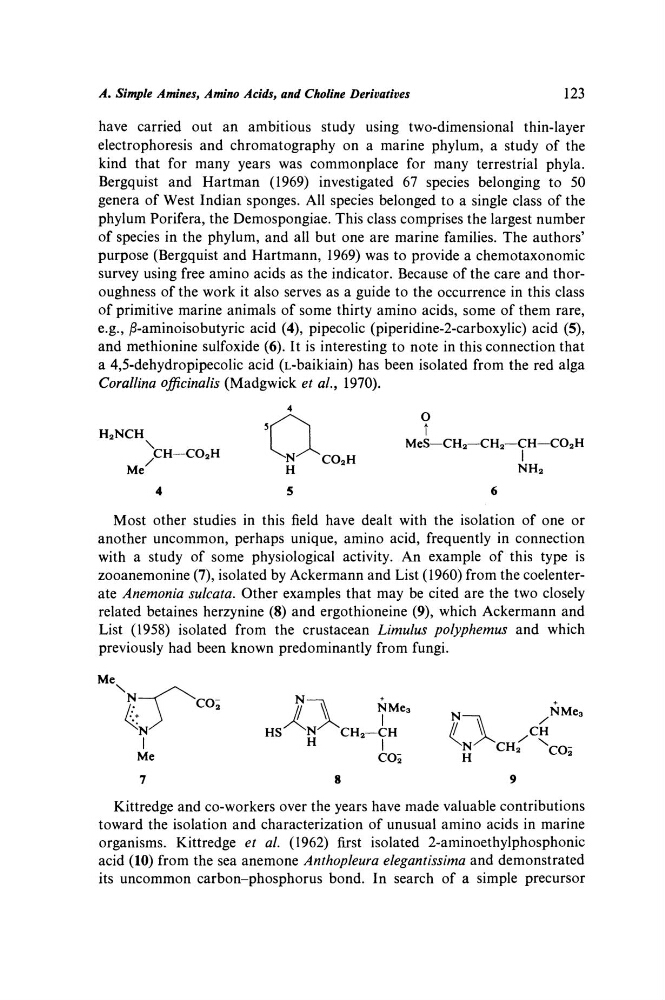
e.g., jS-aminoisobutyric acid (4), pipecolic (piperidine-2-carboxylic) acid (5),
and methionine sulfoxide (6). It is interesting to note in this connection that
a 4,5-dehydropipecolic acid (L-baikiain) has been isolated from the red alga
Corallina officinalis (Madgwick et al., 1970).
H 2 NCH
5
Γ^Ί
î
\
I
I
MeS—CH 2 —CH 2 —CH—C0 2 H
CH-CO.H
S^C0 2 H
I
Me
H
NH 2
4
5
6
Most other studies in this field have dealt with the isolation of one or
another uncommon, perhaps unique, amino acid, frequently in connection
with a study of some physiological activity. An example of this type is
zooanemonine (7), isolated by Ackermann and List (1960) from the coelenterate Anemonia sulcata. Other examples that may be cited are the two closely
related betaines herzynine (8) and ergothioneine (9), which Ackermann and
List (1958) isolated from the crustacean Limulus polyphemus and which
previously had been known predominantly from fungi.
Me^
Vf^
C O ~*
ΑΧ
Γ
" Ν—Λ
>Me 3
X N
X
HS^N^CH 2 —CH
//
\\
/CH
I
Η
I
S^CH^ ^C0 2
Me
C0 2
Η
C
°
2
7
8
9
Kittredge and co-workers over the years have made valuable contributions
toward the isolation and characterization of unusual amino acids in marine
organisms. Kittredge et al. (1962) first isolated 2-aminoethylphosphonic
acid (10) from the sea anemone Anthopleura elegantissima and demonstrated
its uncommon carbon-phosphorus bond. In search of a simple precursor
123
have carried out an ambitious study using two-dimensional thin-layer
electrophoresis and chromatography on a marine phylum, a study of the
kind that for many years was commonplace for many terrestrial phyla.
Bergquist and Hartman (1969) investigated 67 species belonging to 50
genera of West Indian sponges. All species belonged to a single class of the
phylum Porifera, the Demospongiae. This class comprises the largest number
of species in the phylum, and all but one are marine families. The authors'
purpose (Bergquist and Hartmann, 1969) was to provide a chemotaxonomic
survey using free amino acids as the indicator. Because of the care and thoroughness of the work it also serves as a guide to the occurrence in this class
of primitive marine animals of some thirty amino acids, some of them rare,
e.g., jS-aminoisobutyric acid (4), pipecolic (piperidine-2-carboxylic) acid (5),
and methionine sulfoxide (6). It is interesting to note in this connection that
a 4,5-dehydropipecolic acid (L-baikiain) has been isolated from the red alga
Corallina officinalis (Madgwick et al., 1970).
H 2 NCH
5
Γ^Ί
î
\
I
I
MeS—CH 2 —CH 2 —CH—C0 2 H
CH-CO.H
S^C0 2 H
I
Me
H
NH 2
4
5
6
Most other studies in this field have dealt with the isolation of one or
another uncommon, perhaps unique, amino acid, frequently in connection
with a study of some physiological activity. An example of this type is
zooanemonine (7), isolated by Ackermann and List (1960) from the coelenterate Anemonia sulcata. Other examples that may be cited are the two closely
related betaines herzynine (8) and ergothioneine (9), which Ackermann and
List (1958) isolated from the crustacean Limulus polyphemus and which
previously had been known predominantly from fungi.
Me^
Vf^
C O ~*
ΑΧ
Γ
" Ν—Λ
>Me 3
X N
X
HS^N^CH 2 —CH
//
\\
/CH
I
Η
I
S^CH^ ^C0 2
Me
C0 2
Η
C
°
2
7
8
9
Kittredge and co-workers over the years have made valuable contributions
toward the isolation and characterization of unusual amino acids in marine
organisms. Kittredge et al. (1962) first isolated 2-aminoethylphosphonic
acid (10) from the sea anemone Anthopleura elegantissima and demonstrated
its uncommon carbon-phosphorus bond. In search of a simple precursor