

122
4. Nitrogenous Compounds
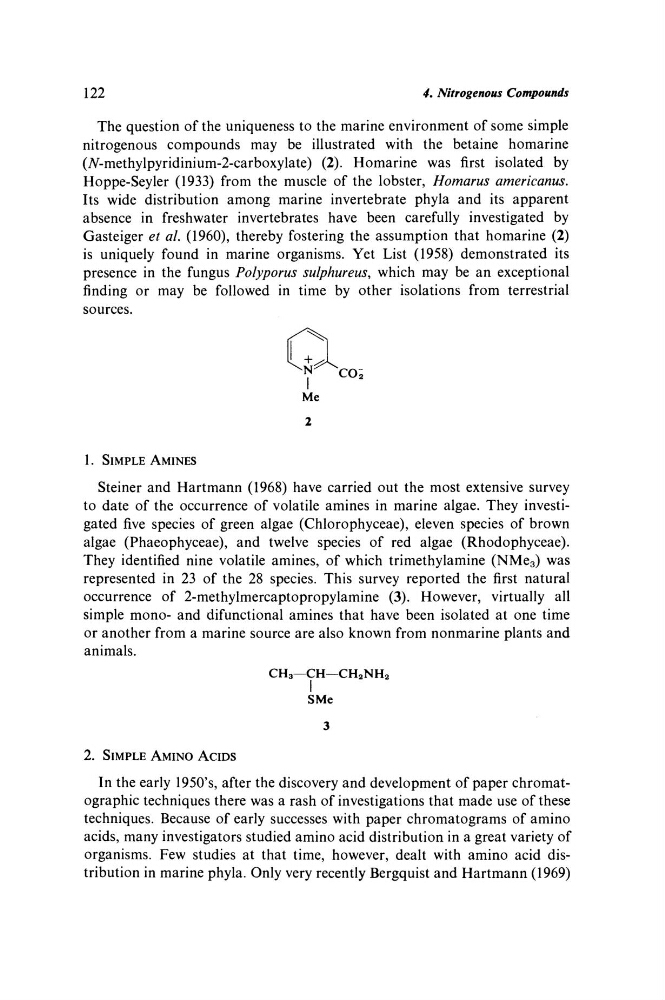
The question of the uniqueness to the marine environment of some simple
nitrogenous compounds may be illustrated with the betaine homarine
(N-methylpyridinium-2-carboxylate) (2). Homarine was first isolated by
Hoppe-Seyler (1933) from the muscle of the lobster, Homarus
americanus.
Its wide distribution among marine invertebrate phyla and its apparent
absence in freshwater invertebrates have been carefully investigated by
Gasteiger et al. (1960), thereby fostering the assumption that homarine (2)
is uniquely found in marine organisms. Yet List (1958) demonstrated its
presence in the fungus Polyporus sulphur eus, which may be an exceptional
finding or may be followed in time by other isolations from terrestrial
sources.
Me
2
1. SIMPLE AMINES
Steiner and Hartmann (1968) have carried out the most extensive survey
to date of the occurrence of volatile amines in marine algae. They investigated five species of green algae (Chlorophyceae), eleven species of brown
algae (Phaeophyceae), and twelve species of red algae (Rhodophyceae).
They identified nine volatile amines, of which trimethylamine (NMe 3 ) was
represented in 23 of the 28 species. This survey reported the first natural
occurrence of 2-methylmercaptopropylamine (3). However, virtually all
simple mono- and difunctional amines that have been isolated at one time
or another from a marine source are also known from nonmarine plants and
animals.
CH 3 —CH—CH 2 NH 2
I
SMe
3
2. SIMPLE AMINO ACIDS
In the early 1950's, after the discovery and development of paper chromatographic techniques there was a rash of investigations that made use of these
techniques. Because of early successes with paper chromatograms of amino
acids, many investigators studied amino acid distribution in a great variety of
organisms. Few studies at that time, however, dealt with amino acid distribution in marine phyla. Only very recently Bergquist and Hartmann (1969)
122
4. Nitrogenous Compounds
The question of the uniqueness to the marine environment of some simple
nitrogenous compounds may be illustrated with the betaine homarine
(N-methylpyridinium-2-carboxylate) (2). Homarine was first isolated by
Hoppe-Seyler (1933) from the muscle of the lobster, Homarus americanus.
Its wide distribution among marine invertebrate phyla and its apparent
absence in freshwater invertebrates have been carefully investigated by
Gasteiger et ale (1960), thereby fostering the assumption that homarine (2)
is uniquely found in marine organisms. Yet List (1958) demonstrated its
presence in the fungus Polyporus sulphureus, which may be an exceptional
finding or may be followed in time by other isolations from terrestrial
sources.
Q I +~
N
coI
2
Me
2
1. SIMPLE AMINES
Steiner and Hartmann (1968) have carried out the most extensive survey
to date of the occurrence of volatile amines in marine algae. They investigated five species of green algae (Chlorophyceae), eleven species of brown
algae (Phaeophyceae), and twelve species of red algae (Rhodophyceae).
They identified nine volatile amines, of which trimethylamine (NMe3) was
represented in 23 of the 28 species. This survey reported the first natural
occurrence of 2-methylmercaptopropylamine (3). However, virtually all
simple mono- and difunctional amines that have been isolated at one time
or another from a marine source are also known from nonmarine plants and
animals.
3
2. SIMPLE AMINO ACIDS
In the early 1950's, after the discovery and development of paper chromatographic techniques there was a rash of investigations that made use of these
techniques. Because of early successes with paper chromatograms of amino
acids, many investigators studied amino acid distribution in a great variety of
organisms. Few studies at that time, however, dealt with amino acid distribution in marine phyla. Only very recently Bergquist and Hartmann (1969)
4. Nitrogenous Compounds
The question of the uniqueness to the marine environment of some simple
nitrogenous compounds may be illustrated with the betaine homarine
(N-methylpyridinium-2-carboxylate) (2). Homarine was first isolated by
Hoppe-Seyler (1933) from the muscle of the lobster, Homarus
americanus.
Its wide distribution among marine invertebrate phyla and its apparent
absence in freshwater invertebrates have been carefully investigated by
Gasteiger et al. (1960), thereby fostering the assumption that homarine (2)
is uniquely found in marine organisms. Yet List (1958) demonstrated its
presence in the fungus Polyporus sulphur eus, which may be an exceptional
finding or may be followed in time by other isolations from terrestrial
sources.
Me
2
1. SIMPLE AMINES
Steiner and Hartmann (1968) have carried out the most extensive survey
to date of the occurrence of volatile amines in marine algae. They investigated five species of green algae (Chlorophyceae), eleven species of brown
algae (Phaeophyceae), and twelve species of red algae (Rhodophyceae).
They identified nine volatile amines, of which trimethylamine (NMe 3 ) was
represented in 23 of the 28 species. This survey reported the first natural
occurrence of 2-methylmercaptopropylamine (3). However, virtually all
simple mono- and difunctional amines that have been isolated at one time
or another from a marine source are also known from nonmarine plants and
animals.
CH 3 —CH—CH 2 NH 2
I
SMe
3
2. SIMPLE AMINO ACIDS
In the early 1950's, after the discovery and development of paper chromatographic techniques there was a rash of investigations that made use of these
techniques. Because of early successes with paper chromatograms of amino
acids, many investigators studied amino acid distribution in a great variety of
organisms. Few studies at that time, however, dealt with amino acid distribution in marine phyla. Only very recently Bergquist and Hartmann (1969)
122
4. Nitrogenous Compounds
The question of the uniqueness to the marine environment of some simple
nitrogenous compounds may be illustrated with the betaine homarine
(N-methylpyridinium-2-carboxylate) (2). Homarine was first isolated by
Hoppe-Seyler (1933) from the muscle of the lobster, Homarus americanus.
Its wide distribution among marine invertebrate phyla and its apparent
absence in freshwater invertebrates have been carefully investigated by
Gasteiger et ale (1960), thereby fostering the assumption that homarine (2)
is uniquely found in marine organisms. Yet List (1958) demonstrated its
presence in the fungus Polyporus sulphureus, which may be an exceptional
finding or may be followed in time by other isolations from terrestrial
sources.
Q I +~
N
coI
2
Me
2
1. SIMPLE AMINES
Steiner and Hartmann (1968) have carried out the most extensive survey
to date of the occurrence of volatile amines in marine algae. They investigated five species of green algae (Chlorophyceae), eleven species of brown
algae (Phaeophyceae), and twelve species of red algae (Rhodophyceae).
They identified nine volatile amines, of which trimethylamine (NMe3) was
represented in 23 of the 28 species. This survey reported the first natural
occurrence of 2-methylmercaptopropylamine (3). However, virtually all
simple mono- and difunctional amines that have been isolated at one time
or another from a marine source are also known from nonmarine plants and
animals.
3
2. SIMPLE AMINO ACIDS
In the early 1950's, after the discovery and development of paper chromatographic techniques there was a rash of investigations that made use of these
techniques. Because of early successes with paper chromatograms of amino
acids, many investigators studied amino acid distribution in a great variety of
organisms. Few studies at that time, however, dealt with amino acid distribution in marine phyla. Only very recently Bergquist and Hartmann (1969)