

D. Anthracene Derivatives
113
hydroxyl group. The trimethyl ether of isorhodoptilometrin (77) could be
compared directly with the dimethyl ether of a mold metabolite nalgiovensin
(Birch and Massy-Westropp, 1957).
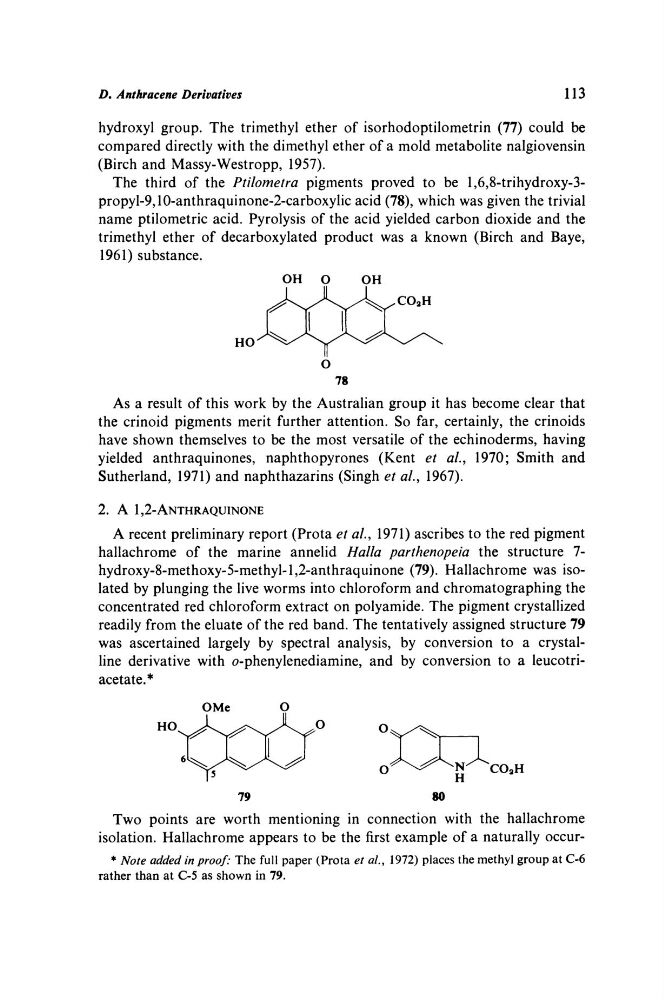
The third of the Ptilometra pigments proved to be l,6,8-trihydroxy-3propyl-9,10-anthraquinone-2-carboxylic acid (78), which was given the trivial
name ptilometric acid. Pyrolysis of the acid yielded carbon dioxide and the
trimethyl ether of decarboxylated product was a known (Birch and Baye,
1961) substance.
OH
Ο
OH
H O ^ ^ Y ^
Ο
78
As a result of this work by the Australian group it has become clear that
the crinoid pigments merit further attention. So far, certainly, the crinoids
have shown themselves to be the most versatile of the echinoderms, having
yielded anthraquinones, naphthopyrones (Kent et al., 1970; Smith and
Sutherland, 1971) and naphthazarins (Singh et al., 1967).
2. A 1,2-ANTHRAQUINONE
A recent preliminary report (Prota et al., 1971) ascribes to the red pigment
hallachrome of the marine annelid Halla parthenopeia the structure 7hydroxy-8-methoxy-5-methyl-1,2-anthraquinone (79). Hallachrome was isolated by plunging the live worms into chloroform and chromatographing the
concentrated red chloroform extract on polyamide. The pigment crystallized
readily from the eluate of the red band. The tentatively assigned structure 79
was ascertained largely by spectral analysis, by conversion to a crystalline derivative with o-phenylenediamine, and by conversion to a leucotriacetate.*
OMe
Ο
I
Η
79
80
Two points are worth mentioning in connection with the hallachrome
isolation. Hallachrome appears to be the first example of a naturally occur* Note added in proof: The full paper (Prota et al, 1972) places the methyl group at C-6
rather than at C-5 as shown in 79.
113
hydroxyl group. The trimethyl ether of isorhodoptilometrin (77) could be
compared directly with the dimethyl ether of a mold metabolite nalgiovensin
(Birch and Massy-Westropp, 1957).
The third of the Ptilometra pigments proved to be l,6,8-trihydroxy-3propyl-9,10-anthraquinone-2-carboxylic acid (78), which was given the trivial
name ptilometric acid. Pyrolysis of the acid yielded carbon dioxide and the
trimethyl ether of decarboxylated product was a known (Birch and Baye,
1961) substance.
OH
Ο
OH
H O ^ ^ Y ^
Ο
78
As a result of this work by the Australian group it has become clear that
the crinoid pigments merit further attention. So far, certainly, the crinoids
have shown themselves to be the most versatile of the echinoderms, having
yielded anthraquinones, naphthopyrones (Kent et al., 1970; Smith and
Sutherland, 1971) and naphthazarins (Singh et al., 1967).
2. A 1,2-ANTHRAQUINONE
A recent preliminary report (Prota et al., 1971) ascribes to the red pigment
hallachrome of the marine annelid Halla parthenopeia the structure 7hydroxy-8-methoxy-5-methyl-1,2-anthraquinone (79). Hallachrome was isolated by plunging the live worms into chloroform and chromatographing the
concentrated red chloroform extract on polyamide. The pigment crystallized
readily from the eluate of the red band. The tentatively assigned structure 79
was ascertained largely by spectral analysis, by conversion to a crystalline derivative with o-phenylenediamine, and by conversion to a leucotriacetate.*
OMe
Ο
I
Η
79
80
Two points are worth mentioning in connection with the hallachrome
isolation. Hallachrome appears to be the first example of a naturally occur* Note added in proof: The full paper (Prota et al, 1972) places the methyl group at C-6
rather than at C-5 as shown in 79.