

114
3. Benzenoids
ring 1,2-anthraquinone. Its structural elucidation has had a long history (see
Prota et al, 1971 for references); hallachrome earlier was believed to be
2,3-dihydroindole-5,6-quinone-2-carboxylic acid (80) (Mazza and Stolfi,
1930). The correctness of this structure was being questioned over the years.
More recent (Bielig and Möllinger, 1960) analytical data pointed to a
C 21 H 2 5N0 9 S formulation.*
Secondly, this work represents one of the few studies that deal with constituents of marine annelids. According to Prota et al. (1971) Halla parthenopeia is a rare polychaete found chiefly in the Bay of Naples, but in general
members of the annelid class Polychaeta (the marine worms) are very common.
According to Barnes (1968) these worms tend to be overlooked because of
their secretive habits. Yet many are said to be strikingly beautiful and are
colored red, pink, or green; and some are iridescent.
£. Miscellaneous Benzenoids
1. A BENZOPYRENE DERIVATIVE
Interestingly enough, another novel quinone pigment has recently been
reported from a marine annelid, the lugworm Arenicola marina (Morimoto
et al., 1970). The pigment arenicochrome had been isolated earlier (van
Duijn et al, 1951; van Duijn, 1952a,b) as a tripotassium salt that liberated
2 moles of sulfuric acid on acid hydrolysis as well as a dark purple pigment,
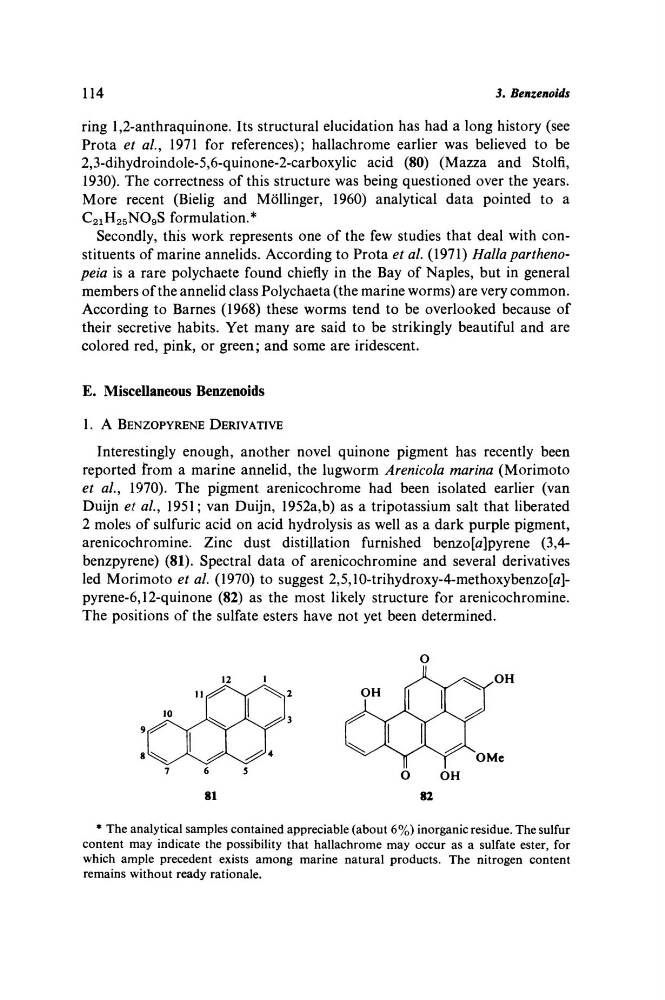
arenicochromine. Zinc dust distillation furnished benzo[a]pyrene (3,4benzpyrene) (81). Spectral data of arenicochromine and several derivatives
led Morimoto et al. (1970) to suggest 2,5,10-trihydroxy-4-methoxybenzo[a]pyrene-6,12-quinone (82) as the most likely structure for arenicochromine.
The positions of the sulfate esters have not yet been determined.
Ο
12
ι
Λ Ν >^ / ΟΗ
7
6
5
Ο
OH
81
82
* The analytical samples contained appreciable (about 6%) inorganic residue. The sulfur
content may indicate the possibility that hallachrome may occur as a sulfate ester, for
which ample precedent exists among marine natural products. The nitrogen content
remains without ready rationale.
3. Benzenoids
ring 1,2-anthraquinone. Its structural elucidation has had a long history (see
Prota et al, 1971 for references); hallachrome earlier was believed to be
2,3-dihydroindole-5,6-quinone-2-carboxylic acid (80) (Mazza and Stolfi,
1930). The correctness of this structure was being questioned over the years.
More recent (Bielig and Möllinger, 1960) analytical data pointed to a
C 21 H 2 5N0 9 S formulation.*
Secondly, this work represents one of the few studies that deal with constituents of marine annelids. According to Prota et al. (1971) Halla parthenopeia is a rare polychaete found chiefly in the Bay of Naples, but in general
members of the annelid class Polychaeta (the marine worms) are very common.
According to Barnes (1968) these worms tend to be overlooked because of
their secretive habits. Yet many are said to be strikingly beautiful and are
colored red, pink, or green; and some are iridescent.
£. Miscellaneous Benzenoids
1. A BENZOPYRENE DERIVATIVE
Interestingly enough, another novel quinone pigment has recently been
reported from a marine annelid, the lugworm Arenicola marina (Morimoto
et al., 1970). The pigment arenicochrome had been isolated earlier (van
Duijn et al, 1951; van Duijn, 1952a,b) as a tripotassium salt that liberated
2 moles of sulfuric acid on acid hydrolysis as well as a dark purple pigment,
arenicochromine. Zinc dust distillation furnished benzo[a]pyrene (3,4benzpyrene) (81). Spectral data of arenicochromine and several derivatives
led Morimoto et al. (1970) to suggest 2,5,10-trihydroxy-4-methoxybenzo[a]pyrene-6,12-quinone (82) as the most likely structure for arenicochromine.
The positions of the sulfate esters have not yet been determined.
Ο
12
ι
Λ Ν >^ / ΟΗ
7
6
5
Ο
OH
81
82
* The analytical samples contained appreciable (about 6%) inorganic residue. The sulfur
content may indicate the possibility that hallachrome may occur as a sulfate ester, for
which ample precedent exists among marine natural products. The nitrogen content
remains without ready rationale.