

112
3. Benzenoids
pigments were obtained. By spectral analysis and chemical degradation the
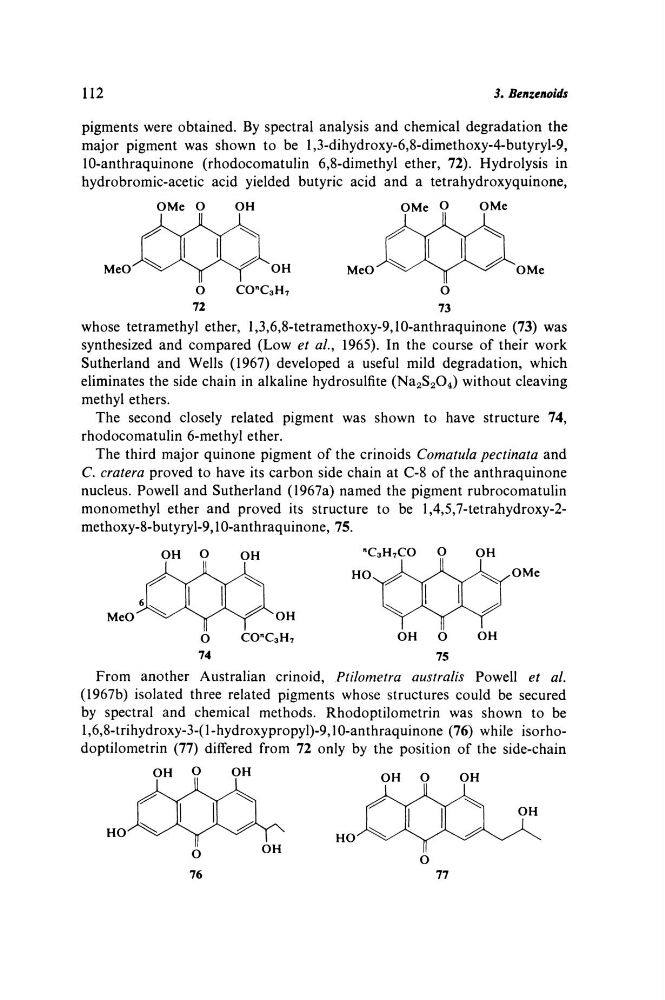
major pigment was shown to be l,3-dihydroxy-6,8-dimethoxy-4-butyryl-9,
10-anthraquinone (rhodocomatulin 6,8-dimethyl ether, 72). Hydrolysis in
hydrobromic-acetic acid yielded butyric acid and a tetrahydroxyquinone,
OMe Ο
OH
OMe Ο
OMe
MeO''^^
OH
MeO''^^
OMe
Ο
CO"C 3 H 7
Ο
72
73
whose tetramethyl ether, l,3,6,8-tetramethoxy-9,10-anthraquinone (73) was
synthesized and compared (Low et al, 1965). In the course of their work
Sutherland and Wells (1967) developed a useful mild degradation, which
eliminates the side chain in alkaline hydrosulfite (Na 2 S 2 0 4 ) without cleaving
methyl ethers.
The second closely related pigment was shown to have structure 74,
rhodocomatulin 6-methyl ether.
The third major quinone pigment of the crinoids Comatula pectinata and
C. cratera proved to have its carbon side chain at C-8 of the anthraquinone
nucleus. Powell and Sutherland (1967a) named the pigment rubrocomatulin
monomethyl ether and proved its structure to be l,4,5,7-tetrahydroxy-2methoxy-8-butyryl-9,10-anthraquinone, 75.
OH
Ο
OH
n
C 3 H 7 CO
Ο
OH
M e O ^ ^ Y ^ Y ^ O H
Ι^^^ίΐΙ^
Ο
CO
n C 3 H 7
OH
Ο
OH
74
75
From another Australian crinoid, Ptilometra australis Powell et al.
(1967b) isolated three related pigments whose structures could be secured
by spectral and chemical methods. Rhodoptilometrin was shown to be
l,6,8-trihydroxy-3-(l-hydroxypropyl)-9,10-anthraquinone (76) while isorhodoptilometrin (77) differed from 72 only by the position of the side-chain
J
H
? °
H
OH
Ο
OH
HO^^
HO^V^XJC^
Ä
OH
II
Υ
Ο
76
77
3. Benzenoids
pigments were obtained. By spectral analysis and chemical degradation the
major pigment was shown to be l,3-dihydroxy-6,8-dimethoxy-4-butyryl-9,
10-anthraquinone (rhodocomatulin 6,8-dimethyl ether, 72). Hydrolysis in
hydrobromic-acetic acid yielded butyric acid and a tetrahydroxyquinone,
OMe Ο
OH
OMe Ο
OMe
MeO''^^
OH
MeO''^^
OMe
Ο
CO"C 3 H 7
Ο
72
73
whose tetramethyl ether, l,3,6,8-tetramethoxy-9,10-anthraquinone (73) was
synthesized and compared (Low et al, 1965). In the course of their work
Sutherland and Wells (1967) developed a useful mild degradation, which
eliminates the side chain in alkaline hydrosulfite (Na 2 S 2 0 4 ) without cleaving
methyl ethers.
The second closely related pigment was shown to have structure 74,
rhodocomatulin 6-methyl ether.
The third major quinone pigment of the crinoids Comatula pectinata and
C. cratera proved to have its carbon side chain at C-8 of the anthraquinone
nucleus. Powell and Sutherland (1967a) named the pigment rubrocomatulin
monomethyl ether and proved its structure to be l,4,5,7-tetrahydroxy-2methoxy-8-butyryl-9,10-anthraquinone, 75.
OH
Ο
OH
n
C 3 H 7 CO
Ο
OH
M e O ^ ^ Y ^ Y ^ O H
Ι^^^ίΐΙ^
Ο
CO
n C 3 H 7
OH
Ο
OH
74
75
From another Australian crinoid, Ptilometra australis Powell et al.
(1967b) isolated three related pigments whose structures could be secured
by spectral and chemical methods. Rhodoptilometrin was shown to be
l,6,8-trihydroxy-3-(l-hydroxypropyl)-9,10-anthraquinone (76) while isorhodoptilometrin (77) differed from 72 only by the position of the side-chain
J
H
? °
H
OH
Ο
OH
HO^^
HO^V^XJC^
Ä
OH
II
Υ
Ο
76
77