

D. Anthracene Derivatives
111
this crinoid species were studied and both yielded the same pigments in
slightly different proportions.
Isolation from the same animal species of a 1,2-dihydroxy compound, its
monomethyl, and its dimethyl ether is reminiscent of plant constituents and
does not resemble what is normally found in animal pigments. Powell
and Sutherland (1967a) in connection with the crinoidal anthraquinone pigments have called attention to the similarity between the pigments of lichens
and crinoids, which in a way reiterates the outward plantlike appearance
of many stalked crinoids (sea lilies).
D. Anthracene Derivatives
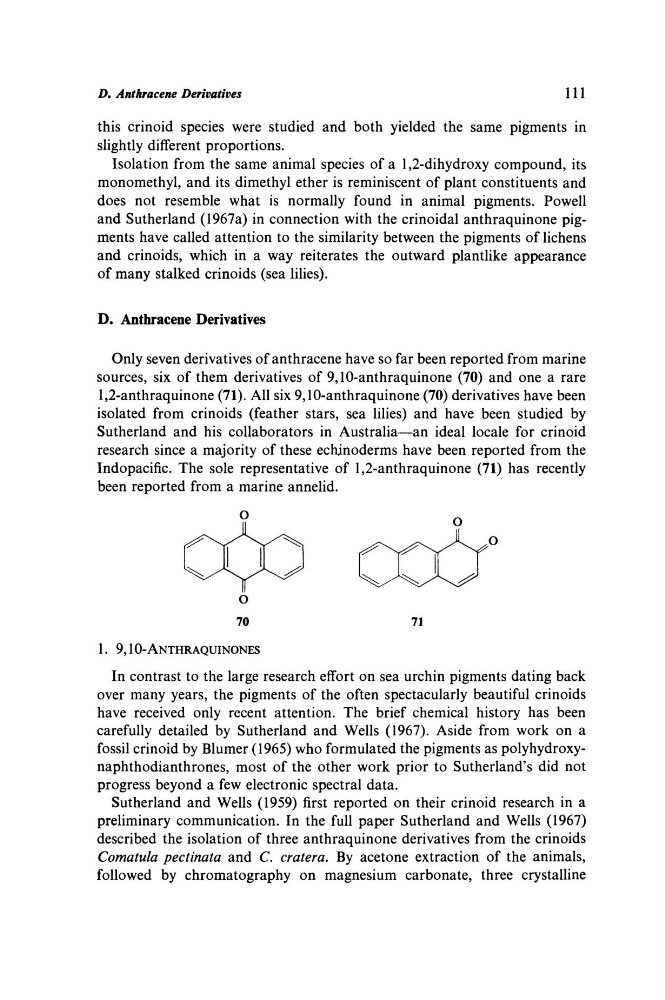
Only seven derivatives of anthracene have so far been reported from marine
sources, six of them derivatives of 9,10-anthraquinone (70) and one a rare
1,2-anthraquinone (71). All six 9,10-anthraquinone (70) derivatives have been
isolated from crinoids (feather stars, sea lilies) and have been studied by
Sutherland and his collaborators in Australia—an ideal locale for crinoid
research since a majority of these echjnoderms have been reported from the
Indopacific. The sole representative of 1,2-anthraquinone (71) has recently
been reported from a marine annelid.
Ο
70
71
1. 9,10-ANTHRAQUINONES
In contrast to the large research effort on sea urchin pigments dating back
over many years, the pigments of the often spectacularly beautiful crinoids
have received only recent attention. The brief chemical history has been
carefully detailed by Sutherland and Wells (1967). Aside from work on a
fossil crinoid by Blumer (1965) who formulated the pigments as polyhydroxynaphthodianthrones, most of the other work prior to Sutherland's did not
progress beyond a few electronic spectral data.
Sutherland and Wells (1959) first reported on their crinoid research in a
preliminary communication. In the full paper Sutherland and Wells (1967)
described the isolation of three anthraquinone derivatives from the crinoids
Comatula pectinata and C. cratera. By acetone extraction of the animals,
followed by chromatography on magnesium carbonate, three crystalline
111
this crinoid species were studied and both yielded the same pigments in
slightly different proportions.
Isolation from the same animal species of a 1,2-dihydroxy compound, its
monomethyl, and its dimethyl ether is reminiscent of plant constituents and
does not resemble what is normally found in animal pigments. Powell
and Sutherland (1967a) in connection with the crinoidal anthraquinone pigments have called attention to the similarity between the pigments of lichens
and crinoids, which in a way reiterates the outward plantlike appearance
of many stalked crinoids (sea lilies).
D. Anthracene Derivatives
Only seven derivatives of anthracene have so far been reported from marine
sources, six of them derivatives of 9,10-anthraquinone (70) and one a rare
1,2-anthraquinone (71). All six 9,10-anthraquinone (70) derivatives have been
isolated from crinoids (feather stars, sea lilies) and have been studied by
Sutherland and his collaborators in Australia—an ideal locale for crinoid
research since a majority of these echjnoderms have been reported from the
Indopacific. The sole representative of 1,2-anthraquinone (71) has recently
been reported from a marine annelid.
Ο
70
71
1. 9,10-ANTHRAQUINONES
In contrast to the large research effort on sea urchin pigments dating back
over many years, the pigments of the often spectacularly beautiful crinoids
have received only recent attention. The brief chemical history has been
carefully detailed by Sutherland and Wells (1967). Aside from work on a
fossil crinoid by Blumer (1965) who formulated the pigments as polyhydroxynaphthodianthrones, most of the other work prior to Sutherland's did not
progress beyond a few electronic spectral data.
Sutherland and Wells (1959) first reported on their crinoid research in a
preliminary communication. In the full paper Sutherland and Wells (1967)
described the isolation of three anthraquinone derivatives from the crinoids
Comatula pectinata and C. cratera. By acetone extraction of the animals,
followed by chromatography on magnesium carbonate, three crystalline