

110
3. Benzenoids
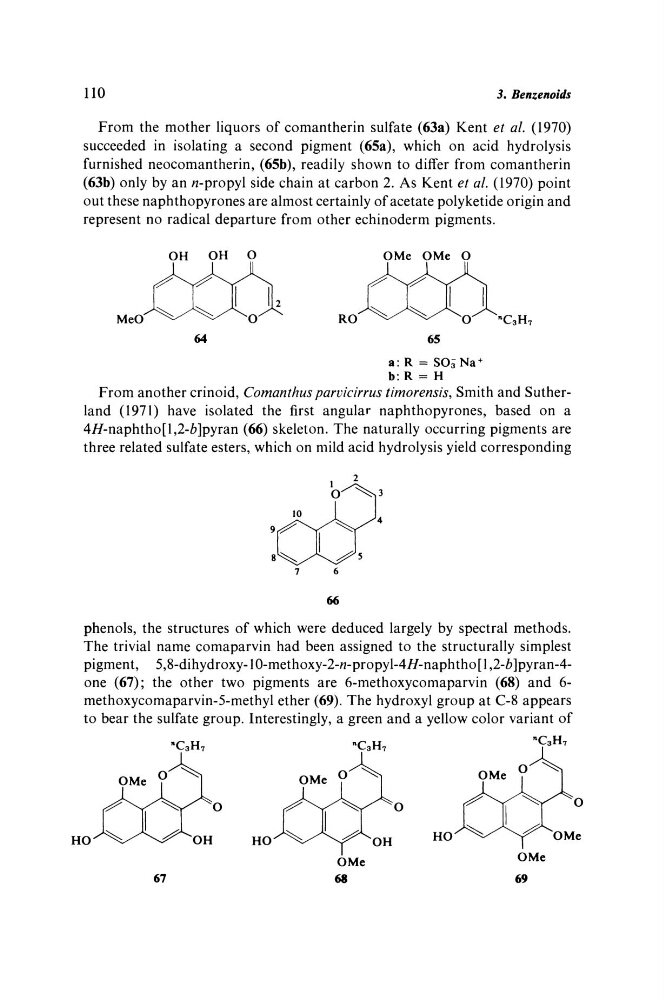
From the mother liquors of comantherin sulfate (63a) Kent et al. (1970)
succeeded in isolating a second pigment (65a), which on acid hydrolysis
furnished neocomantherin, (65b), readily shown to differ from comantherin
(63b) only by an ^-propyl side chain at carbon 2. As Kent et al. (1970) point
out these naphthopyrones are almost certainly of acetate polyketide origin and
represent no radical departure from other echinoderm pigments.
O H
O H Ο
O M e O M e Ο
64
65
a: R = SOä Na
+
b: R = Η
From another crinoid, Comanthus parvicirrus timorensis, Smith and Sutherland (1971) have isolated the first angular naphthopyrones, based on a
4//-naphtho[l,2-6]pyran (66) skeleton. The naturally occurring pigments are
three related sulfate esters, which on mild acid hydrolysis yield corresponding
2
7
6
66
phenols, the structures of which were deduced largely by spectral methods.
The trivial name comaparvin had been assigned to the structurally simplest
pigment,
5,8-dihydroxy-10-methoxy-2-«-propyl-4i/-naphtho[l,2-Z?]pyran-4one (67); the other two pigments are 6-methoxycomaparvin (68) and 6methoxycomaparvin-5-methyl ether (69). The hydroxyl group at C-8 appears
to bear the sulfate group. Interestingly, a green and a yellow color variant of
n C 3 H 7
n
C 3 H 7
"Ç
3
**
7
O M e ° ^
O M e Λ
J M e ?
|
H O - ^ - ^ ^ O H
H O ^ ^ ^ ^ O H
H O '
A
^ Y ^ O M e
O M e
OMe
67
68
69
3. Benzenoids
From the mother liquors of comantherin sulfate (63a) Kent et al. (1970)
succeeded in isolating a second pigment (65a), which on acid hydrolysis
furnished neocomantherin, (65b), readily shown to differ from comantherin
(63b) only by an ^-propyl side chain at carbon 2. As Kent et al. (1970) point
out these naphthopyrones are almost certainly of acetate polyketide origin and
represent no radical departure from other echinoderm pigments.
O H
O H Ο
O M e O M e Ο
64
65
a: R = SOä Na
+
b: R = Η
From another crinoid, Comanthus parvicirrus timorensis, Smith and Sutherland (1971) have isolated the first angular naphthopyrones, based on a
4//-naphtho[l,2-6]pyran (66) skeleton. The naturally occurring pigments are
three related sulfate esters, which on mild acid hydrolysis yield corresponding
2
7
6
66
phenols, the structures of which were deduced largely by spectral methods.
The trivial name comaparvin had been assigned to the structurally simplest
pigment,
5,8-dihydroxy-10-methoxy-2-«-propyl-4i/-naphtho[l,2-Z?]pyran-4one (67); the other two pigments are 6-methoxycomaparvin (68) and 6methoxycomaparvin-5-methyl ether (69). The hydroxyl group at C-8 appears
to bear the sulfate group. Interestingly, a green and a yellow color variant of
n C 3 H 7
n
C 3 H 7
"Ç
3
**
7
O M e ° ^
O M e Λ
J M e ?
|
H O - ^ - ^ ^ O H
H O ^ ^ ^ ^ O H
H O '
A
^ Y ^ O M e
O M e
OMe
67
68
69