

C. Naphthalene Derivatives
109
h. Biosynthesis
In contrast to the many experiments that have been carried out over the
years toward the elucidation of the biosynthetic pathways occurring in plants
and microorganisms, very little work has been reported on the biosynthetic
pathways that take place in marine invertebrates. Only a single paper (Salaque et al., 1967) has so far dealt with the biosynthesis of naphthoquinone
pigments in echinoderms. In parallel experiments sea urchins (Arbacia
pustulosa) were fed labeled methionine, acetic, and propionic acids. Whereas
incorporation of the label was poor in all cases, it was clearly best with
acetic acid. Labeled echinochrome A (6-ethyl-2,3,7-trihydroxynaphthazarin,
11) was isolated and the side chain was degraded. The principal results
showed that echinoids can biosynthesize naphthoquinone pigments de novo
and that the extremely poor incorporation of the label in the side chain may
indicate that biosynthesis takes place stepwise, addition of a side chain
following synthesis of the nucleus.
Oxygenation patterns and the prevalance of no or a two-carbon side chain
in these pigments (Singh et al., 1967) have pointed to an acetate-polyketide
pathway. Further experiments will be necessary to confirm the findings of
Salaque et al (1967) and to fill in the details of the biosynthetic pathways.
2. NAPHTHOPYRONES
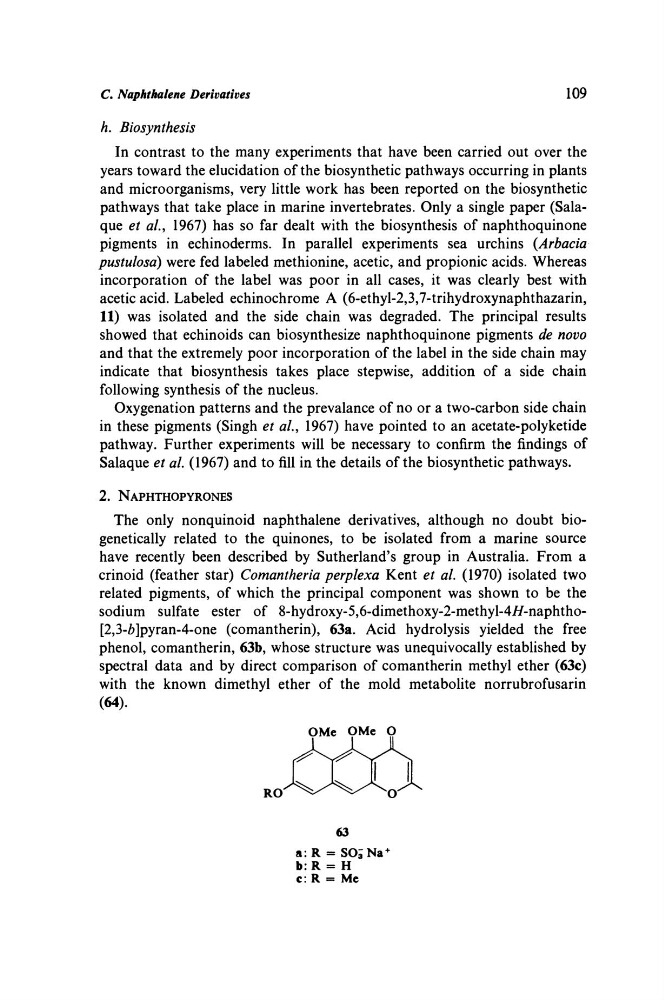
The only nonquinoid naphthalene derivatives, although no doubt biogenetically related to the quinones, to be isolated from a marine source
have recently been described by Sutherland's group in Australia. From a
crinoid (feather star) Comantheria perplexa Kent et al. (1970) isolated two
related pigments, of which the principal component was shown to be the
sodium sulfate ester of 8-hydroxy-5,6-dimethoxy-2-methyl-4i/-naphtho[2,3-Z?]pyran-4-one (comantherin), 63a. Acid hydrolysis yielded the free
phenol, comantherin, 63b, whose structure was unequivocally established by
spectral data and by direct comparison of comantherin methyl ether (63c)
with the known dimethyl ether of the mold metabolite norrubrofusarin
(64).
OMe OMe Ο
RO'^^
63
a: R = SO;Na
+
b: R = Η
c: R = Me
109
h. Biosynthesis
In contrast to the many experiments that have been carried out over the
years toward the elucidation of the biosynthetic pathways occurring in plants
and microorganisms, very little work has been reported on the biosynthetic
pathways that take place in marine invertebrates. Only a single paper (Salaque et al., 1967) has so far dealt with the biosynthesis of naphthoquinone
pigments in echinoderms. In parallel experiments sea urchins (Arbacia
pustulosa) were fed labeled methionine, acetic, and propionic acids. Whereas
incorporation of the label was poor in all cases, it was clearly best with
acetic acid. Labeled echinochrome A (6-ethyl-2,3,7-trihydroxynaphthazarin,
11) was isolated and the side chain was degraded. The principal results
showed that echinoids can biosynthesize naphthoquinone pigments de novo
and that the extremely poor incorporation of the label in the side chain may
indicate that biosynthesis takes place stepwise, addition of a side chain
following synthesis of the nucleus.
Oxygenation patterns and the prevalance of no or a two-carbon side chain
in these pigments (Singh et al., 1967) have pointed to an acetate-polyketide
pathway. Further experiments will be necessary to confirm the findings of
Salaque et al (1967) and to fill in the details of the biosynthetic pathways.
2. NAPHTHOPYRONES
The only nonquinoid naphthalene derivatives, although no doubt biogenetically related to the quinones, to be isolated from a marine source
have recently been described by Sutherland's group in Australia. From a
crinoid (feather star) Comantheria perplexa Kent et al. (1970) isolated two
related pigments, of which the principal component was shown to be the
sodium sulfate ester of 8-hydroxy-5,6-dimethoxy-2-methyl-4i/-naphtho[2,3-Z?]pyran-4-one (comantherin), 63a. Acid hydrolysis yielded the free
phenol, comantherin, 63b, whose structure was unequivocally established by
spectral data and by direct comparison of comantherin methyl ether (63c)
with the known dimethyl ether of the mold metabolite norrubrofusarin
(64).
OMe OMe Ο
RO'^^
63
a: R = SO;Na
+
b: R = Η
c: R = Me