

106
5. Benzenoids
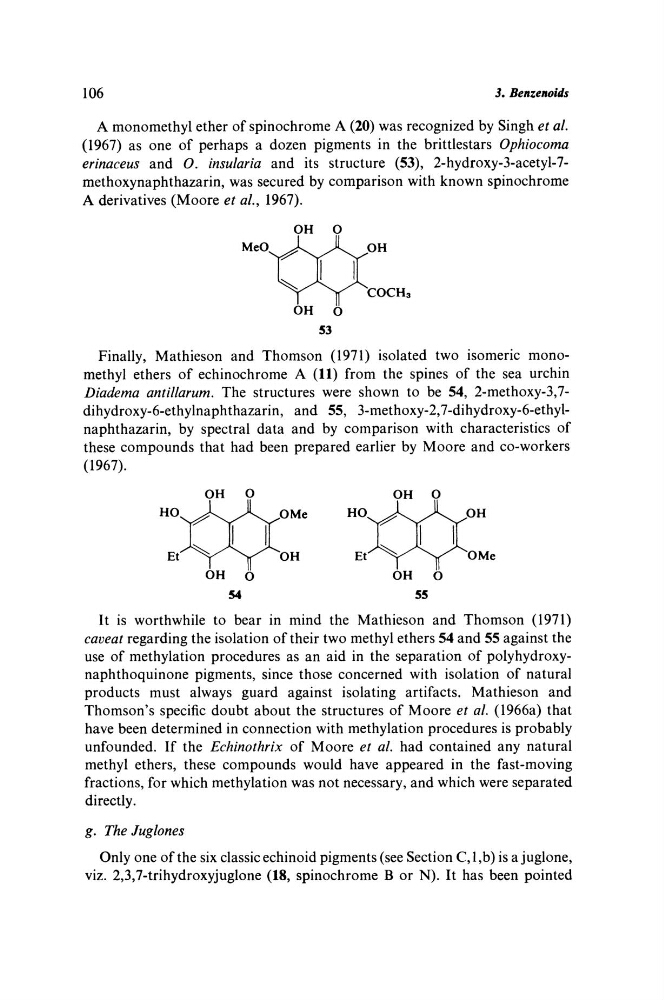
A monomethyl ether of spinochrome A (20) was recognized by Singh et al.
(1967) as one of perhaps a dozen pigments in the brittlestars Ophiocoma
erinaceus and O. insularia and its structure (53), 2-hydroxy-3-acetyl-7methoxynaphthazarin, was secured by comparison with known spinochrome
A derivatives (Moore et al, 1967).
OH
Ο
"XOC
OH
Ο
53
Finally, Mathieson and Thomson (1971) isolated two isomeric monomethyl ethers of echinochrome A (11) from the spines of the sea urchin
Diadema antillarum. The structures were shown to be 54, 2-methoxy-3,7dihydroxy-6-ethylnaphthazarin, and 55, 3-methoxy-2,7-dihydroxy-6-ethylnaphthazarin, by spectral data and by comparison with characteristics of
these compounds that had been prepared earlier by Moore and co-workers
(1967).
OH
Ο
OH
Ο
Η
°τΥγ
ΟΜβ H
V^VY
OH
E t ^ Y ^ Y ^ O H
Et^Y^Y^OMe
OH
Ο
OH
Ο
54
55
It is worthwhile to bear in mind the Mathieson and Thomson (1971)
caveat regarding the isolation of their two methyl ethers 54 and 55 against the
use of methylation procedures as an aid in the separation of polyhydroxynaphthoquinone pigments, since those concerned with isolation of natural
products must always guard against isolating artifacts. Mathieson and
Thomson's specific doubt about the structures of Moore et al. (1966a) that
have been determined in connection with methylation procedures is probably
unfounded. If the Echinothrix of Moore et al. had contained any natural
methyl ethers, these compounds would have appeared in the fast-moving
fractions, for which methylation was not necessary, and which were separated
directly.
g. The Juglones
Only one of the six classic echinoid pigments (see Section C,l,b) is a juglone,
viz. 2,3,7-trihydroxyjuglone (18, spinochrome Β or N). It has been pointed
5. Benzenoids
A monomethyl ether of spinochrome A (20) was recognized by Singh et al.
(1967) as one of perhaps a dozen pigments in the brittlestars Ophiocoma
erinaceus and O. insularia and its structure (53), 2-hydroxy-3-acetyl-7methoxynaphthazarin, was secured by comparison with known spinochrome
A derivatives (Moore et al, 1967).
OH
Ο
"XOC
OH
Ο
53
Finally, Mathieson and Thomson (1971) isolated two isomeric monomethyl ethers of echinochrome A (11) from the spines of the sea urchin
Diadema antillarum. The structures were shown to be 54, 2-methoxy-3,7dihydroxy-6-ethylnaphthazarin, and 55, 3-methoxy-2,7-dihydroxy-6-ethylnaphthazarin, by spectral data and by comparison with characteristics of
these compounds that had been prepared earlier by Moore and co-workers
(1967).
OH
Ο
OH
Ο
Η
°τΥγ
ΟΜβ H
V^VY
OH
E t ^ Y ^ Y ^ O H
Et^Y^Y^OMe
OH
Ο
OH
Ο
54
55
It is worthwhile to bear in mind the Mathieson and Thomson (1971)
caveat regarding the isolation of their two methyl ethers 54 and 55 against the
use of methylation procedures as an aid in the separation of polyhydroxynaphthoquinone pigments, since those concerned with isolation of natural
products must always guard against isolating artifacts. Mathieson and
Thomson's specific doubt about the structures of Moore et al. (1966a) that
have been determined in connection with methylation procedures is probably
unfounded. If the Echinothrix of Moore et al. had contained any natural
methyl ethers, these compounds would have appeared in the fast-moving
fractions, for which methylation was not necessary, and which were separated
directly.
g. The Juglones
Only one of the six classic echinoid pigments (see Section C,l,b) is a juglone,
viz. 2,3,7-trihydroxyjuglone (18, spinochrome Β or N). It has been pointed