

C. Naphthalene Derivatives
105
OH
Ο
Ο
OH
ΗΟ'^Κ^ΓΓ^Γ^^^
OH
Ο
Ο
OH
49
furnish a parent peak {jn\e 484), which gave rise to the base peak by loss of a
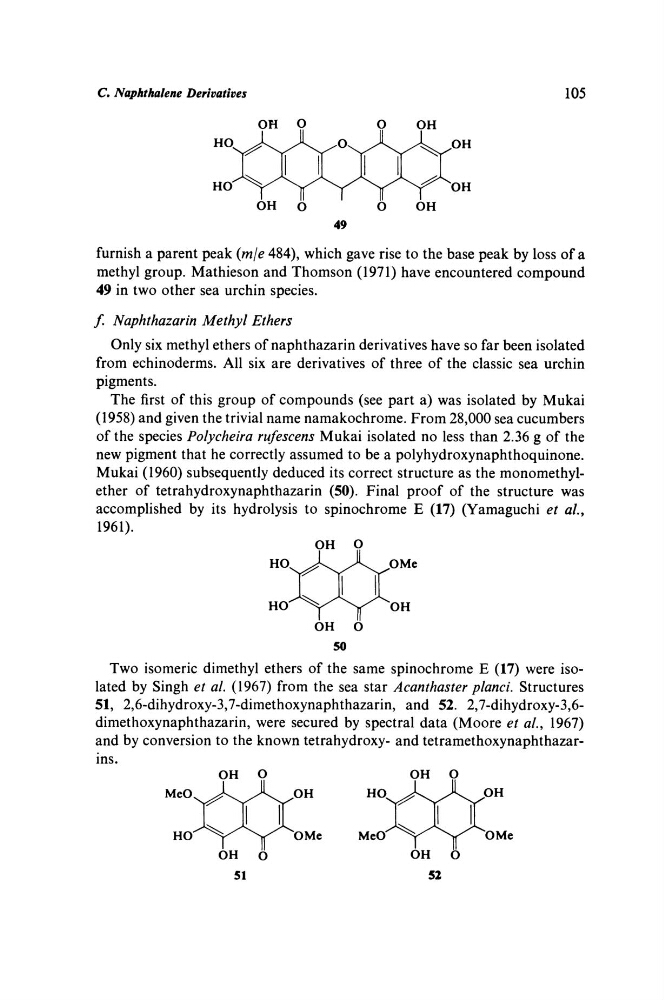
methyl group. Mathieson and Thomson (1971) have encountered compound
49 in two other sea urchin species.
/. Naphthazarin Methyl Ethers
Only six methyl ethers of naphthazarin derivatives have so far been isolated
from echinoderms. All six are derivatives of three of the classic sea urchin
pigments.
The first of this group of compounds (see part a) was isolated by Mukai
(1958) and given the trivial name namakochrome. From 28,000 sea cucumbers
of the species Polycheira rufescens Mukai isolated no less than 2.36 g of the
new pigment that he correctly assumed to be a polyhydroxynaphthoquinone.
Mukai (1960) subsequently deduced its correct structure as the monomethylether of tetrahydroxynaphthazarin (50). Final proof of the structure was
accomplished by its hydrolysis to spinochrome Ε (17) (Yamaguchi et al,
1961).
OH
Ο
H ° Y ^ Y ^ Y -
O
M E
ΗΟ^Γ^Γ^ΟΗ
OH
Ο
50
Two isomeric dimethyl ethers of the same spinochrome Ε (17) were isolated by Singh et al. (1967) from the sea star Acanthaster planci. Structures
51, 2,6-dihydroxy-3,7-dimethoxynaphthazarin, and 52. 2,7-dihydroxy-3,6dimethoxynaphthazarin, were secured by spectral data (Moore et al, 1967)
and by conversion to the known tetrahydroxy- and tetramethoxynaphthazarins.
OH
Ο
OH Ο
Μ6
°Ί^ΊΜΓ°
Η
HO
Y\\
OH
HO-^Y^Y^OMe
MeO^Y^YOME
OH
Ο
OH
Ο
51
52
105
OH
Ο
Ο
OH
ΗΟ'^Κ^ΓΓ^Γ^^^
OH
Ο
Ο
OH
49
furnish a parent peak {jn\e 484), which gave rise to the base peak by loss of a
methyl group. Mathieson and Thomson (1971) have encountered compound
49 in two other sea urchin species.
/. Naphthazarin Methyl Ethers
Only six methyl ethers of naphthazarin derivatives have so far been isolated
from echinoderms. All six are derivatives of three of the classic sea urchin
pigments.
The first of this group of compounds (see part a) was isolated by Mukai
(1958) and given the trivial name namakochrome. From 28,000 sea cucumbers
of the species Polycheira rufescens Mukai isolated no less than 2.36 g of the
new pigment that he correctly assumed to be a polyhydroxynaphthoquinone.
Mukai (1960) subsequently deduced its correct structure as the monomethylether of tetrahydroxynaphthazarin (50). Final proof of the structure was
accomplished by its hydrolysis to spinochrome Ε (17) (Yamaguchi et al,
1961).
OH
Ο
H ° Y ^ Y ^ Y -
O
M E
ΗΟ^Γ^Γ^ΟΗ
OH
Ο
50
Two isomeric dimethyl ethers of the same spinochrome Ε (17) were isolated by Singh et al. (1967) from the sea star Acanthaster planci. Structures
51, 2,6-dihydroxy-3,7-dimethoxynaphthazarin, and 52. 2,7-dihydroxy-3,6dimethoxynaphthazarin, were secured by spectral data (Moore et al, 1967)
and by conversion to the known tetrahydroxy- and tetramethoxynaphthazarins.
OH
Ο
OH Ο
Μ6
°Ί^ΊΜΓ°
Η
HO
Y\\
OH
HO-^Y^Y^OMe
MeO^Y^YOME
OH
Ο
OH
Ο
51
52