

C. Naphthalene Derivatives
107
out earlier that in contrast to naphthazarin, the unsymmetrical juglone
structure gives rise to a larger number of possible isomers. Furthermore, the
unsubstituted «-position in a naphthoquinone system makes these compounds
more susceptible to further oxidation than naphthazarins lacking this structural feature. Perhaps because of these inherent difficulties, perhaps for other
reasons not yet apparent, only six additional juglone derivatives have been
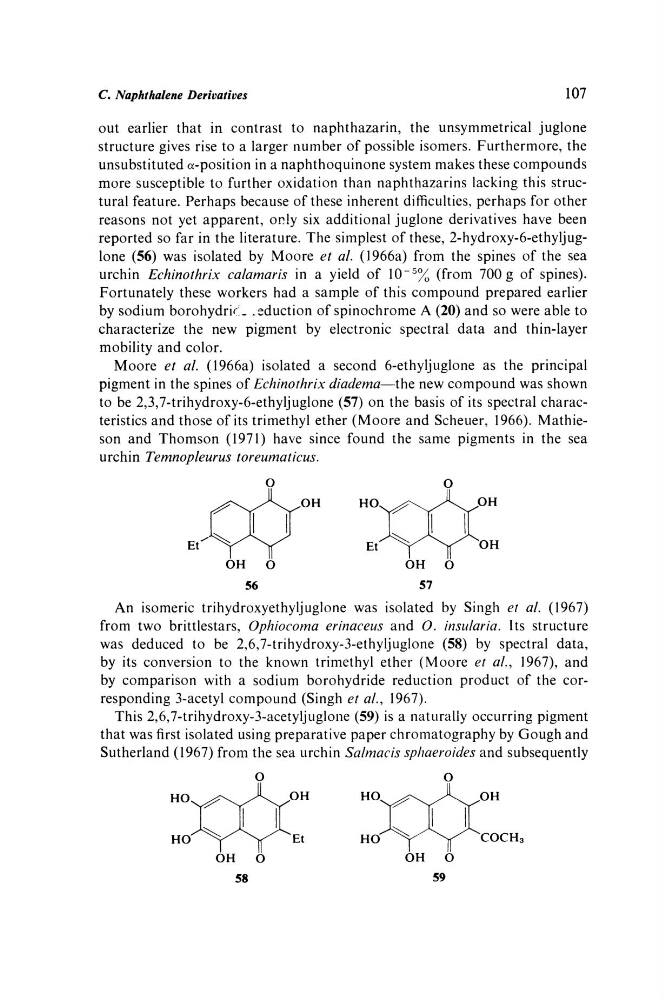
reported so far in the literature. The simplest of these, 2-hydroxy-6-ethyljuglone (56) was isolated by Moore et al. (1966a) from the spines of the sea
urchin Echinothrix calamaris in a yield of 10~
5 % (from 700 g of spines).
Fortunately these workers had a sample of this compound prepared earlier
by sodium borohydrkL .eduction of spinochrome A (20) and so were able to
characterize the new pigment by electronic spectral data and thin-layer
mobility and color.
Moore et al. (1966a) isolated a second 6-ethyljuglone as the principal
pigment in the spines of Echinothrix diadema—the new compound was shown
to be 2,3,7-trihydroxy-6-ethyljuglone (57) on the basis of its spectral characteristics and those of its trimethyl ether (Moore and Scheuer, 1966). Mathieson and Thomson (1971) have since found the same pigments in the sea
urchin Temnopleurus toreumaticus.
OH
Ο
OH
Ο
56
57
An isomeric trihydroxyethyljuglone was isolated by Singh et al. (1967)
from two brittlestars, Ophiocoma erinaceus and O. insularia. Its structure
was deduced to be 2,6,7-trihydroxy-3-ethyljuglone (58) by spectral data,
by its conversion to the known trimethyl ether (Moore et al, 1967), and
by comparison with a sodium borohydride reduction product of the corresponding 3-acetyl compound (Singh et al, 1967).
This 2,6,7-trihydroxy-3-acetyljuglone (59) is a naturally occurring pigment
that was first isolated using preparative paper chromatography by Gough and
Sutherland (1967) from the sea urchin Salmacis sphaeroides and subsequently
Ο
Ο
H O ^ ^ A ^ O H
YIO^^X.
OH
H O ^ Y ^ Y ^ E t
HO^Y^Y^COCH 3
OH
Ο
OH
Ο
58
59
107
out earlier that in contrast to naphthazarin, the unsymmetrical juglone
structure gives rise to a larger number of possible isomers. Furthermore, the
unsubstituted «-position in a naphthoquinone system makes these compounds
more susceptible to further oxidation than naphthazarins lacking this structural feature. Perhaps because of these inherent difficulties, perhaps for other
reasons not yet apparent, only six additional juglone derivatives have been
reported so far in the literature. The simplest of these, 2-hydroxy-6-ethyljuglone (56) was isolated by Moore et al. (1966a) from the spines of the sea
urchin Echinothrix calamaris in a yield of 10~
5 % (from 700 g of spines).
Fortunately these workers had a sample of this compound prepared earlier
by sodium borohydrkL .eduction of spinochrome A (20) and so were able to
characterize the new pigment by electronic spectral data and thin-layer
mobility and color.
Moore et al. (1966a) isolated a second 6-ethyljuglone as the principal
pigment in the spines of Echinothrix diadema—the new compound was shown
to be 2,3,7-trihydroxy-6-ethyljuglone (57) on the basis of its spectral characteristics and those of its trimethyl ether (Moore and Scheuer, 1966). Mathieson and Thomson (1971) have since found the same pigments in the sea
urchin Temnopleurus toreumaticus.
OH
Ο
OH
Ο
56
57
An isomeric trihydroxyethyljuglone was isolated by Singh et al. (1967)
from two brittlestars, Ophiocoma erinaceus and O. insularia. Its structure
was deduced to be 2,6,7-trihydroxy-3-ethyljuglone (58) by spectral data,
by its conversion to the known trimethyl ether (Moore et al, 1967), and
by comparison with a sodium borohydride reduction product of the corresponding 3-acetyl compound (Singh et al, 1967).
This 2,6,7-trihydroxy-3-acetyljuglone (59) is a naturally occurring pigment
that was first isolated using preparative paper chromatography by Gough and
Sutherland (1967) from the sea urchin Salmacis sphaeroides and subsequently
Ο
Ο
H O ^ ^ A ^ O H
YIO^^X.
OH
H O ^ Y ^ Y ^ E t
HO^Y^Y^COCH 3
OH
Ο
OH
Ο
58
59