

C. Naphthalene Derivatives
97
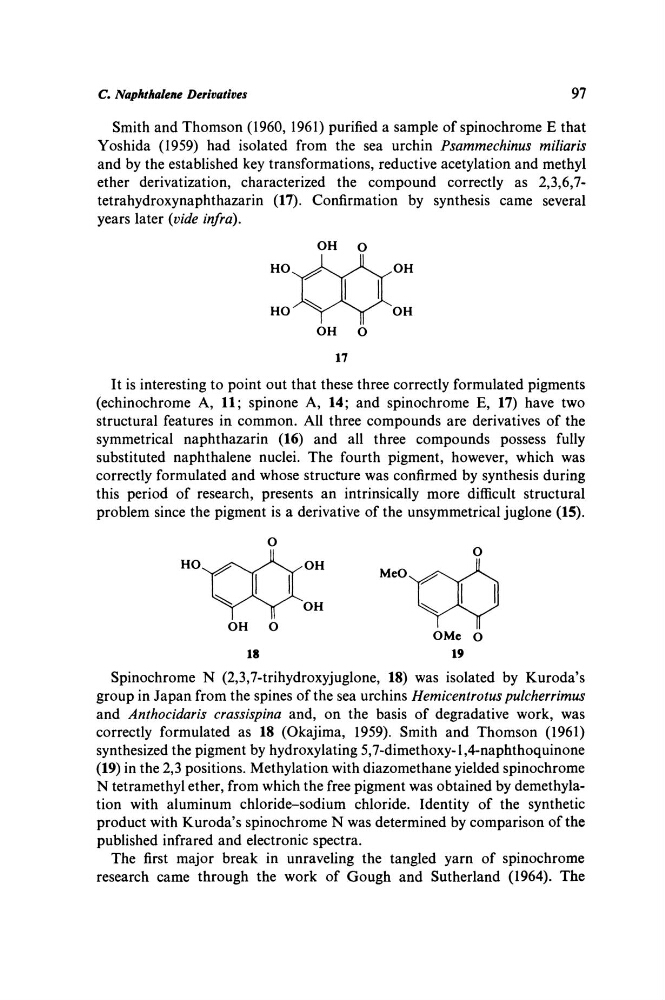
Smith and Thomson (1960, 1961) purified a sample of spinochrome Ε that
Yoshida (1959) had isolated from the sea urchin Psammechinus
miliaris
and by the established key transformations, reductive acetylation and methyl
ether derivatization, characterized the compound correctly as 2,3,6,7tetrahydroxynaphthazarin (17). Confirmation by synthesis came several
years later {vide infra).
OH
Ο
Η
Ο
ν ^ ν ^ γ
Ο
Η
ΗΟ^Γ^Γ^ΟΗ
OH
Ο
17
It is interesting to point out that these three correctly formulated pigments
(echinochrome A, 11; spinone A, 14; and spinochrome E, 17) have two
structural features in common. All three compounds are derivatives of the
symmetrical naphthazarin (16) and all three compounds possess fully
substituted naphthalene nuclei. The fourth pigment, however, which was
correctly formulated and whose structure was confirmed by synthesis during
this period of research, presents an intrinsically more difficult structural
problem since the pigment is a derivative of the unsymmetrical juglone (15).
OH
o
X w II
OMe Ο
18
19
Spinochrome Ν (2,3,7-trihydroxyjuglone, 18) was isolated by Kuroda's
group in Japan from the spines of the sea urchins Hemicentrotus
pulcherrimus
and Anthocidaris crassispina and, on the basis of degradative work, was
correctly formulated as 18 (Okajima, 1959). Smith and Thomson (1961)
synthesized the pigment by hydroxylating 5,7-dimethoxy-l,4-naphthoquinone
(19) in the 2,3 positions. Methylation with diazomethane yielded spinochrome
Ν tetramethyl ether, from which the free pigment was obtained by demethylation with aluminum chloride-sodium chloride. Identity of the synthetic
product with Kuroda's spinochrome Ν was determined by comparison of the
published infrared and electronic spectra.
The first major break in unraveling the tangled yarn of spinochrome
research came through the work of Gough and Sutherland (1964). The
97
Smith and Thomson (1960, 1961) purified a sample of spinochrome Ε that
Yoshida (1959) had isolated from the sea urchin Psammechinus
miliaris
and by the established key transformations, reductive acetylation and methyl
ether derivatization, characterized the compound correctly as 2,3,6,7tetrahydroxynaphthazarin (17). Confirmation by synthesis came several
years later {vide infra).
OH
Ο
Η
Ο
ν ^ ν ^ γ
Ο
Η
ΗΟ^Γ^Γ^ΟΗ
OH
Ο
17
It is interesting to point out that these three correctly formulated pigments
(echinochrome A, 11; spinone A, 14; and spinochrome E, 17) have two
structural features in common. All three compounds are derivatives of the
symmetrical naphthazarin (16) and all three compounds possess fully
substituted naphthalene nuclei. The fourth pigment, however, which was
correctly formulated and whose structure was confirmed by synthesis during
this period of research, presents an intrinsically more difficult structural
problem since the pigment is a derivative of the unsymmetrical juglone (15).
OH
o
X w II
OMe Ο
18
19
Spinochrome Ν (2,3,7-trihydroxyjuglone, 18) was isolated by Kuroda's
group in Japan from the spines of the sea urchins Hemicentrotus
pulcherrimus
and Anthocidaris crassispina and, on the basis of degradative work, was
correctly formulated as 18 (Okajima, 1959). Smith and Thomson (1961)
synthesized the pigment by hydroxylating 5,7-dimethoxy-l,4-naphthoquinone
(19) in the 2,3 positions. Methylation with diazomethane yielded spinochrome
Ν tetramethyl ether, from which the free pigment was obtained by demethylation with aluminum chloride-sodium chloride. Identity of the synthetic
product with Kuroda's spinochrome Ν was determined by comparison of the
published infrared and electronic spectra.
The first major break in unraveling the tangled yarn of spinochrome
research came through the work of Gough and Sutherland (1964). The