

96
3. Benzenoids
was referred to as echinochrome A in order to distinguish it from partially
characterized companion pigments, has frequently been encountered as one
of the pigments occurring in the spines of the animals and, chemically, the
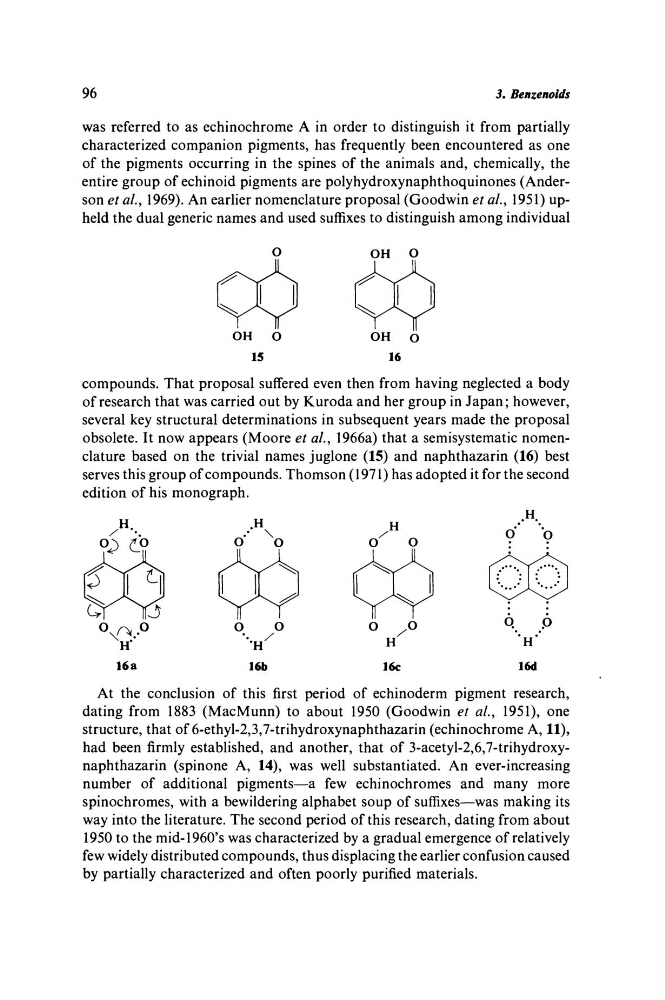
entire group of echinoid pigments are polyhydroxynaphthoquinones (Anderson et al, 1969). An earlier nomenclature proposal (Goodwin et ah, 1951) upheld the dual generic names and used suffixes to distinguish among individual
Ο
OH
Ο
Φ CO
OH
Ο
OH
Ο
15
16
compounds. That proposal suffered even then from having neglected a body
of research that was carried out by Kuroda and her group in Japan; however,
several key structural determinations in subsequent years made the proposal
obsolete. It now appears (Moore et al., 1966a) that a semisystematic nomenclature based on the trivial names juglone (15) and naphthazarin (16) best
serves this group of compounds. Thomson (1971) has adopted it for the second
edition of his monograph.
H
H.
.H
H
\
£o
o""
x o
o
y
Ο
?
?
CO CO CO ff
V
•·Η
/
H
'
Η '
16 a
16b
16c
16d
At the conclusion of this first period of echinoderm pigment research,
dating from 1883 (MacMunn) to about 1950 (Goodwin et ah, 1951), one
structure, that of 6-ethyl-2,3,7-trihydroxynaphthazarin (echinochrome A, 11),
had been firmly established, and another, that of 3-acetyl-2,6,7-trihydroxynaphthazarin (spinone A, 14), was well substantiated. An ever-increasing
number of additional pigments—a few echinochromes and many more
spinochromes, with a bewildering alphabet soup of suffixes—was making its
way into the literature. The second period of this research, dating from about
1950 to the mid-1960's was characterized by a gradual emergence of relatively
few widely distributed compounds, thus displacing the earlier confusion caused
by partially characterized and often poorly purified materials.
96
3. Benzenoids
was referred to as echinochrome A in order to distinguish it from partially
characterized companion pigments, has frequently been encountered as one
of the pigments occurring in the spines of the animals and, chemically, the
entire group of echinoid pigments are polyhydroxynaphthoquinones (Anderson et af., 1969). An earlier nomenclature proposal (Goodwin et af., 1951) upheld the dual generic names and used suffixes to distinguish among individual
o
OH 0
15
OH 0
OH 0
16
compounds. That proposal suffered even then from having neglected a body
of research that was carried out by Kuroda and her group in Japan; however,
several key structural determinations in subsequent years made the proposal
obsolete. It now appears (Moore et af., 1966a) that a semisystematic nomenclature based on the trivial names juglone (15) and naphthazarin (16) best
serves this group of compounds. Thomson (1971) has adopted it for the second
edition of his monograph.
16a
.H
.. ' "
o
0
o
0
.. /
·H
16b
00 · · : · · · · · · · ·
:
: : :
...... ......
Q /.>
H
16d
At the conclusion of this first period of echinoderm pigment research,
dating from 1883 (MacMunn) to about 1950 (Goodwin et af., 1951), one
structure, that of 6-ethyl-2,3,7-trihydroxynaphthazarin (echinochrome A, 11),
had been firmly established, and another, that of 3-acetyl-2,6,7-trihydroxynaphthazarin (spinone A, 14), was well substantiated. An ever-increasing
number of additional pigments-a few echinochromes and many more
spinochromes, with a bewildering alphabet soup of suffixes-was making its
way into the literature. The second period of this research, dating from about
1950 to the mid-1960's was characterized by a gradual emergence of relatively
few widely distributed compounds, thus displacing the earlier confusion caused
by partially characterized and often poorly purified materials.
3. Benzenoids
was referred to as echinochrome A in order to distinguish it from partially
characterized companion pigments, has frequently been encountered as one
of the pigments occurring in the spines of the animals and, chemically, the
entire group of echinoid pigments are polyhydroxynaphthoquinones (Anderson et al, 1969). An earlier nomenclature proposal (Goodwin et ah, 1951) upheld the dual generic names and used suffixes to distinguish among individual
Ο
OH
Ο
Φ CO
OH
Ο
OH
Ο
15
16
compounds. That proposal suffered even then from having neglected a body
of research that was carried out by Kuroda and her group in Japan; however,
several key structural determinations in subsequent years made the proposal
obsolete. It now appears (Moore et al., 1966a) that a semisystematic nomenclature based on the trivial names juglone (15) and naphthazarin (16) best
serves this group of compounds. Thomson (1971) has adopted it for the second
edition of his monograph.
H
H.
.H
H
\
£o
o""
x o
o
y
Ο
?
?
CO CO CO ff
V
•·Η
/
H
'
Η '
16 a
16b
16c
16d
At the conclusion of this first period of echinoderm pigment research,
dating from 1883 (MacMunn) to about 1950 (Goodwin et ah, 1951), one
structure, that of 6-ethyl-2,3,7-trihydroxynaphthazarin (echinochrome A, 11),
had been firmly established, and another, that of 3-acetyl-2,6,7-trihydroxynaphthazarin (spinone A, 14), was well substantiated. An ever-increasing
number of additional pigments—a few echinochromes and many more
spinochromes, with a bewildering alphabet soup of suffixes—was making its
way into the literature. The second period of this research, dating from about
1950 to the mid-1960's was characterized by a gradual emergence of relatively
few widely distributed compounds, thus displacing the earlier confusion caused
by partially characterized and often poorly purified materials.
96
3. Benzenoids
was referred to as echinochrome A in order to distinguish it from partially
characterized companion pigments, has frequently been encountered as one
of the pigments occurring in the spines of the animals and, chemically, the
entire group of echinoid pigments are polyhydroxynaphthoquinones (Anderson et af., 1969). An earlier nomenclature proposal (Goodwin et af., 1951) upheld the dual generic names and used suffixes to distinguish among individual
o
OH 0
15
OH 0
OH 0
16
compounds. That proposal suffered even then from having neglected a body
of research that was carried out by Kuroda and her group in Japan; however,
several key structural determinations in subsequent years made the proposal
obsolete. It now appears (Moore et af., 1966a) that a semisystematic nomenclature based on the trivial names juglone (15) and naphthazarin (16) best
serves this group of compounds. Thomson (1971) has adopted it for the second
edition of his monograph.
16a
.H
.. ' "
o
0
o
0
.. /
·H
16b
00 · · : · · · · · · · ·
:
: : :
...... ......
Q /.>
H
16d
At the conclusion of this first period of echinoderm pigment research,
dating from 1883 (MacMunn) to about 1950 (Goodwin et af., 1951), one
structure, that of 6-ethyl-2,3,7-trihydroxynaphthazarin (echinochrome A, 11),
had been firmly established, and another, that of 3-acetyl-2,6,7-trihydroxynaphthazarin (spinone A, 14), was well substantiated. An ever-increasing
number of additional pigments-a few echinochromes and many more
spinochromes, with a bewildering alphabet soup of suffixes-was making its
way into the literature. The second period of this research, dating from about
1950 to the mid-1960's was characterized by a gradual emergence of relatively
few widely distributed compounds, thus displacing the earlier confusion caused
by partially characterized and often poorly purified materials.