

Β. Flavonoids
91
second phenolic substance in both algae was assigned the novel structure 7,
3,5-dibromo-4-hydroxybenzyl alcohol, by nmr analysis of the diacetate of 7
and by direct comparison with a synthetic sample.
2. A BENZOQUINONE DERIVATIVE
A single benzoquinone has so far been reported from a marine organism.
Moore and co-workers (1966a) isolated from the spines of the sea urchin
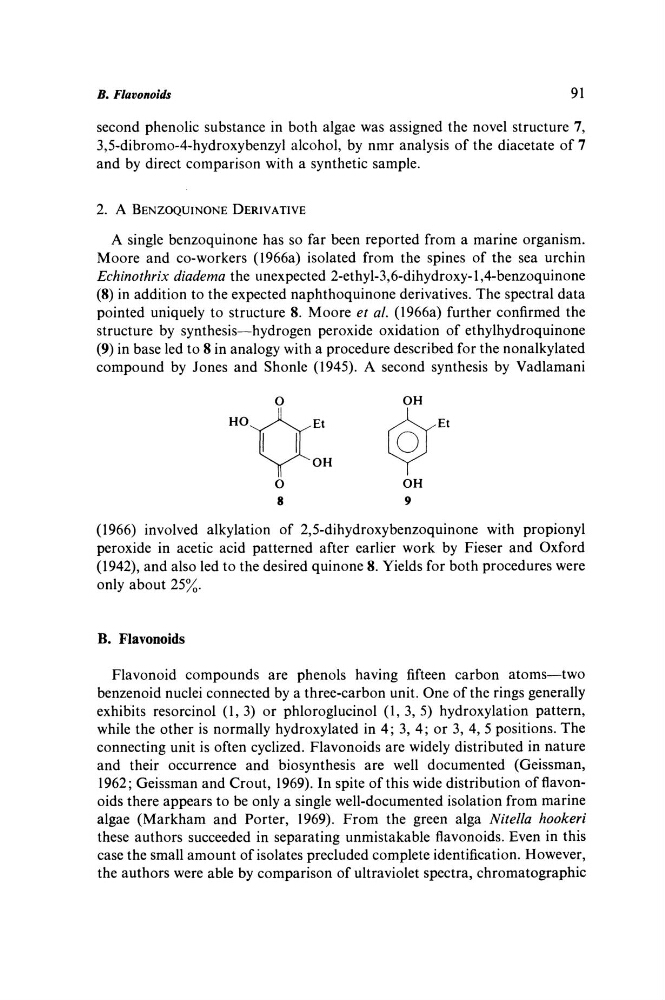
Echinothrix diadema the unexpected 2-ethyl-3,6-dihydroxy-l,4-benzoquinone
(8) in addition to the expected naphthoquinone derivatives. The spectral data
pointed uniquely to structure 8. Moore et al (1966a) further confirmed the
structure by synthesis—hydrogen peroxide oxidation of ethylhydroquinone
(9) in base led to 8 in analogy with a procedure described for the nonalkylated
compound by Jones and Shonle (1945). A second synthesis by Vadlamani
Ο
OH
Ο
OH
8
9
(1966) involved alkylation of 2,5-dihydroxybenzoquinone with propionyl
peroxide in acetic acid patterned after earlier work by Fieser and Oxford
(1942), and also led to the desired quinone 8. Yields for both procedures were
only about 25%.
B. Flavonoids
Flavonoid compounds are phenols having fifteen carbon atoms—two
benzenoid nuclei connected by a three-carbon unit. One of the rings generally
exhibits resorcinol (1, 3) or phloroglucinol (1, 3, 5) hydroxylation pattern,
while the other is normally hydroxylated in 4; 3, 4; or 3, 4, 5 positions. The
connecting unit is often cyclized. Flavonoids are widely distributed in nature
and their occurrence and biosynthesis are well documented (Geissman,
1962; Geissman and Crout, 1969). In spite of this wide distribution of flavonoids there appears to be only a single well-documented isolation from marine
algae (Markham and Porter, 1969). From the green alga Nitella hookeri
these authors succeeded in separating unmistakable flavonoids. Even in this
case the small amount of isolates precluded complete identification. However,
the authors were able by comparison of ultraviolet spectra, chromatographic
91
second phenolic substance in both algae was assigned the novel structure 7,
3,5-dibromo-4-hydroxybenzyl alcohol, by nmr analysis of the diacetate of 7
and by direct comparison with a synthetic sample.
2. A BENZOQUINONE DERIVATIVE
A single benzoquinone has so far been reported from a marine organism.
Moore and co-workers (1966a) isolated from the spines of the sea urchin
Echinothrix diadema the unexpected 2-ethyl-3,6-dihydroxy-l,4-benzoquinone
(8) in addition to the expected naphthoquinone derivatives. The spectral data
pointed uniquely to structure 8. Moore et al (1966a) further confirmed the
structure by synthesis—hydrogen peroxide oxidation of ethylhydroquinone
(9) in base led to 8 in analogy with a procedure described for the nonalkylated
compound by Jones and Shonle (1945). A second synthesis by Vadlamani
Ο
OH
Ο
OH
8
9
(1966) involved alkylation of 2,5-dihydroxybenzoquinone with propionyl
peroxide in acetic acid patterned after earlier work by Fieser and Oxford
(1942), and also led to the desired quinone 8. Yields for both procedures were
only about 25%.
B. Flavonoids
Flavonoid compounds are phenols having fifteen carbon atoms—two
benzenoid nuclei connected by a three-carbon unit. One of the rings generally
exhibits resorcinol (1, 3) or phloroglucinol (1, 3, 5) hydroxylation pattern,
while the other is normally hydroxylated in 4; 3, 4; or 3, 4, 5 positions. The
connecting unit is often cyclized. Flavonoids are widely distributed in nature
and their occurrence and biosynthesis are well documented (Geissman,
1962; Geissman and Crout, 1969). In spite of this wide distribution of flavonoids there appears to be only a single well-documented isolation from marine
algae (Markham and Porter, 1969). From the green alga Nitella hookeri
these authors succeeded in separating unmistakable flavonoids. Even in this
case the small amount of isolates precluded complete identification. However,
the authors were able by comparison of ultraviolet spectra, chromatographic