

90
3. Benzenoids
and sulfur trioxide-pyridine complex. Spectral analysis of compounds 2 and
3 and transformation of 3 to 2,3-dideuterio-4,5-dimethoxybenzoic acid (4)
and comparison with a synthetic sample secured the structure of 2.
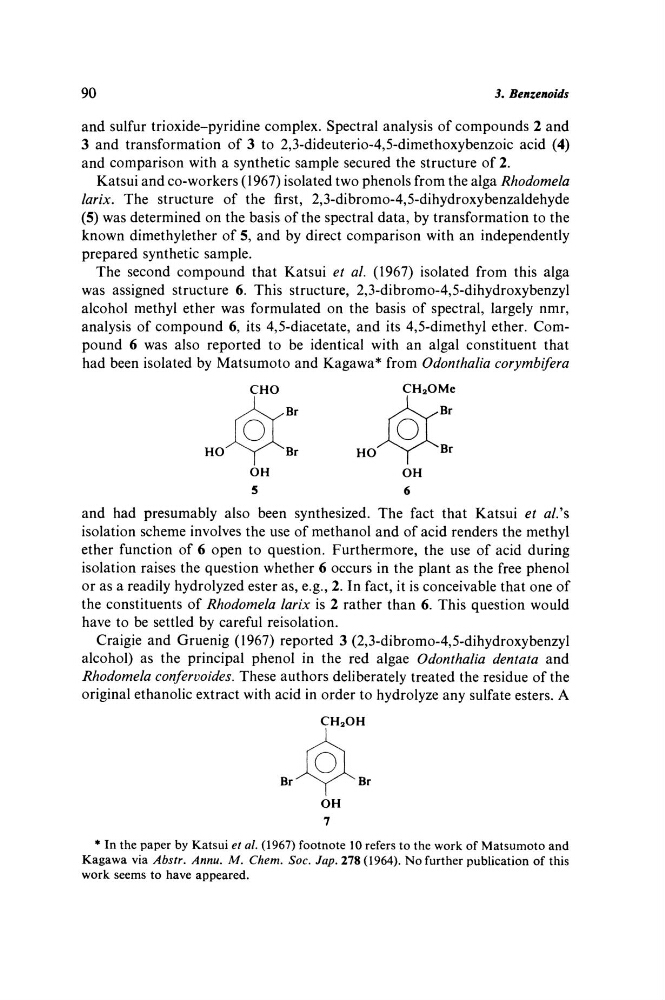
Katsui and co-workers (1967) isolated two phenols from the alga Rhodomela
larix. The structure of the first, 2,3-dibromo-4,5-dihydroxybenzaldehyde
(5) was determined on the basis of the spectral data, by transformation to the
known dimethylether of 5, and by direct comparison with an independently
prepared synthetic sample.
The second compound that Katsui et al. (1967) isolated from this alga
was assigned structure 6. This structure, 2,3-dibromo-4,5-dihydroxybenzyl
alcohol methyl ether was formulated on the basis of spectral, largely nmr,
analysis of compound 6, its 4,5-diacetate, and its 4,5-dimethyl ether. Compound 6 was also reported to be identical with an algal constituent that
had been isolated by Matsumoto and Kagawa* from Odonthalia
corymbifera
CHO
CH 2 OMe
EC
EC
OH
OH
5
6
and had presumably also been synthesized. The fact that Katsui et α/.'s
isolation scheme involves the use of methanol and of acid renders the methyl
ether function of 6 open to question. Furthermore, the use of acid during
isolation raises the question whether 6 occurs in the plant as the free phenol
or as a readily hydrolyzed ester as, e.g., 2. In fact, it is conceivable that one of
the constituents of Rhodomela larix is 2 rather than 6. This question would
have to be settled by careful reisolation.
Craigie and Gruenig (1967) reported 3 (2,3-dibromo-4,5-dihydroxybenzyl
alcohol) as the principal phenol in the red algae Odonthalia dentata and
Rhodomela confervoides. These authors deliberately treated the residue of the
original ethanolic extract with acid in order to hydrolyze any sulfate esters. A
CH 2 OH
OH
7
* In the paper by Katsui et al. (1967) footnote 10 refers to the work of Matsumoto and
Kagawa via Abstr. Annu. M. Chem. Soc. Jap. 278(1964). No further publication of this
work seems to have appeared.
3. Benzenoids
and sulfur trioxide-pyridine complex. Spectral analysis of compounds 2 and
3 and transformation of 3 to 2,3-dideuterio-4,5-dimethoxybenzoic acid (4)
and comparison with a synthetic sample secured the structure of 2.
Katsui and co-workers (1967) isolated two phenols from the alga Rhodomela
larix. The structure of the first, 2,3-dibromo-4,5-dihydroxybenzaldehyde
(5) was determined on the basis of the spectral data, by transformation to the
known dimethylether of 5, and by direct comparison with an independently
prepared synthetic sample.
The second compound that Katsui et al. (1967) isolated from this alga
was assigned structure 6. This structure, 2,3-dibromo-4,5-dihydroxybenzyl
alcohol methyl ether was formulated on the basis of spectral, largely nmr,
analysis of compound 6, its 4,5-diacetate, and its 4,5-dimethyl ether. Compound 6 was also reported to be identical with an algal constituent that
had been isolated by Matsumoto and Kagawa* from Odonthalia
corymbifera
CHO
CH 2 OMe
EC
EC
OH
OH
5
6
and had presumably also been synthesized. The fact that Katsui et α/.'s
isolation scheme involves the use of methanol and of acid renders the methyl
ether function of 6 open to question. Furthermore, the use of acid during
isolation raises the question whether 6 occurs in the plant as the free phenol
or as a readily hydrolyzed ester as, e.g., 2. In fact, it is conceivable that one of
the constituents of Rhodomela larix is 2 rather than 6. This question would
have to be settled by careful reisolation.
Craigie and Gruenig (1967) reported 3 (2,3-dibromo-4,5-dihydroxybenzyl
alcohol) as the principal phenol in the red algae Odonthalia dentata and
Rhodomela confervoides. These authors deliberately treated the residue of the
original ethanolic extract with acid in order to hydrolyze any sulfate esters. A
CH 2 OH
OH
7
* In the paper by Katsui et al. (1967) footnote 10 refers to the work of Matsumoto and
Kagawa via Abstr. Annu. M. Chem. Soc. Jap. 278(1964). No further publication of this
work seems to have appeared.