

A, Simple Benzene Derivatives
89
pinastroides and concluded that these substances are identical and perhaps
characteristic of the algal family Rhodomelaceae. Augier (1953) pursued this
idea and screened twenty species belonging to eleven genera (among a total
of 94 genera in the family) of the Rhodomelaceae for the presence of bromophenols by the color that an alcoholic extract produced with ferric chloride.
Eight species were found to give a positive reaction and were therefore
believed to contain bromophenols.
The first fully documented structure of a bromophenol was published in
Japan (Saito and Ando, 1955). From Polysiphonia morrowii these authors
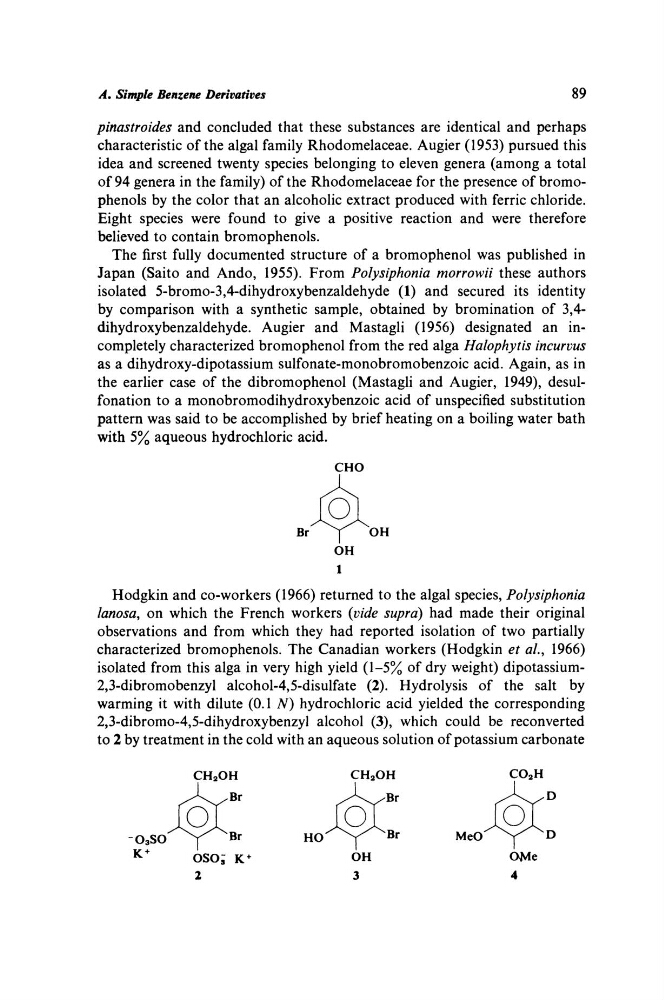
isolated 5-bromo-3,4-dihydroxybenzaldehyde (1) and secured its identity
by comparison with a synthetic sample, obtained by bromination of 3,4dihydroxybenzaldehyde. Augier and Mastagli (1956) designated an incompletely characterized bromophenol from the red alga Halophytis incurvus
as a dihydroxy-dipotassium sulfonate-monobromobenzoic acid. Again, as in
the earlier case of the dibromophenol (Mastagli and Augier, 1949), desulfonation to a monobromodihydroxybenzoic acid of unspecified substitution
pattern was said to be accomplished by brief heating on a boiling water bath
with 5% aqueous hydrochloric acid.
CHO
&
OH
1
Hodgkin and co-workers (1966) returned to the algal species, Polysiphonia
lanosa, on which the French workers (vide supra) had made their original
observations and from which they had reported isolation of two partially
characterized bromophenols. The Canadian workers (Hodgkin et ai, 1966)
isolated from this alga in very high yield (1-5% of dry weight) dipotassium2,3-dibromobenzyl alcohol-4,5-disulfate (2). Hydrolysis of the salt by
warming it with dilute (0.1 N) hydrochloric acid yielded the corresponding
2,3-dibromo-4,5-dihydroxybenzyl alcohol (3), which could be reconverted
to 2 by treatment in the cold with an aqueous solution of potassium carbonate
CH 2 OH
CH 2 OH
C0 2 H
-OaSO^^^Br
HO^^^
MeO^^"D
K+
OSOi K
+
OH
OMe
2
3
4
89
pinastroides and concluded that these substances are identical and perhaps
characteristic of the algal family Rhodomelaceae. Augier (1953) pursued this
idea and screened twenty species belonging to eleven genera (among a total
of 94 genera in the family) of the Rhodomelaceae for the presence of bromophenols by the color that an alcoholic extract produced with ferric chloride.
Eight species were found to give a positive reaction and were therefore
believed to contain bromophenols.
The first fully documented structure of a bromophenol was published in
Japan (Saito and Ando, 1955). From Polysiphonia morrowii these authors
isolated 5-bromo-3,4-dihydroxybenzaldehyde (1) and secured its identity
by comparison with a synthetic sample, obtained by bromination of 3,4dihydroxybenzaldehyde. Augier and Mastagli (1956) designated an incompletely characterized bromophenol from the red alga Halophytis incurvus
as a dihydroxy-dipotassium sulfonate-monobromobenzoic acid. Again, as in
the earlier case of the dibromophenol (Mastagli and Augier, 1949), desulfonation to a monobromodihydroxybenzoic acid of unspecified substitution
pattern was said to be accomplished by brief heating on a boiling water bath
with 5% aqueous hydrochloric acid.
CHO
&
OH
1
Hodgkin and co-workers (1966) returned to the algal species, Polysiphonia
lanosa, on which the French workers (vide supra) had made their original
observations and from which they had reported isolation of two partially
characterized bromophenols. The Canadian workers (Hodgkin et ai, 1966)
isolated from this alga in very high yield (1-5% of dry weight) dipotassium2,3-dibromobenzyl alcohol-4,5-disulfate (2). Hydrolysis of the salt by
warming it with dilute (0.1 N) hydrochloric acid yielded the corresponding
2,3-dibromo-4,5-dihydroxybenzyl alcohol (3), which could be reconverted
to 2 by treatment in the cold with an aqueous solution of potassium carbonate
CH 2 OH
CH 2 OH
C0 2 H
-OaSO^^^Br
HO^^^
MeO^^"D
K+
OSOi K
+
OH
OMe
2
3
4