

92
3. Benzenoids
R
JL^OH
C-glycosyl
Γ Τ ) |
HO
Ι ^ Ο γ ^ ^
glycosyl-C
OH
Ο
10
a: R = OH
b: R = H
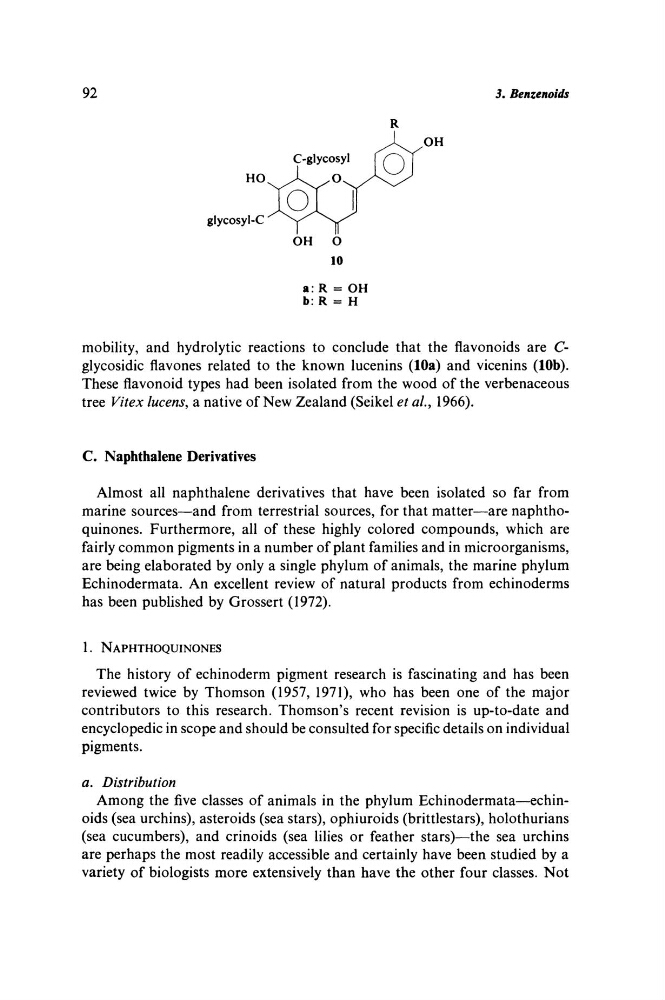
mobility, and hydrolytic reactions to conclude that the flavonoids are Cglycosidic flavones related to the known lucenins (10a) and vicenins (10b).
These flavonoid types had been isolated from the wood of the verbenaceous
tree Vitex lucens, a native of New Zealand (Seikel et al, 1966).
C. Naphthalene Derivatives
Almost all naphthalene derivatives that have been isolated so far from
marine sources—and from terrestrial sources, for that matter—are naphthoquinones. Furthermore, all of these highly colored compounds, which are
fairly common pigments in a number of plant families and in microorganisms,
are being elaborated by only a single phylum of animals, the marine phylum
Echinodermata. An excellent review of natural products from echinoderms
has been published by Grossert (1972).
1. NAPHTHOQUINONES
The history of echinoderm pigment research is fascinating and has been
reviewed twice by Thomson (1957, 1971), who has been one of the major
contributors to this research. Thomson's recent revision is up-to-date and
encyclopedic in scope and should be consulted for specific details on individual
pigments.
a. Distribution
Among the five classes of animals in the phylum Echinodermata—echinoids (sea urchins), asteroids (sea stars), ophiuroids (brittlestars), holothurians
(sea cucumbers), and crinoids (sea lilies or feather stars)—the sea urchins
are perhaps the most readily accessible and certainly have been studied by a
variety of biologists more extensively than have the other four classes. Not
3. Benzenoids
R
JL^OH
C-glycosyl
Γ Τ ) |
HO
Ι ^ Ο γ ^ ^
glycosyl-C
OH
Ο
10
a: R = OH
b: R = H
mobility, and hydrolytic reactions to conclude that the flavonoids are Cglycosidic flavones related to the known lucenins (10a) and vicenins (10b).
These flavonoid types had been isolated from the wood of the verbenaceous
tree Vitex lucens, a native of New Zealand (Seikel et al, 1966).
C. Naphthalene Derivatives
Almost all naphthalene derivatives that have been isolated so far from
marine sources—and from terrestrial sources, for that matter—are naphthoquinones. Furthermore, all of these highly colored compounds, which are
fairly common pigments in a number of plant families and in microorganisms,
are being elaborated by only a single phylum of animals, the marine phylum
Echinodermata. An excellent review of natural products from echinoderms
has been published by Grossert (1972).
1. NAPHTHOQUINONES
The history of echinoderm pigment research is fascinating and has been
reviewed twice by Thomson (1957, 1971), who has been one of the major
contributors to this research. Thomson's recent revision is up-to-date and
encyclopedic in scope and should be consulted for specific details on individual
pigments.
a. Distribution
Among the five classes of animals in the phylum Echinodermata—echinoids (sea urchins), asteroids (sea stars), ophiuroids (brittlestars), holothurians
(sea cucumbers), and crinoids (sea lilies or feather stars)—the sea urchins
are perhaps the most readily accessible and certainly have been studied by a
variety of biologists more extensively than have the other four classes. Not