

BINARY R A N W M WALKS: ADDENDUM
69
3. THE LIMIT OF A CONTINUMJS D r C r m r a u n ~ ~
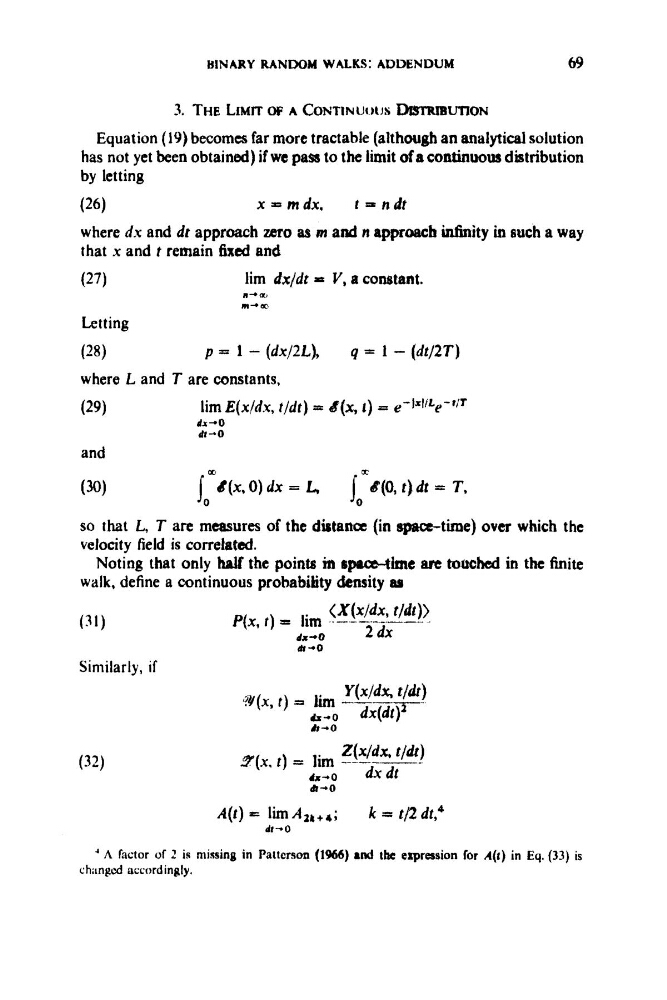
Equation (19) becomes far more tractable (although an analytical solution
has not yet been obtained) if we pass to the limit of a coutinuous distribution
by letting
(26)
x = = m d x ,
t - n d r
where dx and dt approach mro as rn and n approecb infinity in such a way
that x and t remain fixed and
lim dx/dt = It, a constant.
1 9 - 5
m-m
(27)
Letting
(28)
(29)
p = 1 - (dx/2L), q = I - (dt/ZT)
iim ~ ( x / d x ,
r/dt) = B(x, t ) = e-lxl%-'''
where L and T are constants,
d x - 0
01-0
and
(30)
j O r n 6 ( X . 0 ) dx = L,
lox6(0, c)dt = T,
so that L, T are measures of the distance (in s p a a t h e ) over which the
velocity field is correiated.
Noting that only half the points m cpoco-tlme am touched in the finite
walk, define a continuous probabiiity density aa
Similarly, if
dt-0
A ( t ) = I i r t ~ A ~ ~ + , ; k = t/2 dt,4
d f - 0
' A factor of 2 is niissing in Patterson (1966) and the erpression for A(t) in Eq. (33) is
c h m g d uccordingly.
69
3. THE LIMIT OF A CONTINUMJS D r C r m r a u n ~ ~
Equation (19) becomes far more tractable (although an analytical solution
has not yet been obtained) if we pass to the limit of a coutinuous distribution
by letting
(26)
x = = m d x ,
t - n d r
where dx and dt approach mro as rn and n approecb infinity in such a way
that x and t remain fixed and
lim dx/dt = It, a constant.
1 9 - 5
m-m
(27)
Letting
(28)
(29)
p = 1 - (dx/2L), q = I - (dt/ZT)
iim ~ ( x / d x ,
r/dt) = B(x, t ) = e-lxl%-'''
where L and T are constants,
d x - 0
01-0
and
(30)
j O r n 6 ( X . 0 ) dx = L,
lox6(0, c)dt = T,
so that L, T are measures of the distance (in s p a a t h e ) over which the
velocity field is correiated.
Noting that only half the points m cpoco-tlme am touched in the finite
walk, define a continuous probabiiity density aa
Similarly, if
dt-0
A ( t ) = I i r t ~ A ~ ~ + , ; k = t/2 dt,4
d f - 0
' A factor of 2 is niissing in Patterson (1966) and the erpression for A(t) in Eq. (33) is
c h m g d uccordingly.