

6H
ti. S. PITTFRSON, JR.
[‘(u, h ; c : z ) is the hypergeometric function defined as
with
( 4 0 = 1
(U)# = a(a + l ) - * . ( a + n - 1).
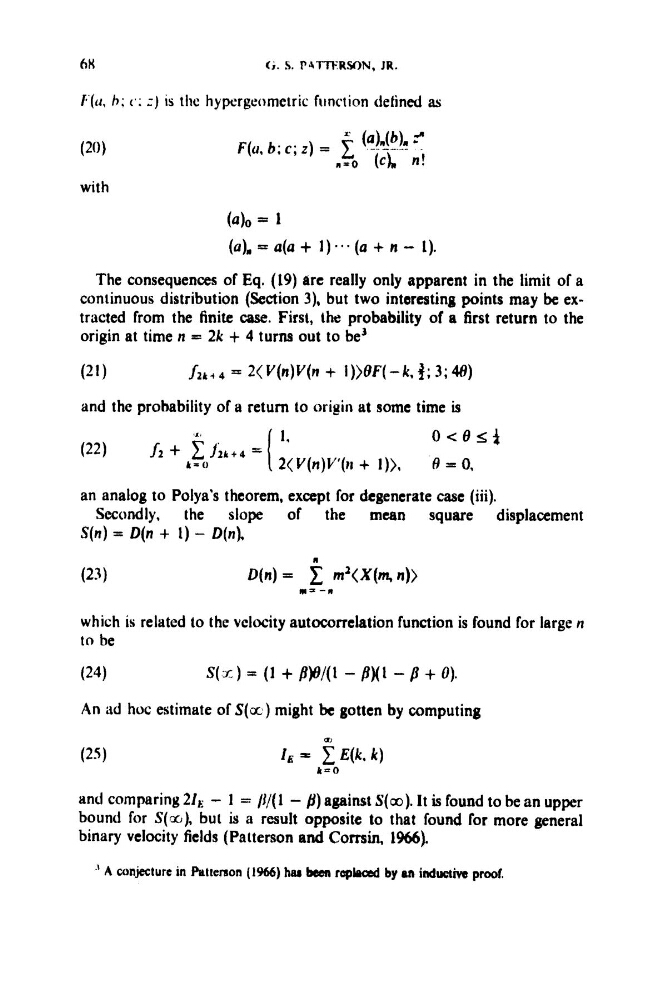
The consequences of Eq. (19) are really only apparent in the limit of a
continuous distribution (Section 3). but two interesting points may be extracted from the finite case. First, the probability of a first return to the
origin at time n = 2k + 4 turns out to be’
(21)
f 2 k , 4 = 2(V(n)V(n + ]))OF( - k . 3; 3; 48)
and the probability of a return to origin at some time is
.xi
0 < 0 s t
k = O
2(V(n)V’(a + l)), 8 = 0,
f 2 + c 1 2 k + 4 = ( 1*
(22)
an analog to Polya’s theorem, except for degenerate case (iii).
Secondly, the slope of the mean square displacement
S(n) = D(n + 1) - D(nX
which is related to the velocity autocorrelation function is found for large n
to be
An ad hoc estimate of S(m) might be gotten by computing
and comparing 2Ib - 1 = /I/( 1 - b) against S( a). It is found to be an upper
bound for S(x,o), but is a result opposite to that found for more general
binary velocity fields (Patterson and Corrsin, 1966).
A conjecture in Patterson (1966) haa bemi roplwed by an indwtiw proof
ti. S. PITTFRSON, JR.
[‘(u, h ; c : z ) is the hypergeometric function defined as
with
( 4 0 = 1
(U)# = a(a + l ) - * . ( a + n - 1).
The consequences of Eq. (19) are really only apparent in the limit of a
continuous distribution (Section 3). but two interesting points may be extracted from the finite case. First, the probability of a first return to the
origin at time n = 2k + 4 turns out to be’
(21)
f 2 k , 4 = 2(V(n)V(n + ]))OF( - k . 3; 3; 48)
and the probability of a return to origin at some time is
.xi
0 < 0 s t
k = O
2(V(n)V’(a + l)), 8 = 0,
f 2 + c 1 2 k + 4 = ( 1*
(22)
an analog to Polya’s theorem, except for degenerate case (iii).
Secondly, the slope of the mean square displacement
S(n) = D(n + 1) - D(nX
which is related to the velocity autocorrelation function is found for large n
to be
An ad hoc estimate of S(m) might be gotten by computing
and comparing 2Ib - 1 = /I/( 1 - b) against S( a). It is found to be an upper
bound for S(x,o), but is a result opposite to that found for more general
binary velocity fields (Patterson and Corrsin, 1966).
A conjecture in Patterson (1966) haa bemi roplwed by an indwtiw proof