

70
(3. S. P.A'I1'EWSON. JR.
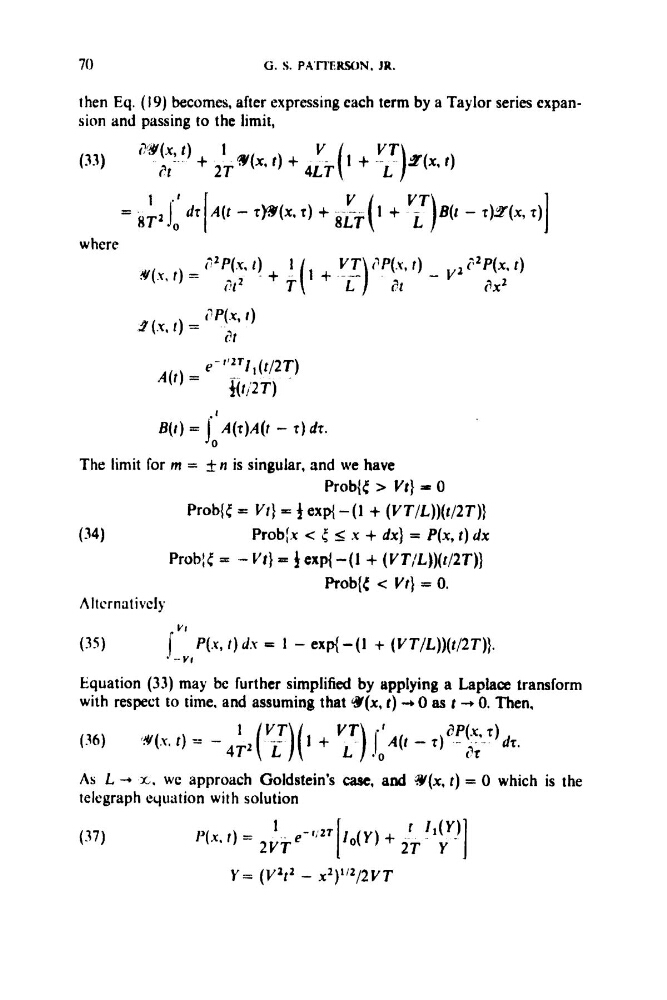
then Eq. ( 19) becomes, after expressing each term by a Taylor series expansion and passing to the limit,
P!#(x, 2)
1
4LT
9 ( x , t ) +
ct- + 277
(33)
dr A(t - t)?#(x, t) + 1 ( 1 + y ) E ( t - T ) ~ ( X , r ) ]
1 .'
= wJo I
8LT
where
P P ( x , t )
- vz
?t
(7X2
P P ( x . t ) 1 ( V' T) (7P(.u, r )
- + - I + - -
T
b(.u, 1 ) =
? t 2
The limit for m = + n is singular, and we have
Prob({ > Vr) = 0
Prob(t = Vr} = 4 exp( - (1 + (VT/L))(t/2T)}
Prob(x < t s x + dx} = P(x, t ) dx
Probit = - b'r} = f exp{ -(I + ( v T / L ) ) ( c / ~ T ) }
(34)
Prob(C < V t } = 0.
Altcrnativcly
(35)
1' ' ~ ( x ,
1 ) d.u I= 1 - exd-(l + (VT/L))(t/2T)).
Equation ( 3 3 ) may be further simplified by applying a Laplace transform
with respect to time, and assuming that 9 ( x , t) -+ 0 as r + 0. Then,
* - - V I
As L --* 3 ~ .
wc approach Goldstein's case, and @(x, t ) = 0 which is the
telegraph equation with solution
(37)
(3. S. P.A'I1'EWSON. JR.
then Eq. ( 19) becomes, after expressing each term by a Taylor series expansion and passing to the limit,
P!#(x, 2)
1
4LT
9 ( x , t ) +
ct- + 277
(33)
dr A(t - t)?#(x, t) + 1 ( 1 + y ) E ( t - T ) ~ ( X , r ) ]
1 .'
= wJo I
8LT
where
P P ( x , t )
- vz
?t
(7X2
P P ( x . t ) 1 ( V' T) (7P(.u, r )
- + - I + - -
T
b(.u, 1 ) =
? t 2
The limit for m = + n is singular, and we have
Prob({ > Vr) = 0
Prob(t = Vr} = 4 exp( - (1 + (VT/L))(t/2T)}
Prob(x < t s x + dx} = P(x, t ) dx
Probit = - b'r} = f exp{ -(I + ( v T / L ) ) ( c / ~ T ) }
(34)
Prob(C < V t } = 0.
Altcrnativcly
(35)
1' ' ~ ( x ,
1 ) d.u I= 1 - exd-(l + (VT/L))(t/2T)).
Equation ( 3 3 ) may be further simplified by applying a Laplace transform
with respect to time, and assuming that 9 ( x , t) -+ 0 as r + 0. Then,
* - - V I
As L --* 3 ~ .
wc approach Goldstein's case, and @(x, t ) = 0 which is the
telegraph equation with solution
(37)