

1940: I.oct~. 1034: Ilicw texts consider only thc primary tcrm in the following
;I 1x1 l y is .)
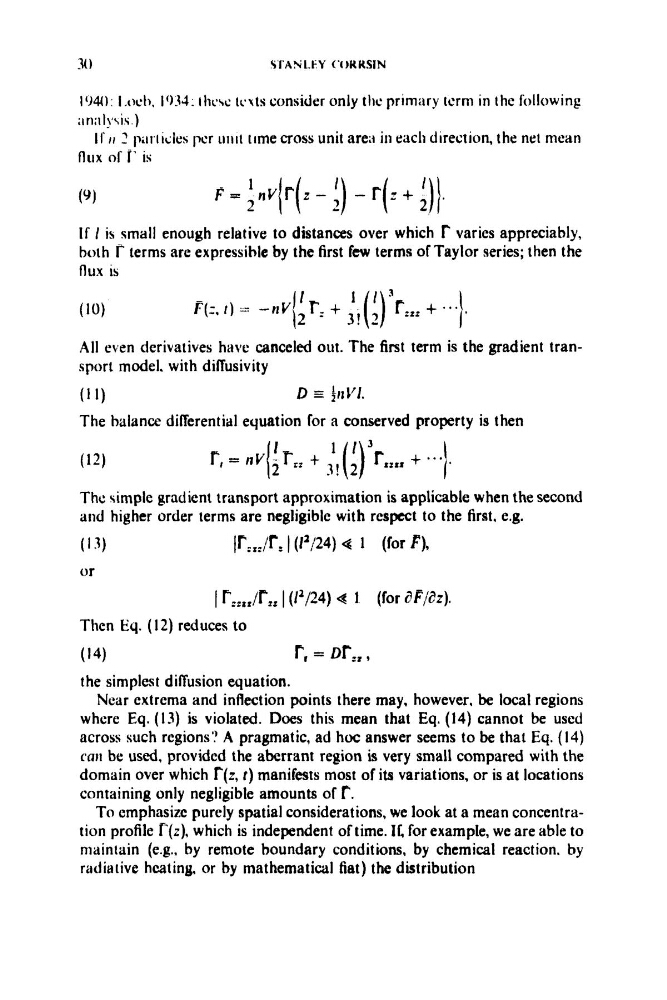
If I I 2 pii1'lkIes pcr tmit time cross unit areu in each direction, the net mean
flux of i' is
P = 2 * ,YIP( z - ;) - r( L + ; ) I .
I f I is small enough relative to distances over which r varies appreciably,
both P terms are expressible by the first few terms of Taylor series; then the
flux is
All even derivatives have canceled out. The first term is the gradient transport model. with diffusivity
( 1 1)
D = frtV1.
The balance differential equation for a conserved property is then
Thc Fimple gradient transport approximation is applicable when the second
and higher order terms are negligible with respect to the first, e.g.
(13)
lfgzz/rz I (Pi24) e I (for F),
or
I P,,,,/f,, I (12/24) 4 1 (for aF/8z).
Then Ey. (12) reduces to
(14)
r, = or,, ,
the simplest diffusion equation.
Near extrema and inflection points there may, however. be local regions
where Eq. (13) is violated. Does this mean that Eq. (14) cannot be used
across such regions'? A pragmatic, ad hoc answer seems to be that Eq. (14)
cat1 be used, provided the aberrant region is very small compared with the
domain over which r(z, t ) manifests most of its variations, or is at locations
containing only negligible amounts of r.
To emphasize purely spatial considerations, we look at a mean concentration profile f'(z), which is independent of time. If, for example, we are able to
maintain (e.g.. by remote boundary conditions, by chemical reaction, by
radiative hcating, or by mathematical fiat) the distribution
;I 1x1 l y is .)
If I I 2 pii1'lkIes pcr tmit time cross unit areu in each direction, the net mean
flux of i' is
P = 2 * ,YIP( z - ;) - r( L + ; ) I .
I f I is small enough relative to distances over which r varies appreciably,
both P terms are expressible by the first few terms of Taylor series; then the
flux is
All even derivatives have canceled out. The first term is the gradient transport model. with diffusivity
( 1 1)
D = frtV1.
The balance differential equation for a conserved property is then
Thc Fimple gradient transport approximation is applicable when the second
and higher order terms are negligible with respect to the first, e.g.
(13)
lfgzz/rz I (Pi24) e I (for F),
or
I P,,,,/f,, I (12/24) 4 1 (for aF/8z).
Then Ey. (12) reduces to
(14)
r, = or,, ,
the simplest diffusion equation.
Near extrema and inflection points there may, however. be local regions
where Eq. (13) is violated. Does this mean that Eq. (14) cannot be used
across such regions'? A pragmatic, ad hoc answer seems to be that Eq. (14)
cat1 be used, provided the aberrant region is very small compared with the
domain over which r(z, t ) manifests most of its variations, or is at locations
containing only negligible amounts of r.
To emphasize purely spatial considerations, we look at a mean concentration profile f'(z), which is independent of time. If, for example, we are able to
maintain (e.g.. by remote boundary conditions, by chemical reaction, by
radiative hcating, or by mathematical fiat) the distribution