

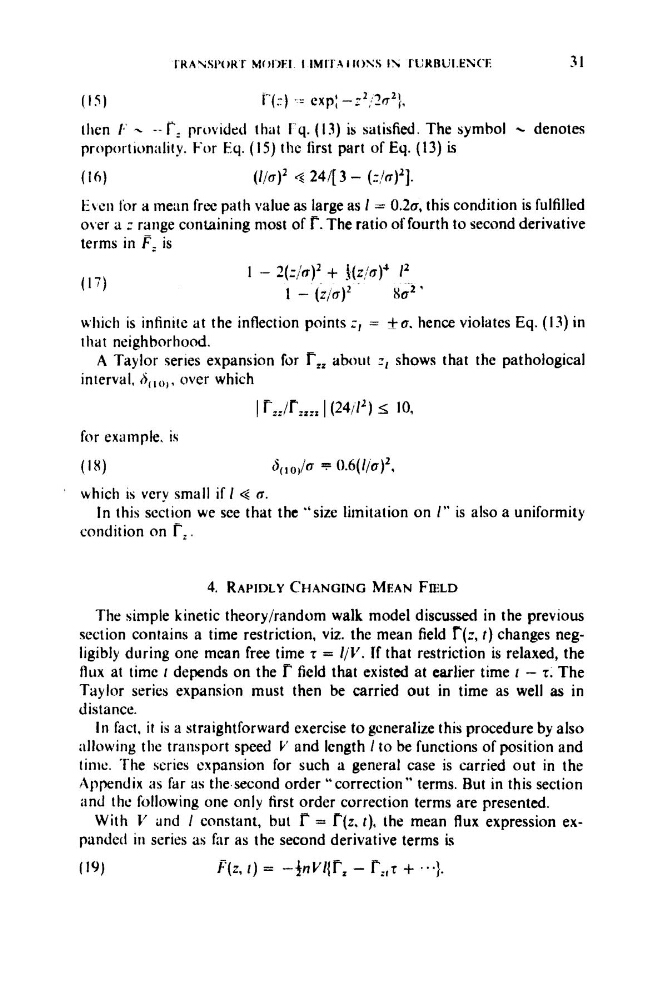
(151
i-(-) - ~ = C X ~ ;
-z*,:W;,
11icn I.‘ - -- Fz p-ovided that rq. (13) is satisfied. The symbol 2 . denotes
proportionality. For Eq. (15) the first part of Eq. (13) is
(1())
(1/0)’ 3 24/[ 3 - (z/o)’].
Even lor a mean free path value as large as 1 = 0.20, this condition is fulfilled
o”er a 2 range containing most of f. The ratio ot’fourth to second derivative
terms i n F, is
(17)
I - 2(z/a)’ + f(z!’a)” 1‘ ~.~
I -
go2 ’
which is infinite at the inflection points z , = +a. hence violates Eq. (13) in
that neighborhood.
A Taylor series expansion for fzz abour z , shows that the pathological
interval, h,,,,,, over which
I ~ , z / ~ i z z z
I (NIL 1 5 10,
for example, is
(18)
which is very small if I 4 0 .
condition on i=*.
8, , o,/o = 0.6( I/a)’,
’
In this section we see that the “size limitation on I” is also a uniformity
4. RAPIDLY CHANGING MEAN FIELD
The siinple kinetic theory/random walk model discussed in the previous
section contains a time restriction, viz. the mean field r ( z , t ) changes negligibly during one mean free time T = l / V . If that restriction is relaxed, the
flux at time t depends on the f field that existed at earlier time t - T. The
Taylor series expansion must then be carried out in time as well as in
distance.
In fact. it is a straightforward exercise to generalize this procedure by also
;illowing the transport speed c’ and length I to be functions of position and
linie. The series expansion for such a general case is carried out in the
Appendix a s far as the second order “correction” terms. But in this section
and the following one only first order correction terms are presented.
With I. ’ and I constant, but f = r ( z , t ) , the mean flux expression expanded in series as far as the second derivative terms is
(19)
F(z, I ) = -inv/(rz - rz,? + - 3.
i-(-) - ~ = C X ~ ;
-z*,:W;,
11icn I.‘ - -- Fz p-ovided that rq. (13) is satisfied. The symbol 2 . denotes
proportionality. For Eq. (15) the first part of Eq. (13) is
(1())
(1/0)’ 3 24/[ 3 - (z/o)’].
Even lor a mean free path value as large as 1 = 0.20, this condition is fulfilled
o”er a 2 range containing most of f. The ratio ot’fourth to second derivative
terms i n F, is
(17)
I - 2(z/a)’ + f(z!’a)” 1‘ ~.~
I -
go2 ’
which is infinite at the inflection points z , = +a. hence violates Eq. (13) in
that neighborhood.
A Taylor series expansion for fzz abour z , shows that the pathological
interval, h,,,,,, over which
I ~ , z / ~ i z z z
I (NIL 1 5 10,
for example, is
(18)
which is very small if I 4 0 .
condition on i=*.
8, , o,/o = 0.6( I/a)’,
’
In this section we see that the “size limitation on I” is also a uniformity
4. RAPIDLY CHANGING MEAN FIELD
The siinple kinetic theory/random walk model discussed in the previous
section contains a time restriction, viz. the mean field r ( z , t ) changes negligibly during one mean free time T = l / V . If that restriction is relaxed, the
flux at time t depends on the f field that existed at earlier time t - T. The
Taylor series expansion must then be carried out in time as well as in
distance.
In fact. it is a straightforward exercise to generalize this procedure by also
;illowing the transport speed c’ and length I to be functions of position and
linie. The series expansion for such a general case is carried out in the
Appendix a s far as the second order “correction” terms. But in this section
and the following one only first order correction terms are presented.
With I. ’ and I constant, but f = r ( z , t ) , the mean flux expression expanded in series as far as the second derivative terms is
(19)
F(z, I ) = -inv/(rz - rz,? + - 3.