

TRAVSPOR‘I MODEI. I.IMIl‘41’10NS IN TIJRBlJLENCE
29
Transport processes in which the effccrs of a11 derivations higher than the
first can be ncglected give finally
(8)
F(=, t ) = -or,
[D > 01
which might be called ‘ * Fourier,Fick transport.” but may be more clearly
identified by a generic name such as ”simple gradient transport.” Of course.
some classes of terms may be ruled out by other considerations, such as the
second law of thermodynamics, self-consistency conditions, and, in systems
of more than one space dimension, appropriate invariance constraints.
A familiar process that illustrates the simplification from Eq. (7) to Eq. (8)
is Brownian motion or rarefied gab molecular kinetics (see, e.g.,
Einstein, 1926).
3. THE SIMPLEST “ KINETIC THEORY ” OR RANDOM W A L K MODEL;
SIZE LIMITATION ON HOMOGENEOUS MEAN FREE PATH
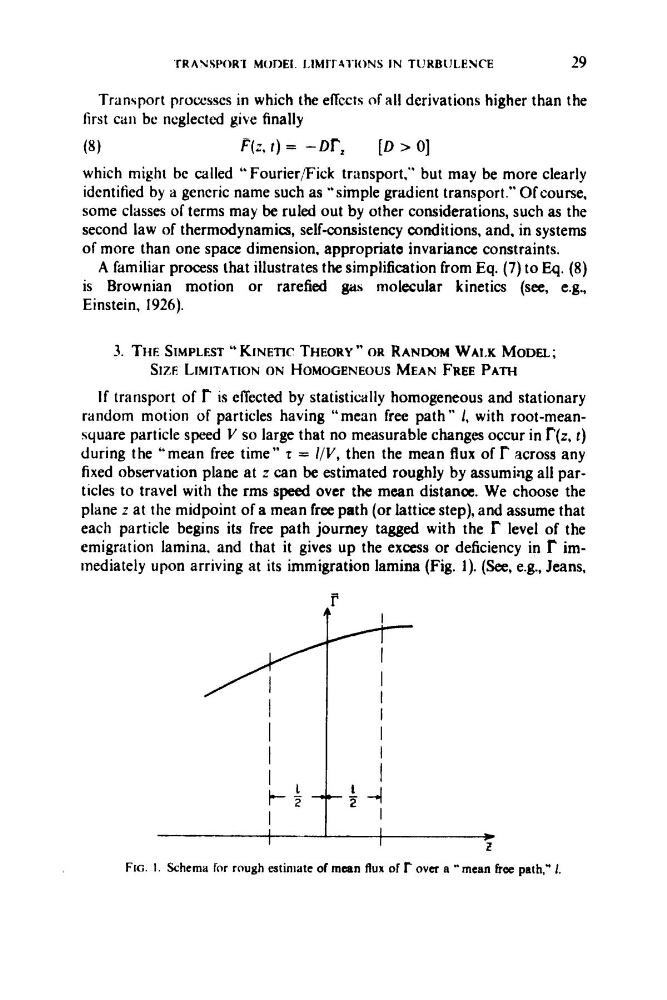
is effected by statistically homogeneous and stationary
random motion of particles having “mean free path” I, with root-meansquare particle speed V so large that no measurable changes occur in f(z, t )
during the “mean free time” t = l/V, then the mean flux of r across any
fixed observation plane at z can be estimated roughly by assumiag all particles to travel with the rms speed over the mean distanoe. We choose the
plane z at the midpoint of a mean free path (or lattice step), and assume that
each particle begins its free path journey tagged with the f level of the
emigration lamina. and that it gives up the excess or deficiency in f immediately upon arriving at its immigration lamina (Fig. 1). (See, e.g., Jeans,
If transport of
f
I
I
I
I
I
I
I
t
- k -- 2 ‘‘I
I
I
A I
I
*
”
E
FIG. I . Schema for rough estimate of mmn flux of r over a *’ mean free path,“ 1.
29
Transport processes in which the effccrs of a11 derivations higher than the
first can be ncglected give finally
(8)
F(=, t ) = -or,
[D > 01
which might be called ‘ * Fourier,Fick transport.” but may be more clearly
identified by a generic name such as ”simple gradient transport.” Of course.
some classes of terms may be ruled out by other considerations, such as the
second law of thermodynamics, self-consistency conditions, and, in systems
of more than one space dimension, appropriate invariance constraints.
A familiar process that illustrates the simplification from Eq. (7) to Eq. (8)
is Brownian motion or rarefied gab molecular kinetics (see, e.g.,
Einstein, 1926).
3. THE SIMPLEST “ KINETIC THEORY ” OR RANDOM W A L K MODEL;
SIZE LIMITATION ON HOMOGENEOUS MEAN FREE PATH
is effected by statistically homogeneous and stationary
random motion of particles having “mean free path” I, with root-meansquare particle speed V so large that no measurable changes occur in f(z, t )
during the “mean free time” t = l/V, then the mean flux of r across any
fixed observation plane at z can be estimated roughly by assumiag all particles to travel with the rms speed over the mean distanoe. We choose the
plane z at the midpoint of a mean free path (or lattice step), and assume that
each particle begins its free path journey tagged with the f level of the
emigration lamina. and that it gives up the excess or deficiency in f immediately upon arriving at its immigration lamina (Fig. 1). (See, e.g., Jeans,
If transport of
f
I
I
I
I
I
I
I
t
- k -- 2 ‘‘I
I
I
A I
I
*
”
E
FIG. I . Schema for rough estimate of mmn flux of r over a *’ mean free path,“ 1.