

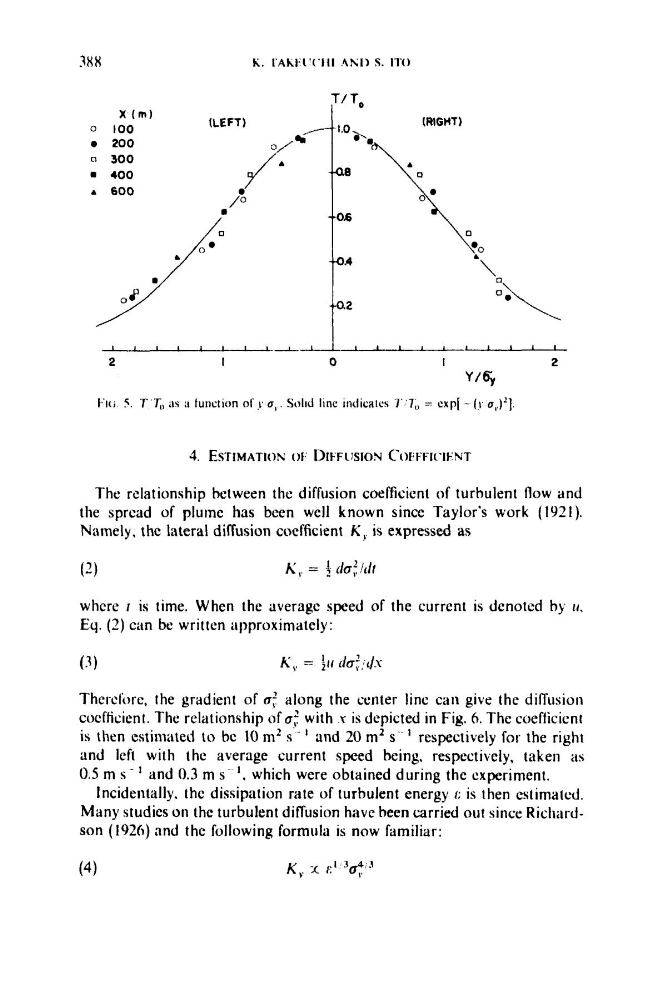
(LEFT)
X ( m )
0
100
1
-
0
200
300
. 400
A
600
0
The relationship between the diffusion coefficient of turbulent flow and
the sprcad of plume has been well known since Taylor's work (1921).
Namely. the lateral diffusion coefficient K, is expressed as
whew I is time. When the average speed of the current is denoted by I ) .
Eq. (2) cun be written approximately:
Thcrclorc, the gradient of of along the center line can give the diniision
coefficient. The relationship of o: with Y is depicted in Fig. 6. The coefficient
is then estiniated to be 10 m r s and 20 m2 s ' respectively for the right
and left with the average current speed being. respectiwly, taken iis
0.5 m s' I and 0.3 m s ', which were obtained during the cxperiment.
Incidentally, the dissipation rate of turbulent energy c is then estimatcd.
Many studies on the turbulent diffusion have been carried out since Richardson (1926) and the following formula IS now familiar:
X ( m )
0
100
1
-
0
200
300
. 400
A
600
0
The relationship between the diffusion coefficient of turbulent flow and
the sprcad of plume has been well known since Taylor's work (1921).
Namely. the lateral diffusion coefficient K, is expressed as
whew I is time. When the average speed of the current is denoted by I ) .
Eq. (2) cun be written approximately:
Thcrclorc, the gradient of of along the center line can give the diniision
coefficient. The relationship of o: with Y is depicted in Fig. 6. The coefficient
is then estiniated to be 10 m r s and 20 m2 s ' respectively for the right
and left with the average current speed being. respectiwly, taken iis
0.5 m s' I and 0.3 m s ', which were obtained during the cxperiment.
Incidentally, the dissipation rate of turbulent energy c is then estimatcd.
Many studies on the turbulent diffusion have been carried out since Richardson (1926) and the following formula IS now familiar: