

374
G . T. CSANADY
Observed spacings of windrows are irregular. When a batch of floating
objects are thrown overboard, they first form closely spaced, short rows, but
after 10 min or so they are found in more widely spaced and welldefined,
longer straight lines. These better defined lines presumably mark
confluences between dominant big eddies, their spacing L ranging according
to location from a few metres to a few tens of metres, say L = O(i03 cm).
Characteristic drift velocities u (of partick floating laterally into convergences, or of nonbuoyant particles sinking below convergences) have been
observed to be a few antimetres per second. We conclude that the time scale
of these big eddies is of order T = L/u = O(10' sec), and indeed individual
windrows can be observed to persist for intervals of precisely that order.
During the summer of 1965 we carried out systematic windrow observations near the h i e du Dore Research Station on Lake Huron, about 5 km
ofl shore. Five observations were taken daily (weather permitting), a total of
2 4 between May and July. Aluminium powder was thrown overboard to
mark windrows. Because windrows are generally irregular in appearance,
the observer often had doubts as to whether what he saw were windrows or
not. Further details of the work are given in a report of limited circulation
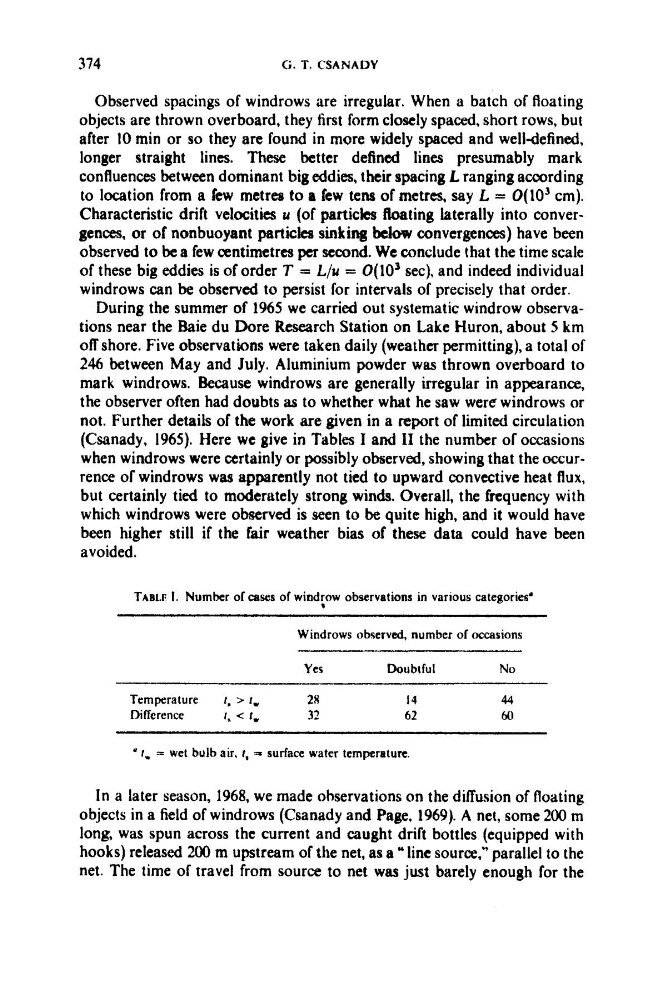
(Csanady, 1965). Here we give in Tables I and I1 the number of occasions
when windrows were certainly or possibly observed, showing that the occurrence of windrows was apparently not tied to upward convective heat flux,
but certainly tied to moderately strong winds. Overall, the fttquency with
which windrows were observed is Seen to be quite high, and it would have
been higher still if the fair weather bias of these data could have been
avoided.
TABLE 1. Number of cases of wind:ow observations in various categories'
Windrows observed, number of occasions
Yes
Doubtful
N O
Temperature
I, > 1,
28
14
44
Diffcrence
' , 1,
32
62
60
" r, = wet bulb air, I, = surface water temperature.
In a later season, 1968, we made observations on the diffusion of floating
objects in a field of windrows (Csanady and Page, 1969). A net, some 200 m
long, was spun across the current and caught drift bottles (equipped with
hooks) released 200 m upstream of the net, as a *line source," parallel to the
net. The time of travel from source to net was just barely enough for the
G . T. CSANADY
Observed spacings of windrows are irregular. When a batch of floating
objects are thrown overboard, they first form closely spaced, short rows, but
after 10 min or so they are found in more widely spaced and welldefined,
longer straight lines. These better defined lines presumably mark
confluences between dominant big eddies, their spacing L ranging according
to location from a few metres to a few tens of metres, say L = O(i03 cm).
Characteristic drift velocities u (of partick floating laterally into convergences, or of nonbuoyant particles sinking below convergences) have been
observed to be a few antimetres per second. We conclude that the time scale
of these big eddies is of order T = L/u = O(10' sec), and indeed individual
windrows can be observed to persist for intervals of precisely that order.
During the summer of 1965 we carried out systematic windrow observations near the h i e du Dore Research Station on Lake Huron, about 5 km
ofl shore. Five observations were taken daily (weather permitting), a total of
2 4 between May and July. Aluminium powder was thrown overboard to
mark windrows. Because windrows are generally irregular in appearance,
the observer often had doubts as to whether what he saw were windrows or
not. Further details of the work are given in a report of limited circulation
(Csanady, 1965). Here we give in Tables I and I1 the number of occasions
when windrows were certainly or possibly observed, showing that the occurrence of windrows was apparently not tied to upward convective heat flux,
but certainly tied to moderately strong winds. Overall, the fttquency with
which windrows were observed is Seen to be quite high, and it would have
been higher still if the fair weather bias of these data could have been
avoided.
TABLE 1. Number of cases of wind:ow observations in various categories'
Windrows observed, number of occasions
Yes
Doubtful
N O
Temperature
I, > 1,
28
14
44
Diffcrence
' , 1,
32
62
60
" r, = wet bulb air, I, = surface water temperature.
In a later season, 1968, we made observations on the diffusion of floating
objects in a field of windrows (Csanady and Page, 1969). A net, some 200 m
long, was spun across the current and caught drift bottles (equipped with
hooks) released 200 m upstream of the net, as a *line source," parallel to the
net. The time of travel from source to net was just barely enough for the