

DIFFI ISION A N D I>I:POSITlON O F FLOATING POLLUTANTS
375
T A H I . ~
11. Number of cases of windrow ohservations in various categories
against wind speed
Windrows observed. number of occasions
0 2.0
2
3
51
Wind
2.1-4.0
5
25
30
speed
4.1 -6.0
21
33
I I
(m/sec)
6.1-8.0
22
15
5
8.115
I
0
drift-bottles to form into windrows (when these existed). Given a typical
current speed of 20 cm sec- I , this also verifies our previous estimate of time
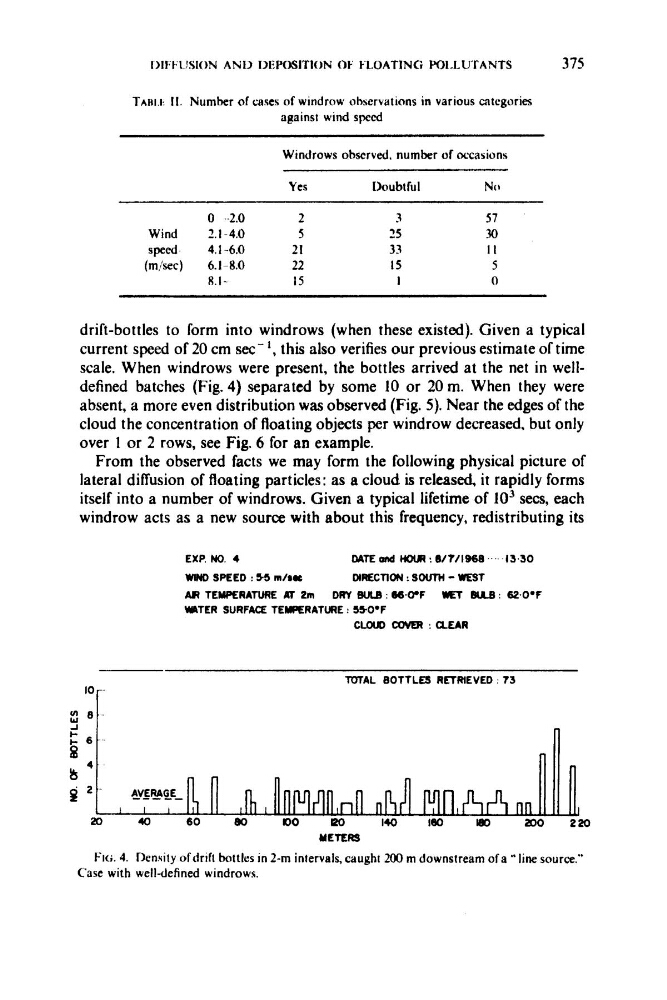
scale. When windrows were present, the bottles arrived at the net in welldefined batches (Fig. 4) separated by some 10 or 20 m. When they were
absent, a morc even distribution was observed (Fig. 5). Near the edges of the
cloud the concentration of floating objects per windrow decreased, but only
over 1 or 2 rows, see Fig. 6 for an example.
From the observed facts we may form the following physical picture of
lateral diffusion of floating particles: as a cloud is released, it rapidly forms
itself into a number of windrows. Given a typical lifetime of lo3 secs, each
windrow acts as a new source with about this frequency, redistributing its
EXP. No 4
DATE ond Hou( : O/7/l%8
13.30
WIND SPEED : 5 5 m / r r
M TEMPERATURE AT 2m
DRY BULB : 66.O.F WX BUB : 62.0.F
WRTER SURFACE TEMPERATWIE : 550.F
MRECTlON : s m - WEST
CUM)
COVER : a u R
TOTAL BOTTLES RflMEVED : 73
METERS
FIG. 4. Density of drift bottles in 2-m intervals, caught 200 m downstream of a ’‘ line source.”
Case with well-defined windrows.
375
T A H I . ~
11. Number of cases of windrow ohservations in various categories
against wind speed
Windrows observed. number of occasions
0 2.0
2
3
51
Wind
2.1-4.0
5
25
30
speed
4.1 -6.0
21
33
I I
(m/sec)
6.1-8.0
22
15
5
8.115
I
0
drift-bottles to form into windrows (when these existed). Given a typical
current speed of 20 cm sec- I , this also verifies our previous estimate of time
scale. When windrows were present, the bottles arrived at the net in welldefined batches (Fig. 4) separated by some 10 or 20 m. When they were
absent, a morc even distribution was observed (Fig. 5). Near the edges of the
cloud the concentration of floating objects per windrow decreased, but only
over 1 or 2 rows, see Fig. 6 for an example.
From the observed facts we may form the following physical picture of
lateral diffusion of floating particles: as a cloud is released, it rapidly forms
itself into a number of windrows. Given a typical lifetime of lo3 secs, each
windrow acts as a new source with about this frequency, redistributing its
EXP. No 4
DATE ond Hou( : O/7/l%8
13.30
WIND SPEED : 5 5 m / r r
M TEMPERATURE AT 2m
DRY BULB : 66.O.F WX BUB : 62.0.F
WRTER SURFACE TEMPERATWIE : 550.F
MRECTlON : s m - WEST
CUM)
COVER : a u R
TOTAL BOTTLES RflMEVED : 73
METERS
FIG. 4. Density of drift bottles in 2-m intervals, caught 200 m downstream of a ’‘ line source.”
Case with well-defined windrows.