

I)II.Fl,'SIOS ANI) I>FP(BITION OF FI.0ATING POLLITANTS
373
f+7
SHEARED CURAENT
A
P
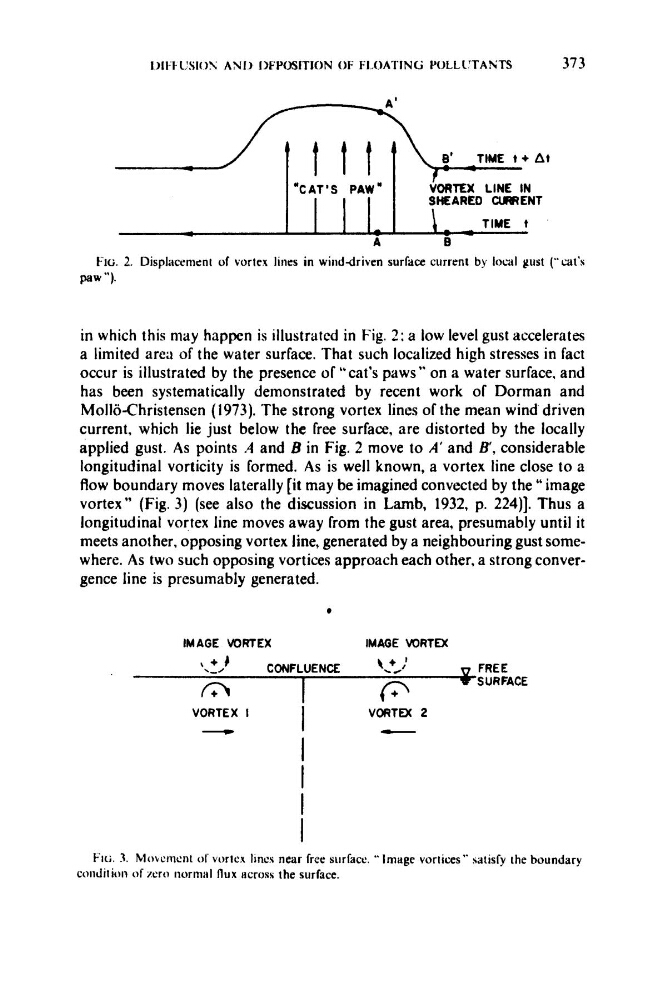
FIG. 2. Displiicenirnt of vortex lines in winddriven surface current by local gust (..at's
paw ").
in which this may happen is illustratcd in Fig. 2: a low level gust accelerates
a limited area of the water surface. That such localized high stresses in fact
occur is illustrated by the presence of "cat's paws" on a water surface, and
has been systematically demonstrated by recent work of Dorman and
Mollo-Christensen (1973). The strong vortex lines of the mean wind driven
current, which lie just below the free surface, are distorted by the locally
applied gust. As points .4 and B in Fig. 2 move to A' and B', considerable
longitudinal vorticity is formed. As is well known, a vortex line close to a
flow boundary moves laterally [it may be imagined convected by the '' image
vortex" (Fig. 3) (see also the discussion in Lamb, 1932, p. 224)]. Thus a
longitudinal vortex line moves away from the gust area, presumably until it
meets another, opposing vortex line, generated by a neighbouring gust somewhere. As two such opposing vortices approach each other, a strong convergence line is presumably generated.
IMAGE VDRTEX
IMAM VORTEX
Flci. 3. tvlobcincnt i l l vortcx Iincs near free surfaca. *'Image vorrims" 4 s f y the boundary
condition o f 7cro normal flux across the surface.
373
f+7
SHEARED CURAENT
A
P
FIG. 2. Displiicenirnt of vortex lines in winddriven surface current by local gust (..at's
paw ").
in which this may happen is illustratcd in Fig. 2: a low level gust accelerates
a limited area of the water surface. That such localized high stresses in fact
occur is illustrated by the presence of "cat's paws" on a water surface, and
has been systematically demonstrated by recent work of Dorman and
Mollo-Christensen (1973). The strong vortex lines of the mean wind driven
current, which lie just below the free surface, are distorted by the locally
applied gust. As points .4 and B in Fig. 2 move to A' and B', considerable
longitudinal vorticity is formed. As is well known, a vortex line close to a
flow boundary moves laterally [it may be imagined convected by the '' image
vortex" (Fig. 3) (see also the discussion in Lamb, 1932, p. 224)]. Thus a
longitudinal vortex line moves away from the gust area, presumably until it
meets another, opposing vortex line, generated by a neighbouring gust somewhere. As two such opposing vortices approach each other, a strong convergence line is presumably generated.
IMAGE VDRTEX
IMAM VORTEX
Flci. 3. tvlobcincnt i l l vortcx Iincs near free surfaca. *'Image vorrims" 4 s f y the boundary
condition o f 7cro normal flux across the surface.