

372
G . 'r. (SANAUY
h u t itny other floating malerial such as seagull feathers, oily substances. and
alewives. Because windrows are prese@t more often than not, it is of some
interest to consider the diffusion of a cloud of buoyant particles in a horizontally infinite or semi-infinite field of windrows.
11. EXPERIMENTAL EVIDENCE ON WINDROWS
So far no satisfactory theory has been proposed to explain how the wind
stress acting at the sea surface sets up a field of Langmuir circulations (Scott
et al.. 1969). The principal physical facts relating to windrows are, however,
well known and provide suficient background for our projected discussion
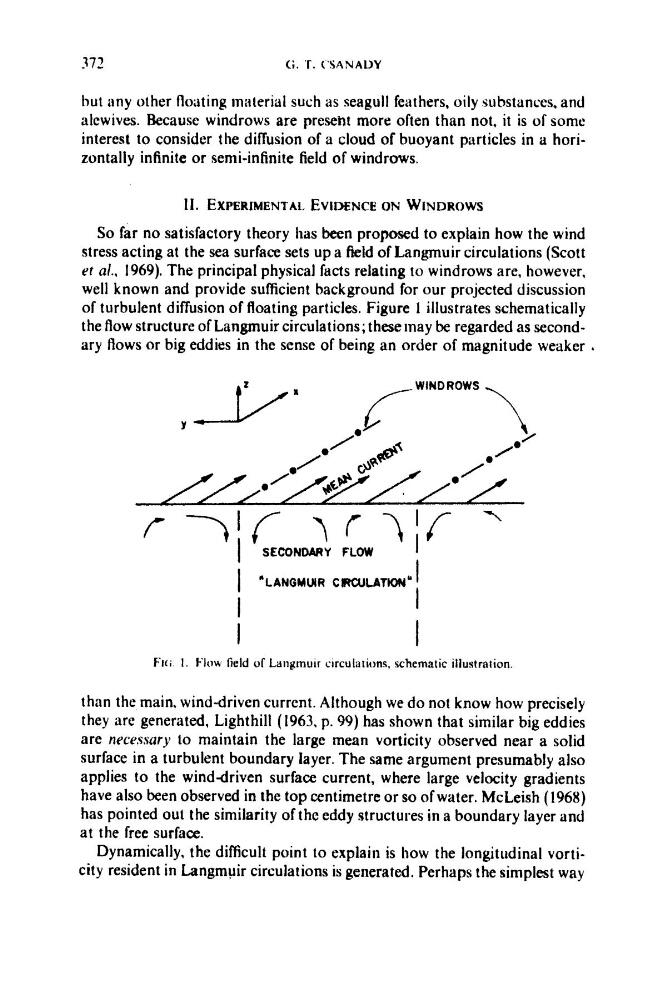
of turbulent diffusion of floating particles. Figure 1 illustrates schematically
the flow structure of Langmuir circulations; these may be regarded as secondary flows or big eddies in the sense of being an order of magnitude weaker .
1
I SECONDARY FLOW
I
I
I *LANGMUIR CIRCUUTIONU
I
I
I
FK, 1. F l o ~ field of Langmuir circulations, schematic illustration
than the main, wind-driven current. Although we do not know how precisely
they are generated. Lighthill (1963. p. 99) has shown that similar big eddies
are necessciry to maintain the large mean vorticity observed near a solid
surface in a turbulent boundary layer. The same argument presumably also
applies to the winddriven surface current, where large velocity gradients
have also been observed in the top centimetre or so of water. McLeish (1968)
has pointed out the similarity of the eddy structures in a boundary layer and
at the free surface.
Dynamically, the difficult point to explain is how the longittidinal vorticity resident in Langmuir circulations is generated. Perhaps the simplest way
G . 'r. (SANAUY
h u t itny other floating malerial such as seagull feathers, oily substances. and
alewives. Because windrows are prese@t more often than not, it is of some
interest to consider the diffusion of a cloud of buoyant particles in a horizontally infinite or semi-infinite field of windrows.
11. EXPERIMENTAL EVIDENCE ON WINDROWS
So far no satisfactory theory has been proposed to explain how the wind
stress acting at the sea surface sets up a field of Langmuir circulations (Scott
et al.. 1969). The principal physical facts relating to windrows are, however,
well known and provide suficient background for our projected discussion
of turbulent diffusion of floating particles. Figure 1 illustrates schematically
the flow structure of Langmuir circulations; these may be regarded as secondary flows or big eddies in the sense of being an order of magnitude weaker .
1
I SECONDARY FLOW
I
I
I *LANGMUIR CIRCUUTIONU
I
I
I
FK, 1. F l o ~ field of Langmuir circulations, schematic illustration
than the main, wind-driven current. Although we do not know how precisely
they are generated. Lighthill (1963. p. 99) has shown that similar big eddies
are necessciry to maintain the large mean vorticity observed near a solid
surface in a turbulent boundary layer. The same argument presumably also
applies to the winddriven surface current, where large velocity gradients
have also been observed in the top centimetre or so of water. McLeish (1968)
has pointed out the similarity of the eddy structures in a boundary layer and
at the free surface.
Dynamically, the difficult point to explain is how the longittidinal vorticity resident in Langmuir circulations is generated. Perhaps the simplest way