

366
CARL H. GIBSON ET AL.
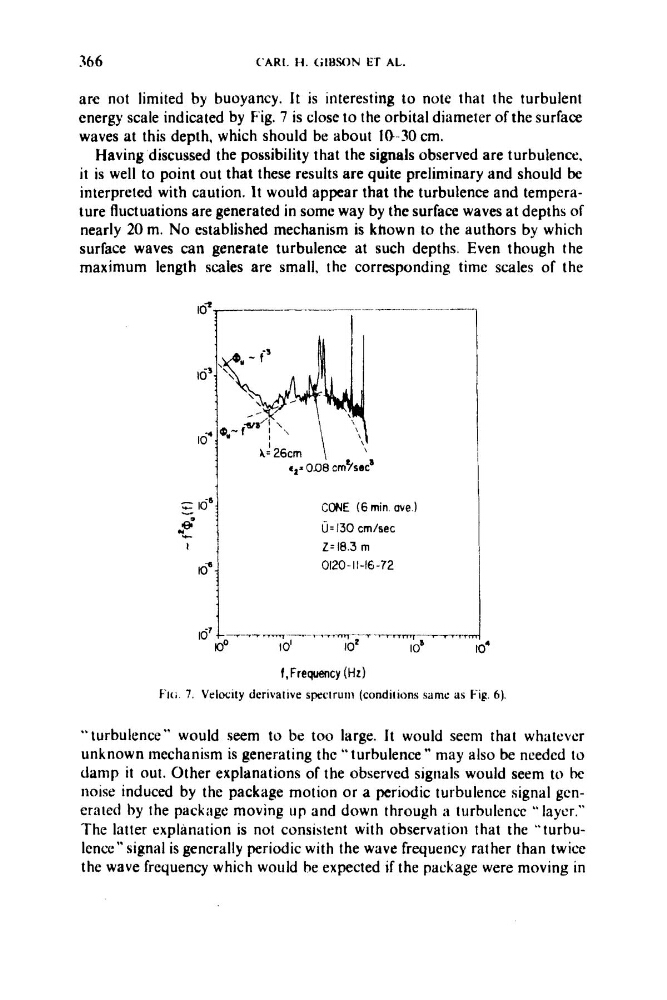
are not limited by buoyancy. It is interesting to note that the turbulent
energy scale indicated by Fig. 7 is close to the orbital diameter of the surface
waves at this depth, which should be about 10-30 cm.
Having discussed the possibility that the signals observed are turbulence.
it is well to point out that these results are quite preliminary and should be
interpreted with caution. It would appear that the turbulence and temperature fluctuations are generated in some way by the surface waves at depths of
nearly 20 m. No established mechanism is khown to the authors by which
surface waves can generate turbulence at such depths. Even though the
maximum length scales are small, the corresponding time scales of the
CONE (6 min. ove.)
U= 130 cm/sec
Z= 18.3 m
0120-1 1-16-72
f,Frequency (Hz)
FK, 7. Velocity dcrivalive speciruiti (conditions u m r as Fig 6)
"turbulence" would seem to be too large. It would seem that whatever
unknown mechanism is generating the "turbulence" may also be needed to
damp it out. Other explanations of the observed signals would seem to be
noise induced by the package motion or a periodic turbulence signal gcnerared by the package moving up and down through a turbulencc " layer."
The latter explanation is not consistent with observation that the "turbulence" signal is generally periodic with the wave frequency rather than twice
the wave frequency which would he expected if the package were moving in
CARL H. GIBSON ET AL.
are not limited by buoyancy. It is interesting to note that the turbulent
energy scale indicated by Fig. 7 is close to the orbital diameter of the surface
waves at this depth, which should be about 10-30 cm.
Having discussed the possibility that the signals observed are turbulence.
it is well to point out that these results are quite preliminary and should be
interpreted with caution. It would appear that the turbulence and temperature fluctuations are generated in some way by the surface waves at depths of
nearly 20 m. No established mechanism is khown to the authors by which
surface waves can generate turbulence at such depths. Even though the
maximum length scales are small, the corresponding time scales of the
CONE (6 min. ove.)
U= 130 cm/sec
Z= 18.3 m
0120-1 1-16-72
f,Frequency (Hz)
FK, 7. Velocity dcrivalive speciruiti (conditions u m r as Fig 6)
"turbulence" would seem to be too large. It would seem that whatever
unknown mechanism is generating the "turbulence" may also be needed to
damp it out. Other explanations of the observed signals would seem to be
noise induced by the package motion or a periodic turbulence signal gcnerared by the package moving up and down through a turbulencc " layer."
The latter explanation is not consistent with observation that the "turbulence" signal is generally periodic with the wave frequency rather than twice
the wave frequency which would he expected if the package were moving in