

20
J. YAMPk DE FhHlET
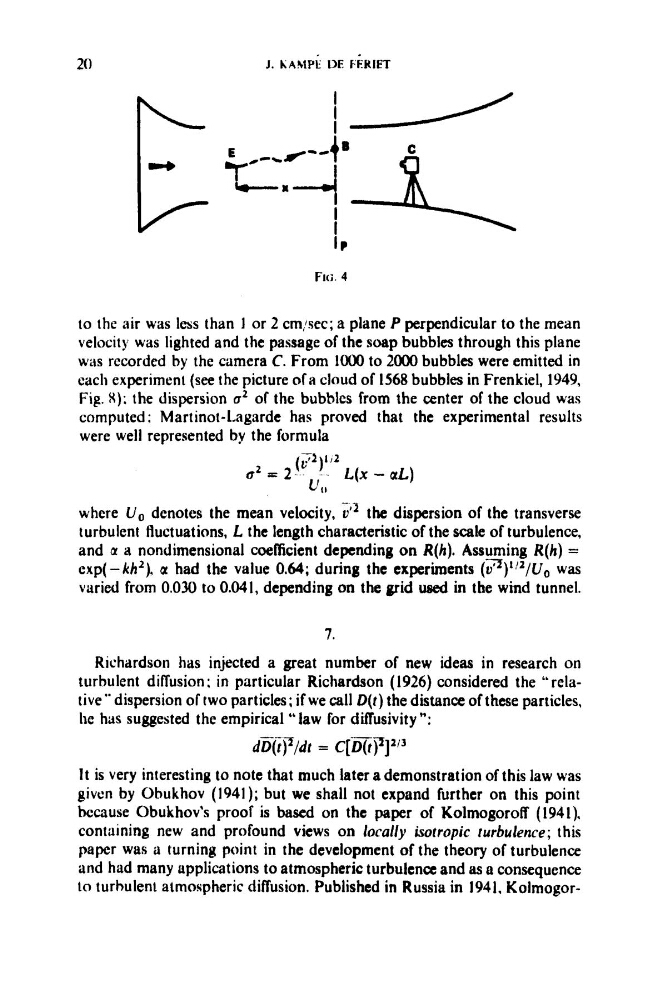
to the air was less than 1 or 2 cm;sec; a plane P perpendicular to the mean
velocity was lighted and the passage of the soap bubbles through this plane
w a s recorded by the camera C. From lo00 to 2000 bubbles were emitted in
each experiment (see the picture ofa cloud of 1568 bubbles in Frenkiel, 1949,
Fig. 8 ) : the dispersion a2 of the bubbles from the center of the cloud was
computed: Martinot-Lagarde has proved that the experimental results
were well represented by the formula
( p p z
u2 = 2 . - - - L(x - a L )
L',,
where U o denotes the mean velocity, ?' the dispersion of the transverse
turbulent fluctuations, L the length characteristic of the scale of turbulence,
and m a nondimensional coefficient depending on R(h). Assuming R(h) =
exp( -kh2). a had the value 0.64; during the experiments (?)"'/U0 was
varied from 0.OM to 0.041, depending on the grid used in the wind tunnel.
7.
Richardson has injected a great number of new ideas in research on
tiirbulent diffusion; in particular Richardson (1926) considered the "relative" dispersion of two particles; if we call D(r) the distance of these particles,
he has suggested the empirical "law for diffusivity '*:
dS(iY/df = C[*jyJ
It is very interesting to note that much later a demonstration of this law was
given by Obukhov (1941); but we shall not expand further on this point
because Obukhov's proof is based on the paper of KolmogoroR (1941).
containing new and profound views on locally isompic rurbulence; this
paper was a turning point in the development of the theory of turbulence
and had many applications to atmospheric turbulence and as a consequence
to turbulent atmospheric diffusion. Published in Russia in 1941. Kolmogor-
J. YAMPk DE FhHlET
to the air was less than 1 or 2 cm;sec; a plane P perpendicular to the mean
velocity was lighted and the passage of the soap bubbles through this plane
w a s recorded by the camera C. From lo00 to 2000 bubbles were emitted in
each experiment (see the picture ofa cloud of 1568 bubbles in Frenkiel, 1949,
Fig. 8 ) : the dispersion a2 of the bubbles from the center of the cloud was
computed: Martinot-Lagarde has proved that the experimental results
were well represented by the formula
( p p z
u2 = 2 . - - - L(x - a L )
L',,
where U o denotes the mean velocity, ?' the dispersion of the transverse
turbulent fluctuations, L the length characteristic of the scale of turbulence,
and m a nondimensional coefficient depending on R(h). Assuming R(h) =
exp( -kh2). a had the value 0.64; during the experiments (?)"'/U0 was
varied from 0.OM to 0.041, depending on the grid used in the wind tunnel.
7.
Richardson has injected a great number of new ideas in research on
tiirbulent diffusion; in particular Richardson (1926) considered the "relative" dispersion of two particles; if we call D(r) the distance of these particles,
he has suggested the empirical "law for diffusivity '*:
dS(iY/df = C[*jyJ
It is very interesting to note that much later a demonstration of this law was
given by Obukhov (1941); but we shall not expand further on this point
because Obukhov's proof is based on the paper of KolmogoroR (1941).
containing new and profound views on locally isompic rurbulence; this
paper was a turning point in the development of the theory of turbulence
and had many applications to atmospheric turbulence and as a consequence
to turbulent atmospheric diffusion. Published in Russia in 1941. Kolmogor-