

19
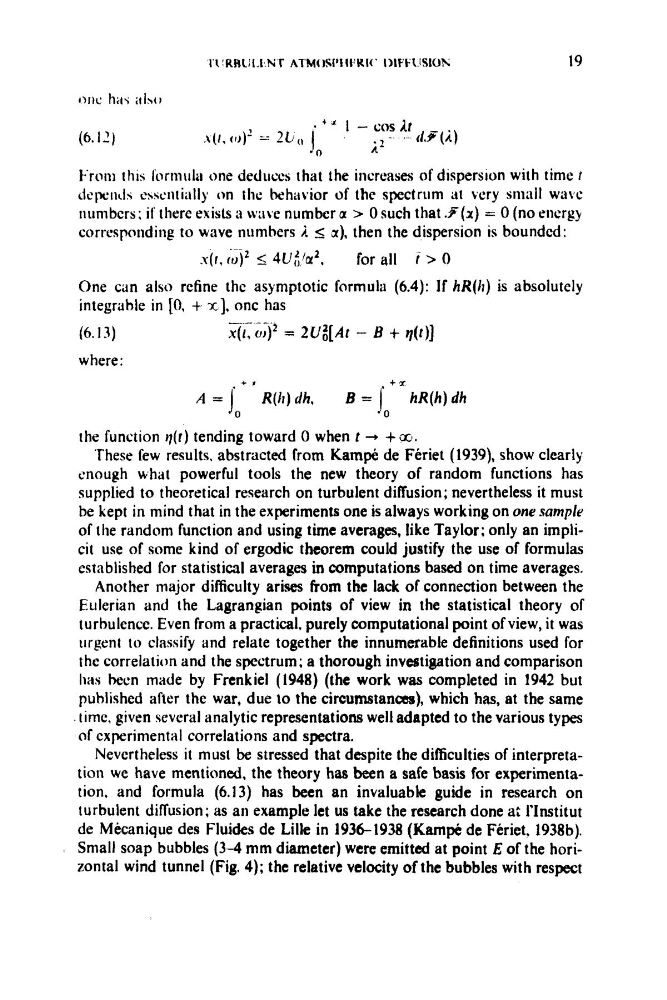
(6.12)
Froni this lorriiula one deduces that the increases of dispersion with time f
~lt'pcii~ls ~ b ~ ~ ~ ~ t i i i l l )
on the hehirvior of the spectrum a1 very SIIXII~ WiiVC
iiiirnbcrs: if' there exists ii wave number D > 0 such that .F((r) = 0 (no energy
corresponding to wave numbers i 5 a), then the dispersion is bounded:
x(r,
I 4u:,/a2.
for ail i > o
One can also refine the asymptotic formula (6.4): If hR(lt) is absolutely
integrablc in [O, + x ] , onc has
- __. .
(6.13)
X ( 1 , 0 ) ) 2 = 2 [ / : [ A l - B + ?&)I
where:
+ ,
+ *
A = jo R(h) dh. B = jo hR(h)dh
the function q ( r ) tending toward 0 when t + + 5 .
'These few results. abstracted from Kampi: de Feriet (1939), show clearly
cnough what powerful tools the new theory of random functions has
supplied to theoretical research on turbulent diffusion; nevertheless it must
be kept in mind that in the experiments one is always working on one sample
of the random function and using time averages, like Taylor; only an implicit use of some kind of ergodic theorem could justify the use of formulas
established for statistical averages in computations based on time averages.
Another major difficulty arises from the lack of connection between the
Eulerian and the Lagrangian points of view in the statistical theory of
turbulence. Even from a practical, purely computational point of view, it was
urgent to classify and relate together the innumerable definitions used for
the correlation and the spectrum; a thorough investigation and comparison
hiis been made by Frenkiel (1948) (the work was completed in 1942 but
published after thc war, due to the circumstances), which has, at the same
timc, given several analytic representations well adapted to the various types
of cxperiniental correlations and spectra.
Nevertheless it must be stressed that despite the dificulties of interpretation we have mentioned, the theory has been a safe basis for experimentation, and formula (6.13) has been an invaluable guide in research on
turbulent diffusion; as an example let us take the research done at I'Institut
de Mecanique des Fluides de Lille in 19361938 (Kampk de Feriet. 1938b).
Small soap bubbles (3-4 mm diameter) were emitted at point E of the horizontal wind tunnel (Fig. 4); the relative velocity of the bubbles with respect
(6.12)
Froni this lorriiula one deduces that the increases of dispersion with time f
~lt'pcii~ls ~ b ~ ~ ~ ~ t i i i l l )
on the hehirvior of the spectrum a1 very SIIXII~ WiiVC
iiiirnbcrs: if' there exists ii wave number D > 0 such that .F((r) = 0 (no energy
corresponding to wave numbers i 5 a), then the dispersion is bounded:
x(r,
I 4u:,/a2.
for ail i > o
One can also refine the asymptotic formula (6.4): If hR(lt) is absolutely
integrablc in [O, + x ] , onc has
- __. .
(6.13)
X ( 1 , 0 ) ) 2 = 2 [ / : [ A l - B + ?&)I
where:
+ ,
+ *
A = jo R(h) dh. B = jo hR(h)dh
the function q ( r ) tending toward 0 when t + + 5 .
'These few results. abstracted from Kampi: de Feriet (1939), show clearly
cnough what powerful tools the new theory of random functions has
supplied to theoretical research on turbulent diffusion; nevertheless it must
be kept in mind that in the experiments one is always working on one sample
of the random function and using time averages, like Taylor; only an implicit use of some kind of ergodic theorem could justify the use of formulas
established for statistical averages in computations based on time averages.
Another major difficulty arises from the lack of connection between the
Eulerian and the Lagrangian points of view in the statistical theory of
turbulence. Even from a practical, purely computational point of view, it was
urgent to classify and relate together the innumerable definitions used for
the correlation and the spectrum; a thorough investigation and comparison
hiis been made by Frenkiel (1948) (the work was completed in 1942 but
published after thc war, due to the circumstances), which has, at the same
timc, given several analytic representations well adapted to the various types
of cxperiniental correlations and spectra.
Nevertheless it must be stressed that despite the dificulties of interpretation we have mentioned, the theory has been a safe basis for experimentation, and formula (6.13) has been an invaluable guide in research on
turbulent diffusion; as an example let us take the research done at I'Institut
de Mecanique des Fluides de Lille in 19361938 (Kampk de Feriet. 1938b).
Small soap bubbles (3-4 mm diameter) were emitted at point E of the horizontal wind tunnel (Fig. 4); the relative velocity of the bubbles with respect