

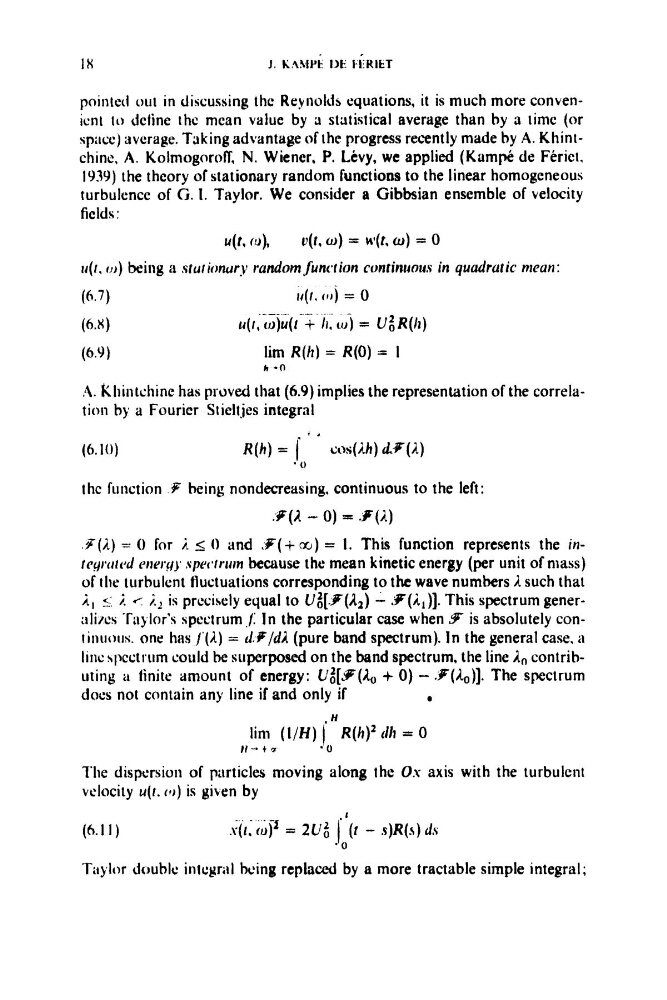
pointed out in discussing the Reynolds equations, it is much more convenicnt to define the mean value by a statistical average than by a time (or
sp;ice) average. Taking advantage of the progress recently made by A. Khintchinc, A. Kolmogoroff, N. Wiener, P. Levy, we applied (Kumpk de Feriet,
1939) the theory of stationary random functions to the linear homogeneous
turbulencc of G . 1. Taylor. We consider a Gibbsian ensemble of velocity
fields:
u(r. m)*
o(r. 0 ) = "(f. w) = 0
I/(/. (1)) being it slul ioncrry random function conrintrous in quadruric mean:
(6.7)
I4(/. (11) = 0
.(6.8)
~ ( t ,
co)u(f + h. w ) = U:R(k)
lim R(h) = N O ) = 1
h - 0
A. kliintchine has proved that (6.9) implies the representation of the correlation by a Fourier Stieltjes integral
(6.10)
thc function .F being nondecreasing, continuous to the left:
.,F(A - 0) = :F(I)
.9(1) =- 0 for E. I 0 and ;F(+m) = 1. This function represents the intcgrtrird merqj ,SpW/rltItI because the mean kinetic energy (per unit of mass)
of the turbulent fluctuations corresponding to the wave numbers I such that
i, I
: j. 0 i , is preciscly equal to U $ [ 9 ( 1 , ) - .F(i,)]. This spectrum genera l i m T;tylor's spectrum ,I: In the particular case when 9 is absolutely continuous. one has \'(A) = d.F/dA (pure band spectrum). In the general case. ii
linc spectrum could be superposed on the band spectrum. the line 1, contributing u finite amount of energy: L'b[S(Ao + 0) - .F(&)]. The spectrum
does not contain any line if and only if
lim (1/H) I R(h)' clk = 0
. H
I f - t u
' 0
The dispersion of piirticles moving along the 0.u axis with the turbulent
velocity u(t. ( I ) ) is given by
(6. I I )
Tiiylijr double intopriIl k i n g replaced by n more tractable simple integral;
sp;ice) average. Taking advantage of the progress recently made by A. Khintchinc, A. Kolmogoroff, N. Wiener, P. Levy, we applied (Kumpk de Feriet,
1939) the theory of stationary random functions to the linear homogeneous
turbulencc of G . 1. Taylor. We consider a Gibbsian ensemble of velocity
fields:
u(r. m)*
o(r. 0 ) = "(f. w) = 0
I/(/. (1)) being it slul ioncrry random function conrintrous in quadruric mean:
(6.7)
I4(/. (11) = 0
.(6.8)
~ ( t ,
co)u(f + h. w ) = U:R(k)
lim R(h) = N O ) = 1
h - 0
A. kliintchine has proved that (6.9) implies the representation of the correlation by a Fourier Stieltjes integral
(6.10)
thc function .F being nondecreasing, continuous to the left:
.,F(A - 0) = :F(I)
.9(1) =- 0 for E. I 0 and ;F(+m) = 1. This function represents the intcgrtrird merqj ,SpW/rltItI because the mean kinetic energy (per unit of mass)
of the turbulent fluctuations corresponding to the wave numbers I such that
i, I
: j. 0 i , is preciscly equal to U $ [ 9 ( 1 , ) - .F(i,)]. This spectrum genera l i m T;tylor's spectrum ,I: In the particular case when 9 is absolutely continuous. one has \'(A) = d.F/dA (pure band spectrum). In the general case. ii
linc spectrum could be superposed on the band spectrum. the line 1, contributing u finite amount of energy: L'b[S(Ao + 0) - .F(&)]. The spectrum
does not contain any line if and only if
lim (1/H) I R(h)' clk = 0
. H
I f - t u
' 0
The dispersion of piirticles moving along the 0.u axis with the turbulent
velocity u(t. ( I ) ) is given by
(6. I I )
Tiiylijr double intopriIl k i n g replaced by n more tractable simple integral;