

17
~ ( t )
= i ( r - ro),
y ( t ) = 0.
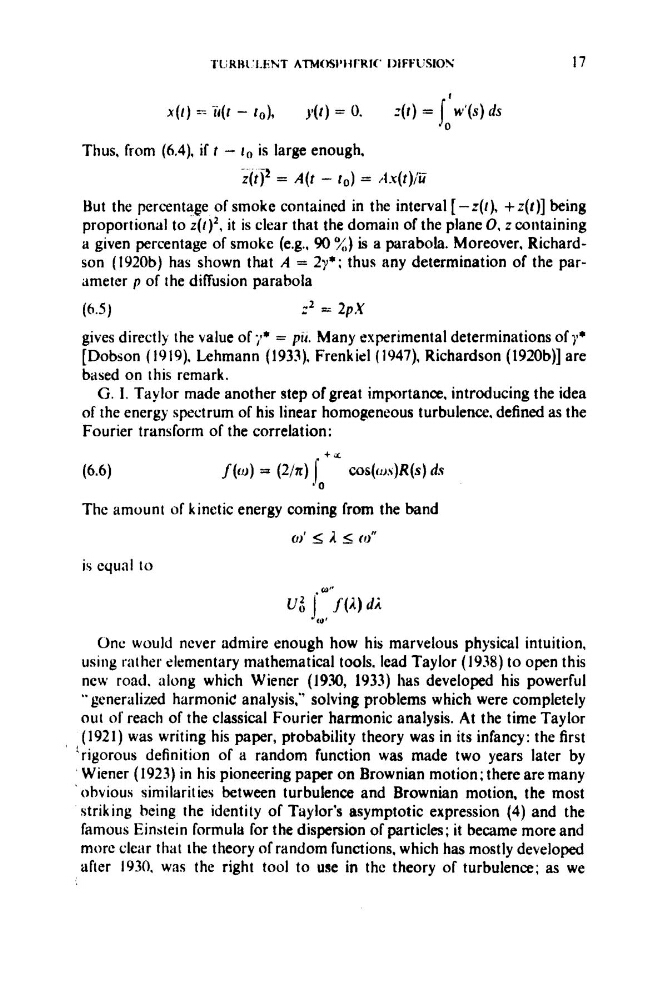
Thus, from (6.4), if t - l o is large enough,
z(r) = ( w ' ( s ) ds
z(tj2 = ~ ( t
- t o ) = ,l.K(r)ii
But the perc~ntage of smoke contained in the interval [ -r(/), + z ( t ) ] being
proportional to ~ ( r ) ~ ,
it is clear that the domain of the plane 0, z containing
a given percentage of smoke (e.g., 90 2,) is a parabola. Moreover, Richardson (1920b) has shown that A = 2y*; thus any determination of the parameter p of the diffusion parabola
(6.5)
=2 = ; 2 p x
gives directly the value of ;' * = fir. Many experimental determinations of y*
[Dobson (1919). Lehmann (1933). Frenkizl (1947). Richardson (1920b)l are
based on this remark.
G. 1. Taylor made another step of great importance, introducing the idea
of the energy spectrum of his linear homogeneous turbulence. defined as the
Fourier transform of the correlation:
+ X
f(w) = (2/n) 1 cos(tu.\)R(s) d.*
The amount of kinetic energy coming from the band
0
(6.6)
0)' 5 1 5 (U"
i5 equal to
0"
u: lo, f'(4 d i
One would never admire enough how his marvelous physical intuition,
using rather elementary mathematical tools, lead Taylor (1938) to open this
new road. along which Wiener (19.30, 1933) has developed his powerful
' . generalized harmonid analysis," solving problems which were completely
out ol' reach of the classical Fourier harmonic analysis. At the time Taylor
(1921) was writing his paper, ptobability theory was in its infancy: the first
'rigorous definition of a random function was made two years later by
Wiener (1923) in his pioneering paper on Brownian motion; there are many
~
obvious similarities between turbulence and Brownian motion, the most
striking being the identity of Taylor's asymptotic expression (4) and the
famous Einstein formula for the dispersion of particles; it became more and
more clear that the theory of random functions. which has mostly developed
after 1930. was the right tool to use in the theory of turbulence; as we
' ,
~ ( t )
= i ( r - ro),
y ( t ) = 0.
Thus, from (6.4), if t - l o is large enough,
z(r) = ( w ' ( s ) ds
z(tj2 = ~ ( t
- t o ) = ,l.K(r)ii
But the perc~ntage of smoke contained in the interval [ -r(/), + z ( t ) ] being
proportional to ~ ( r ) ~ ,
it is clear that the domain of the plane 0, z containing
a given percentage of smoke (e.g., 90 2,) is a parabola. Moreover, Richardson (1920b) has shown that A = 2y*; thus any determination of the parameter p of the diffusion parabola
(6.5)
=2 = ; 2 p x
gives directly the value of ;' * = fir. Many experimental determinations of y*
[Dobson (1919). Lehmann (1933). Frenkizl (1947). Richardson (1920b)l are
based on this remark.
G. 1. Taylor made another step of great importance, introducing the idea
of the energy spectrum of his linear homogeneous turbulence. defined as the
Fourier transform of the correlation:
+ X
f(w) = (2/n) 1 cos(tu.\)R(s) d.*
The amount of kinetic energy coming from the band
0
(6.6)
0)' 5 1 5 (U"
i5 equal to
0"
u: lo, f'(4 d i
One would never admire enough how his marvelous physical intuition,
using rather elementary mathematical tools, lead Taylor (1938) to open this
new road. along which Wiener (19.30, 1933) has developed his powerful
' . generalized harmonid analysis," solving problems which were completely
out ol' reach of the classical Fourier harmonic analysis. At the time Taylor
(1921) was writing his paper, ptobability theory was in its infancy: the first
'rigorous definition of a random function was made two years later by
Wiener (1923) in his pioneering paper on Brownian motion; there are many
~
obvious similarities between turbulence and Brownian motion, the most
striking being the identity of Taylor's asymptotic expression (4) and the
famous Einstein formula for the dispersion of particles; it became more and
more clear that the theory of random functions. which has mostly developed
after 1930. was the right tool to use in the theory of turbulence; as we
' ,