

MIXING RATE AND TEMPERATURE IN STRATIFIED WATERS
345
far as the density structure can be determined from the temperature
observations.
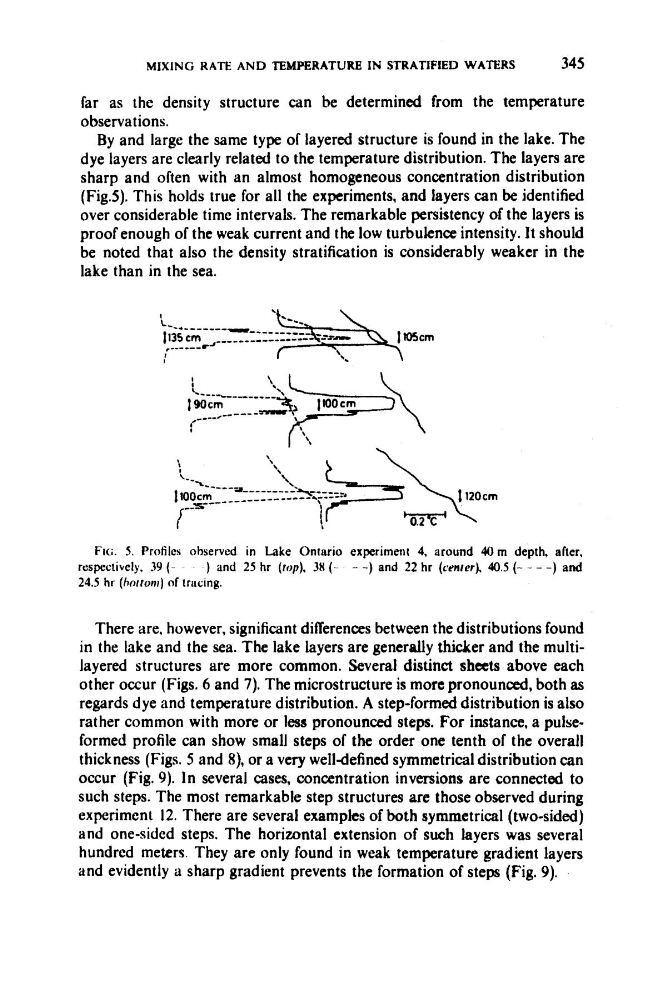
By and large the same type of layered structure is found in the lake. The
dye layers are clearly related to the temperature distribution. The layers are
sharp and often with an almost homogeneous concentration distribution
(Fig.5). This holds true for all the experiments, and layers can be identified
over considerable time intervals. The remarkable persistency of the layers is
proof enough of the weak current and the low turbulence intensity. It should
be noted that also the density stratification is considerably weaker in the
lake than in the sea.
FIG. S. Profiles observed in Lake Ontario experiment 4, around 40m depth, after,
- -) and 22 hr (center), 40.5 (- - - -) and
respectively, 39 (
24.5 hr ( h o r r m ) of tracing.
) and 25 hr (rop), 38 (
There are. however, significant differences between the distributions found
in the lake and the sea. The lake layers are generally thicker and the multilayered structures are more common. Several distinct sheets above each
other occur (Figs, 6 and 7). The microstructure is more pronounced, both as
regards dye and temperature distribution. A step-formed distribution is also
rather common with more or less pronounced steps. For instance, a pulseformed profile can show small steps of the order one tenth of the overall
thickness (Figs. 5 and 8), or a very well-defined symmetrical distribution can
occur (Fig. 9). In several cases, concentration inversions are connected to
such steps. The most remarkable step structures are those observed during
experiment 12. There are several examples of both symmetrical (two-sided)
and one-sided steps. The horizontal extension of such layers was several
hundred meters. They are only found in weak temperature gradient layers
and evidently a sharp gradient prevents the formation of steps (Fig. 9).
345
far as the density structure can be determined from the temperature
observations.
By and large the same type of layered structure is found in the lake. The
dye layers are clearly related to the temperature distribution. The layers are
sharp and often with an almost homogeneous concentration distribution
(Fig.5). This holds true for all the experiments, and layers can be identified
over considerable time intervals. The remarkable persistency of the layers is
proof enough of the weak current and the low turbulence intensity. It should
be noted that also the density stratification is considerably weaker in the
lake than in the sea.
FIG. S. Profiles observed in Lake Ontario experiment 4, around 40m depth, after,
- -) and 22 hr (center), 40.5 (- - - -) and
respectively, 39 (
24.5 hr ( h o r r m ) of tracing.
) and 25 hr (rop), 38 (
There are. however, significant differences between the distributions found
in the lake and the sea. The lake layers are generally thicker and the multilayered structures are more common. Several distinct sheets above each
other occur (Figs, 6 and 7). The microstructure is more pronounced, both as
regards dye and temperature distribution. A step-formed distribution is also
rather common with more or less pronounced steps. For instance, a pulseformed profile can show small steps of the order one tenth of the overall
thickness (Figs. 5 and 8), or a very well-defined symmetrical distribution can
occur (Fig. 9). In several cases, concentration inversions are connected to
such steps. The most remarkable step structures are those observed during
experiment 12. There are several examples of both symmetrical (two-sided)
and one-sided steps. The horizontal extension of such layers was several
hundred meters. They are only found in weak temperature gradient layers
and evidently a sharp gradient prevents the formation of steps (Fig. 9).