

344
GUN N AR K U LLENBERG
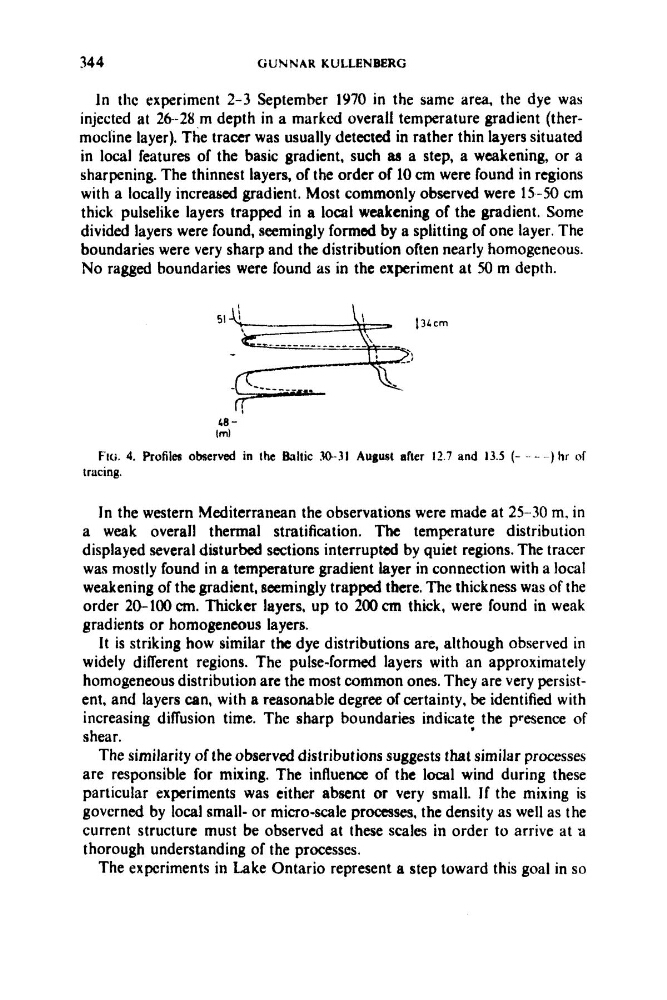
I n the experiment 2-3 September 1970 in the same area, the dye was
injected at 26-28 m depth in a marked overall temperature gradient (thermocline layer). The tracer was usually detected in rather thin layers situated
in local features of the basic gradient, such as a step, a wakening, or a
sharpening. The thinnest layers, of the order of 10 cm were found in regions
with a locally increased gradient. Most commonly observed were 15-50 cm
thick pulselike layers trapped in a local weakening of the gradient. Some
divided layers were found, seemingly formed by a splitting of one layer. The
boundaries were very sharp and the distribution often nearly homogeneous.
No ragged boundaries were found as in the experiment at 50 m depth.
L6 -
Im)
FIG. 4. Profiles observed in the Baltic .30-31 August after 12.7 and 13.5 (- '.. - -) hr of
tracing.
In the western Mediterranean the observations were made at 25-.30 m. in
a weak overall thermal stratification. The temperature distribution
displayed several disturbed sections interrupted by quiet regions. The tracer
was mostly found in a temperature gradient layer in connection with a local
weakening of the gradient, seemingly trapped there. The thickness was of the
order 20-100cm. Thicker layers, up to 200cm thick, were found in weak
gradients or homogeneous layers.
It is striking how similar the dye distributions are, although observed in
widely different regions. The p u l s e - f o r d layers with an approximately
homogeneous distribution are the most common ones. They are very persistent, and layers can, with a reasonable degree of certainty, be identified with
increasing diffusion time. The sharp boundaries indicate the presence of
shear.
The similarity of the observed distributions suggests that similar processes
are responsible for mixing. The influence of the local wind during these
particular experiments was either absent or very small. If the mixing is
governed by local small- or micro-scale processes. the density as well as the
current structure must be observed at these scales in order to arrive at a
thorough understanding of the processes.
The experiments in Lake Ontario represent a step toward this goal in so
.
GUN N AR K U LLENBERG
I n the experiment 2-3 September 1970 in the same area, the dye was
injected at 26-28 m depth in a marked overall temperature gradient (thermocline layer). The tracer was usually detected in rather thin layers situated
in local features of the basic gradient, such as a step, a wakening, or a
sharpening. The thinnest layers, of the order of 10 cm were found in regions
with a locally increased gradient. Most commonly observed were 15-50 cm
thick pulselike layers trapped in a local weakening of the gradient. Some
divided layers were found, seemingly formed by a splitting of one layer. The
boundaries were very sharp and the distribution often nearly homogeneous.
No ragged boundaries were found as in the experiment at 50 m depth.
L6 -
Im)
FIG. 4. Profiles observed in the Baltic .30-31 August after 12.7 and 13.5 (- '.. - -) hr of
tracing.
In the western Mediterranean the observations were made at 25-.30 m. in
a weak overall thermal stratification. The temperature distribution
displayed several disturbed sections interrupted by quiet regions. The tracer
was mostly found in a temperature gradient layer in connection with a local
weakening of the gradient, seemingly trapped there. The thickness was of the
order 20-100cm. Thicker layers, up to 200cm thick, were found in weak
gradients or homogeneous layers.
It is striking how similar the dye distributions are, although observed in
widely different regions. The p u l s e - f o r d layers with an approximately
homogeneous distribution are the most common ones. They are very persistent, and layers can, with a reasonable degree of certainty, be identified with
increasing diffusion time. The sharp boundaries indicate the presence of
shear.
The similarity of the observed distributions suggests that similar processes
are responsible for mixing. The influence of the local wind during these
particular experiments was either absent or very small. If the mixing is
governed by local small- or micro-scale processes. the density as well as the
current structure must be observed at these scales in order to arrive at a
thorough understanding of the processes.
The experiments in Lake Ontario represent a step toward this goal in so
.