

334
JACQUES C . J. NIHOUL
S represents the shear effect, Q is thc mean flux of suspended particles. which
depends essentially on the flux at the free surface-if any-and on the deposition on the bottom. It is observed that when the friction velocity at the
bottom exceeds a critical value u,, the laminar boundary layer is disrupted
and some of the sedimanting particles are ejectad in the fluid above. When
the friction velocity exceeds a further critical value u+,, the flow is able to
erode the bottom and more material is returned to the water column. Near
the coast, waves arc reported to have an important action on the processes
of deposition and erosion.
It is assumed here that Q is known from sedimentation analysis. Expressions of Q appropriate to numerical modelling can be found in Nihoul(l973)
with a discussion of the empirical formulas widely used in coastal
engineering.
4. SHEAR EFFECT
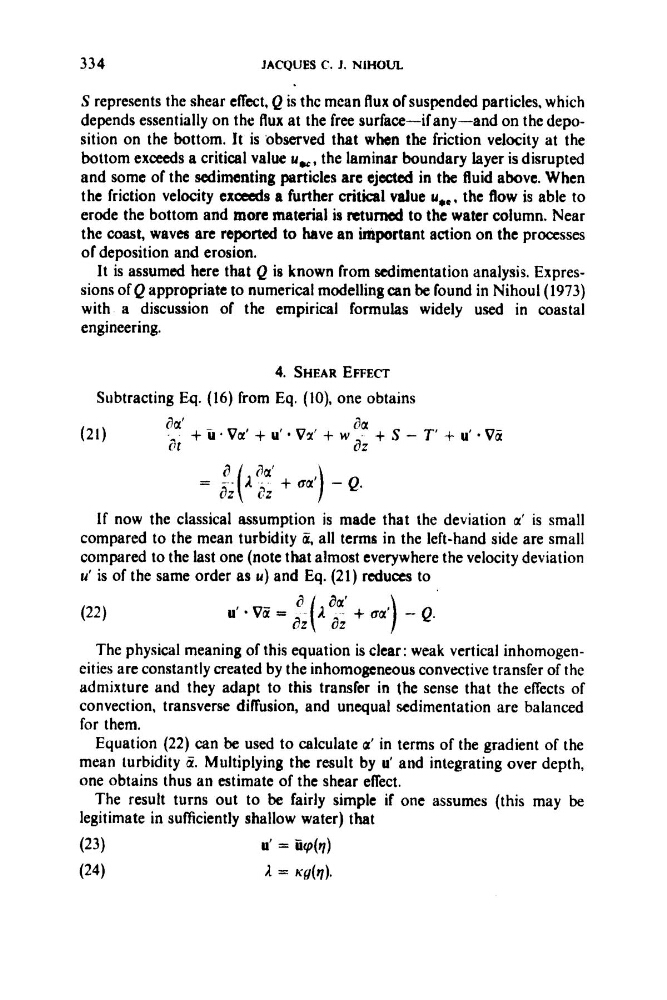
Subtracting Eq. (16) from Eq. (lo), one obtains
da'
da
.
+ U * V U ' + I J " V Z ' + W - + S - T ' + u ' * V &
SC
dz
If now the classical assumption is made that the deviation a' is small
compared to the mean turbidity 8, all terms in the left-hand side are small
compared to the last one (note that almost everywhere the velocity deviation
u' is of the same order as u ) and Eq. (21) reduces to
The physical meaning of this equation is clear: weak vertical inhomogeneities are constantly created by the inhomogeneous convective transfer of the
admixture and they adapt to this transfer in the sense that the effects of
convection, transverse diffusion, and unequal sedimentation are balanced
for them.
Equation (22) can be used to calculate a' in terms of the gradient of the
mean turbidity Z. Multiplying the result by u' and integrating over depth,
one obtains thus an estimate of the shear effect.
The result turns out to be fairly simple if one assumes (this may be
legitimate in sumciently shallow water) that
(23)
u' = iilp(?l)
(24)
R = Kg(V)*
JACQUES C . J. NIHOUL
S represents the shear effect, Q is thc mean flux of suspended particles. which
depends essentially on the flux at the free surface-if any-and on the deposition on the bottom. It is observed that when the friction velocity at the
bottom exceeds a critical value u,, the laminar boundary layer is disrupted
and some of the sedimanting particles are ejectad in the fluid above. When
the friction velocity exceeds a further critical value u+,, the flow is able to
erode the bottom and more material is returned to the water column. Near
the coast, waves arc reported to have an important action on the processes
of deposition and erosion.
It is assumed here that Q is known from sedimentation analysis. Expressions of Q appropriate to numerical modelling can be found in Nihoul(l973)
with a discussion of the empirical formulas widely used in coastal
engineering.
4. SHEAR EFFECT
Subtracting Eq. (16) from Eq. (lo), one obtains
da'
da
.
+ U * V U ' + I J " V Z ' + W - + S - T ' + u ' * V &
SC
dz
If now the classical assumption is made that the deviation a' is small
compared to the mean turbidity 8, all terms in the left-hand side are small
compared to the last one (note that almost everywhere the velocity deviation
u' is of the same order as u ) and Eq. (21) reduces to
The physical meaning of this equation is clear: weak vertical inhomogeneities are constantly created by the inhomogeneous convective transfer of the
admixture and they adapt to this transfer in the sense that the effects of
convection, transverse diffusion, and unequal sedimentation are balanced
for them.
Equation (22) can be used to calculate a' in terms of the gradient of the
mean turbidity Z. Multiplying the result by u' and integrating over depth,
one obtains thus an estimate of the shear effect.
The result turns out to be fairly simple if one assumes (this may be
legitimate in sumciently shallow water) that
(23)
u' = iilp(?l)
(24)
R = Kg(V)*