

TlJHRlnlTY DIFFUSION BY SHEAR EFFECT
335
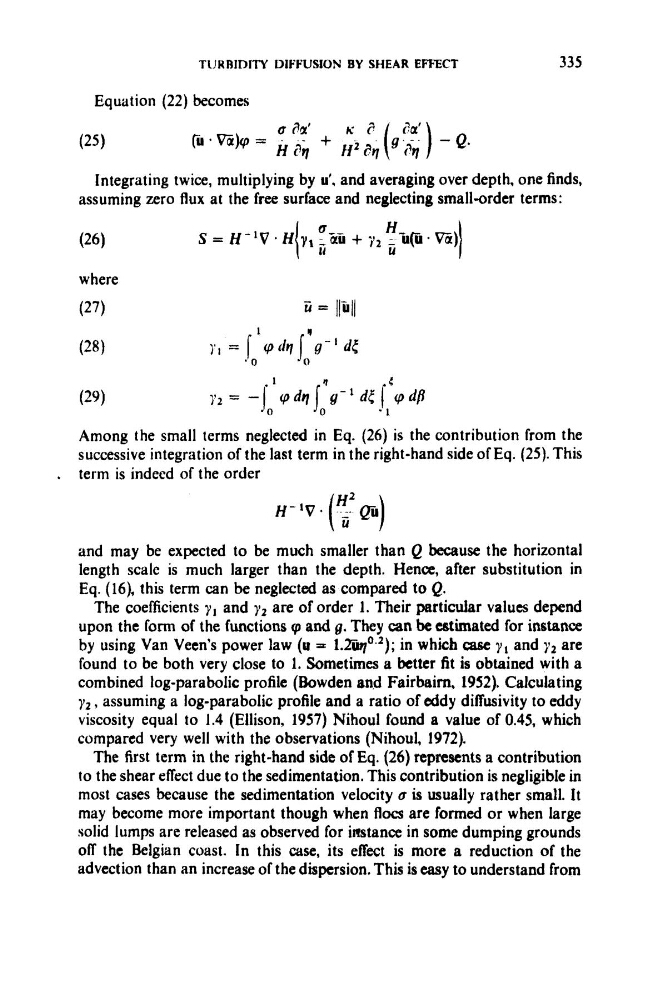
Equation (22) becomes
Integrating twice, multiplying by u'. and averaging over depth, one finds,
assuming zero flux at the free surface and neglecting small-order terms:
Among the small terms neglected in Eq. (26) is the contribution from the
successive integration of the last term in the right-hand side of Eq. (25). This
term is indeed of the order
and may be expected to be much smaller than Q because the horizontal
length scale is much larger than the depth. Hence, after substitution in
Eq. (16). this term can be neglected as compared to Q.
The coefficients y , and y2 are of order 1. Their particular values depend
upon the form of the functions cp and g. They can bc estimated for instance
by using Van Veen's power law (u = 1.Ziio,2); in which case yI and y2 are
found to be both very close to 1. Sometimes a better fit is obtained with a
combined log-parabolic profile (Bowden and Fairbairn, 1952). Calculating
y2, assuming a log-parabolic profile and a ratio of eddy diffusivity to eddy
viscosity equal to 1.4 (Ellison, 1957) Nihoul found a value of 0.45, which
compared very well with the observations (Nihoul, 1972).
The first term in the right-hand side of Eq. (26) represents a contribution
to the shear effect due to the sedimentation. This contribution is negligible in
most cases because the sedimentation velocity c is usually rather small. It
may become more important though when flocs are formed or when large
solid lumps are released as observed for instance in some dumping grounds
off the Belgian coast. In this case, its effect is more a reduction of the
advection than an increase of the dispersion. This is easy to understand from
335
Equation (22) becomes
Integrating twice, multiplying by u'. and averaging over depth, one finds,
assuming zero flux at the free surface and neglecting small-order terms:
Among the small terms neglected in Eq. (26) is the contribution from the
successive integration of the last term in the right-hand side of Eq. (25). This
term is indeed of the order
and may be expected to be much smaller than Q because the horizontal
length scale is much larger than the depth. Hence, after substitution in
Eq. (16). this term can be neglected as compared to Q.
The coefficients y , and y2 are of order 1. Their particular values depend
upon the form of the functions cp and g. They can bc estimated for instance
by using Van Veen's power law (u = 1.Ziio,2); in which case yI and y2 are
found to be both very close to 1. Sometimes a better fit is obtained with a
combined log-parabolic profile (Bowden and Fairbairn, 1952). Calculating
y2, assuming a log-parabolic profile and a ratio of eddy diffusivity to eddy
viscosity equal to 1.4 (Ellison, 1957) Nihoul found a value of 0.45, which
compared very well with the observations (Nihoul, 1972).
The first term in the right-hand side of Eq. (26) represents a contribution
to the shear effect due to the sedimentation. This contribution is negligible in
most cases because the sedimentation velocity c is usually rather small. It
may become more important though when flocs are formed or when large
solid lumps are released as observed for instance in some dumping grounds
off the Belgian coast. In this case, its effect is more a reduction of the
advection than an increase of the dispersion. This is easy to understand from