

TURBIDITY DIFFUSION BY SHEAR EFFECT
333
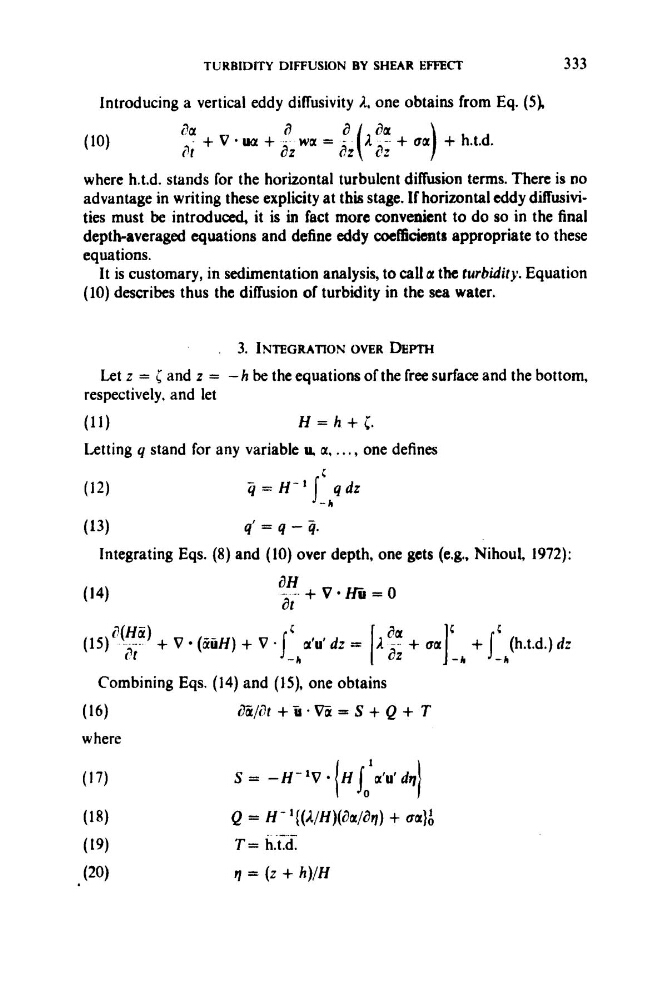
Introducing a vertical eddy diffusivity 1, one obtains from Eq. (5),
(7t
where h.t.d. stands for the horizontal turbulent diffusion terms. There is DO
advantage in writing these explicity at this stage. If horizontal eddy dflusivities must be introduced, it is in fact more convenient to do so in the final
depth-averaged equations and define eddy ooefficiants appropriate to these
equations.
It is customary, in sedimentation analysis, to call a the trtrbidity. Equation
(10) describes thus the diffusion of turbidity in the sea water.
3. INTEGRATION OVER DEPTH
Let z = i and z = - h be the equations of the free surface and the bottom,
respectively, and let
(11)
H = h + [ .
Letting q stand for any variable u, a, . . . , one defines
- y = H - ' j b q d z
- h
(12)
(13)
q' = q - ij.
Integrating Eqs. (8) and (10) over depth, one gets (e.g., Nihoul, 1972):
dH
- - + V * W u = O
at
(14)
c!(Hcl)
da
Z
(15) ?t- + V (6UH) + V .I' a'u'dz = [ A + r ~ a ] : ~
+ (h.t.d.) dz
- h
- h
Combining Eqs. (14) and (15), one obtains
(16)
where
dZ/& + b * VZ = S + Q + T
Q = H-'{(A/H)(da/2q) + aa}h
T = h i d
q = ( z + h)/H
333
Introducing a vertical eddy diffusivity 1, one obtains from Eq. (5),
(7t
where h.t.d. stands for the horizontal turbulent diffusion terms. There is DO
advantage in writing these explicity at this stage. If horizontal eddy dflusivities must be introduced, it is in fact more convenient to do so in the final
depth-averaged equations and define eddy ooefficiants appropriate to these
equations.
It is customary, in sedimentation analysis, to call a the trtrbidity. Equation
(10) describes thus the diffusion of turbidity in the sea water.
3. INTEGRATION OVER DEPTH
Let z = i and z = - h be the equations of the free surface and the bottom,
respectively, and let
(11)
H = h + [ .
Letting q stand for any variable u, a, . . . , one defines
- y = H - ' j b q d z
- h
(12)
(13)
q' = q - ij.
Integrating Eqs. (8) and (10) over depth, one gets (e.g., Nihoul, 1972):
dH
- - + V * W u = O
at
(14)
c!(Hcl)
da
Z
(15) ?t- + V (6UH) + V .I' a'u'dz = [ A + r ~ a ] : ~
+ (h.t.d.) dz
- h
- h
Combining Eqs. (14) and (15), one obtains
(16)
where
dZ/& + b * VZ = S + Q + T
Q = H-'{(A/H)(da/2q) + aa}h
T = h i d
q = ( z + h)/H