

332
JACQUEs C. J. NIHOUL
dumpings in the Belgian part of the Southern Bight release large size particles with a fairly important sedimentation velocity. The strong tides however produce high friction velocities at the bed and substantial recirculation.
In the following, the classioal theory of thc s h u v effect is extended to take
into account the rotation of the tides and thc sedimentation-recirculation
process. A simple formulation i s sought for the purpose of numerical prediction. The model appears to agree very well with experiments.
2. DIFFUSION OF TURBIDITY
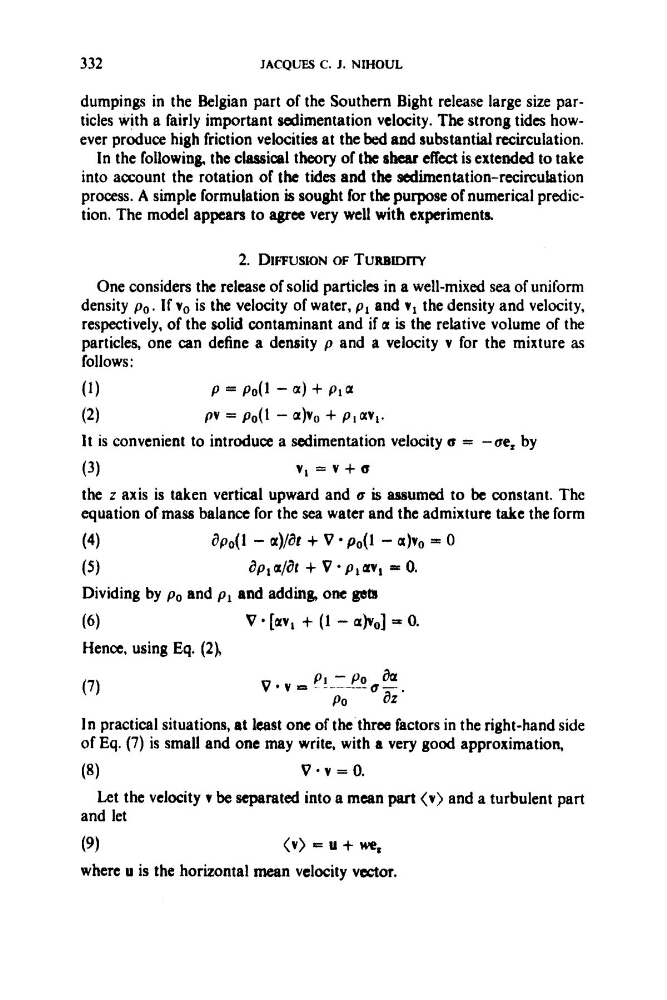
One considers the release of solid particles in a well-mixed sea of uniform
density p o . If vo is the velocity of water, p1 and v1 the density and velocity,
respectively, of the solid contaminant and if a is the relative volume of the
particles, one can define a density p and a velocity v for the mixture as
follows :
(1)
(2)
(3)
v , = v + a
P = P O ( 1 - a ) + P I E
pv = po( 1 - .)V" + pi av1.
It is convenient to introduce a sedimentation velocity CT = -be, by
the z axis is taken vertical upward and D is assumed to be constant. The
equation of mass balance for the sea water and the admixture take the form
(4)
8po( 1 - a)/& + V po( 1 - a)vo = 0
( 5 )
a p l a / i % + V * p , c r v , = O .
Dividing by po and p1 and adding, one e t a
(6)
V [avI + (1 - u)vo] = 0.
Hence, using Eq. (2),
(7)
In practical situations, at least one of the three factors in the right-hand side
of Eq. (7) is small and one may write, with a very good approximation,
(8)
v * v = o .
Let the velocity v be separated into a mean part (v) and a turbulent part
and let
(9)
(v) = u + we,
where u is the horizontal mean velocity vector.
JACQUEs C. J. NIHOUL
dumpings in the Belgian part of the Southern Bight release large size particles with a fairly important sedimentation velocity. The strong tides however produce high friction velocities at the bed and substantial recirculation.
In the following, the classioal theory of thc s h u v effect is extended to take
into account the rotation of the tides and thc sedimentation-recirculation
process. A simple formulation i s sought for the purpose of numerical prediction. The model appears to agree very well with experiments.
2. DIFFUSION OF TURBIDITY
One considers the release of solid particles in a well-mixed sea of uniform
density p o . If vo is the velocity of water, p1 and v1 the density and velocity,
respectively, of the solid contaminant and if a is the relative volume of the
particles, one can define a density p and a velocity v for the mixture as
follows :
(1)
(2)
(3)
v , = v + a
P = P O ( 1 - a ) + P I E
pv = po( 1 - .)V" + pi av1.
It is convenient to introduce a sedimentation velocity CT = -be, by
the z axis is taken vertical upward and D is assumed to be constant. The
equation of mass balance for the sea water and the admixture take the form
(4)
8po( 1 - a)/& + V po( 1 - a)vo = 0
( 5 )
a p l a / i % + V * p , c r v , = O .
Dividing by po and p1 and adding, one e t a
(6)
V [avI + (1 - u)vo] = 0.
Hence, using Eq. (2),
(7)
In practical situations, at least one of the three factors in the right-hand side
of Eq. (7) is small and one may write, with a very good approximation,
(8)
v * v = o .
Let the velocity v be separated into a mean part (v) and a turbulent part
and let
(9)
(v) = u + we,
where u is the horizontal mean velocity vector.