

14
1. IIAMPF. I X FEHIET
atmosphere. extending frequently up to 1500 m; for instance.
T ( 100 m) -- T(0) = + 10;C
Immcdiatd) after sunrise the ground. absorbing the solar radiation.
warms quickly; on the itveriige, between February 15 and March IS, thc
tempcrature increasc of the ground was 6.5 'C per hour, with a maximum of
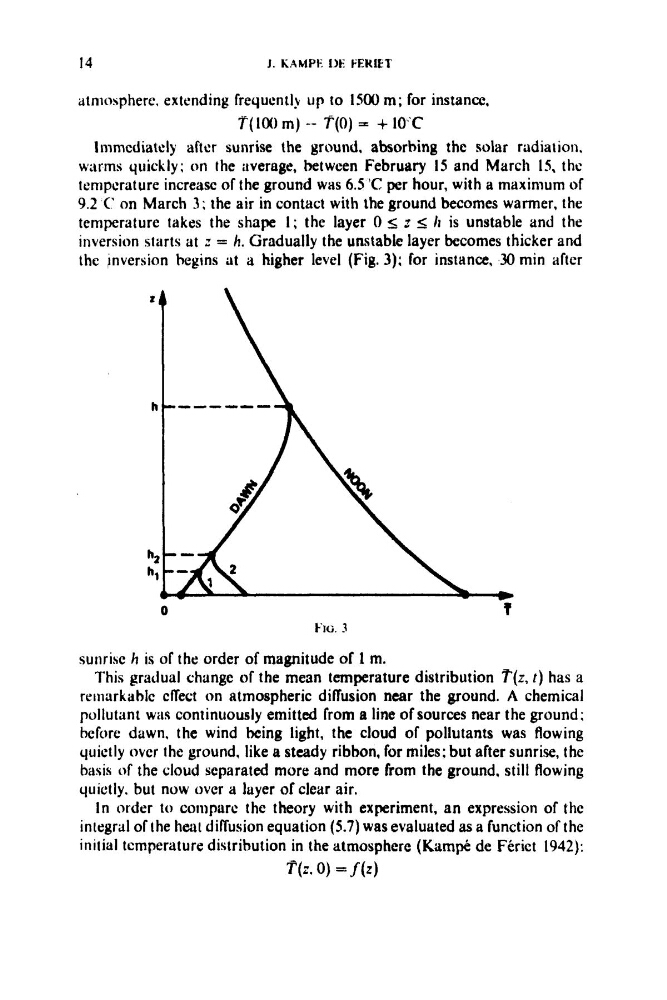
9.2 C on March 3; the air in contact with the ground becomes warmer, the
temperature takes the shape 1; the layer 0 s I I It is unstable and the
inversion starts at z = h. Gradually the unstable layer becomes thicker and
the inversion begins at a higher level (Fig. 3); for instance, 30 min aftcr
0
t
FIG. 3
sunrise h is of the order of magnitude of 1 m.
This gradual change of the mean temperature distribution 't(z, t ) has a
reinurkahlc cffect on atmospheric dinusion near the ground. A chemical
pollutant was continuously emitted from a line of sources near the ground;
before dawn, the wind king light, the cloud of pollutants was flowing
quietly over the ground, like a steady ribbon, for miles; but after sunrise, the
basis of the cloud separated more and more from the ground, still flowing
quictly. but now over a luyer of clear air.
In order to compure the theory with exjwriment, an expression of thc
integral of the h a t difbsion equation (5.7) was evaluated as a function of the
initial temperature distribution in the atmosphere (Kamp6 de Ferict 1942):
T(r. 0) = f ( z )
1. IIAMPF. I X FEHIET
atmosphere. extending frequently up to 1500 m; for instance.
T ( 100 m) -- T(0) = + 10;C
Immcdiatd) after sunrise the ground. absorbing the solar radiation.
warms quickly; on the itveriige, between February 15 and March IS, thc
tempcrature increasc of the ground was 6.5 'C per hour, with a maximum of
9.2 C on March 3; the air in contact with the ground becomes warmer, the
temperature takes the shape 1; the layer 0 s I I It is unstable and the
inversion starts at z = h. Gradually the unstable layer becomes thicker and
the inversion begins at a higher level (Fig. 3); for instance, 30 min aftcr
0
t
FIG. 3
sunrise h is of the order of magnitude of 1 m.
This gradual change of the mean temperature distribution 't(z, t ) has a
reinurkahlc cffect on atmospheric dinusion near the ground. A chemical
pollutant was continuously emitted from a line of sources near the ground;
before dawn, the wind king light, the cloud of pollutants was flowing
quietly over the ground, like a steady ribbon, for miles; but after sunrise, the
basis of the cloud separated more and more from the ground, still flowing
quictly. but now over a luyer of clear air.
In order to compure the theory with exjwriment, an expression of thc
integral of the h a t difbsion equation (5.7) was evaluated as a function of the
initial temperature distribution in the atmosphere (Kamp6 de Ferict 1942):
T(r. 0) = f ( z )