

13
The influence of the gradient of temperature
p ( z ) J --i?r/az
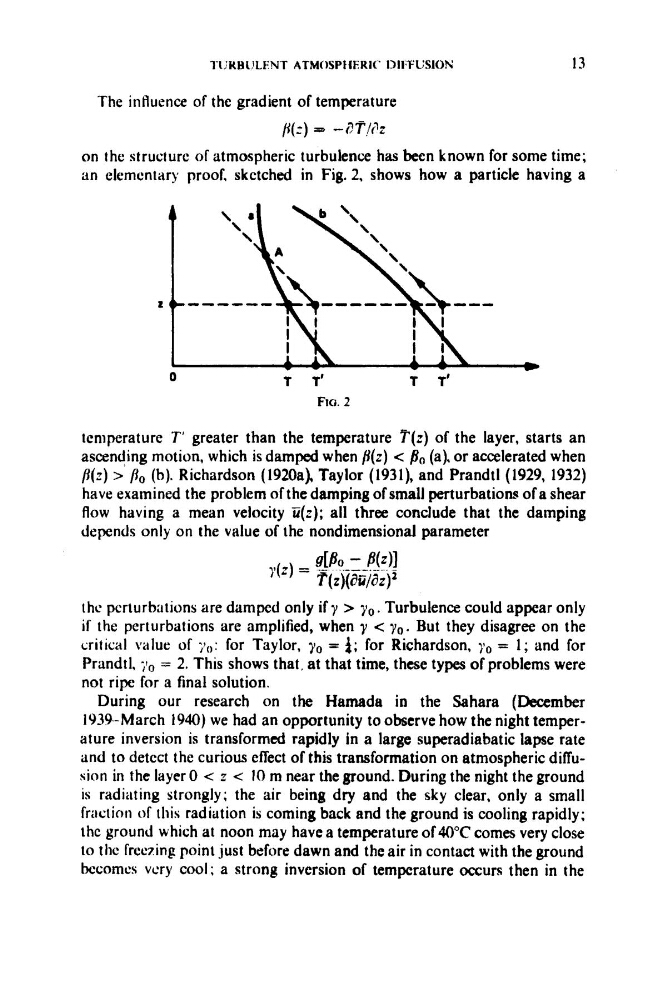
on the structure of atmospheric turbulence has been known for some time;
an elemcntary proof, skctched in Fig. 2, shows how a particle having a
T 1'
T t'
Fio. 2
temperature T' greater than the temperature T(z) of the layer, starts an
ascending motion, which is damped when p(z) < /lo (a), or accelerated when
/I(-.) > /Yo (b). Richardson (192Oah Taylor (1931), and Prandtl (1929, 1932)
have examined the problem of the damping of small perturbations of a shear
flow having a mean velocity U ( z ) ; all three conclude that the damping
depends only on the value of the nondimensional parameter
the perturbations are damped only if y > y o . Turbulence could appear only
if the perturbations are amplified, when y < yo. But they disagree on the
critical value of yo: for Taylor, yo = 4; for Richardson, yo = 1; and for
Prandtl, ;lo = 2. This shows that, at that time, these types of problems were
not ripe for a final solution.
During our research on the Hamada in the Sahara (December
1039-March 1940) we had an opportunity to observe how the night temperature inversion is transformed rapidly in a large superadiabatic lapse rate
and to detect the curious effect of this transformation on atmospheric diffusion in the layer 0 < z < 10 m near the ground. During the night the ground
is radiating strongly; the air being dry and the sky clear, only a small
fraction of this radiation is coming back and the ground is cooling rapidly;
thc ground which at noon may have a temperature of 40°C comes very close
to t he freczing point just before dawn and the air in contact with the ground
becomes vcry cool; a strong inversion of temperature occurs then in the
The influence of the gradient of temperature
p ( z ) J --i?r/az
on the structure of atmospheric turbulence has been known for some time;
an elemcntary proof, skctched in Fig. 2, shows how a particle having a
T 1'
T t'
Fio. 2
temperature T' greater than the temperature T(z) of the layer, starts an
ascending motion, which is damped when p(z) < /lo (a), or accelerated when
/I(-.) > /Yo (b). Richardson (192Oah Taylor (1931), and Prandtl (1929, 1932)
have examined the problem of the damping of small perturbations of a shear
flow having a mean velocity U ( z ) ; all three conclude that the damping
depends only on the value of the nondimensional parameter
the perturbations are damped only if y > y o . Turbulence could appear only
if the perturbations are amplified, when y < yo. But they disagree on the
critical value of yo: for Taylor, yo = 4; for Richardson, yo = 1; and for
Prandtl, ;lo = 2. This shows that, at that time, these types of problems were
not ripe for a final solution.
During our research on the Hamada in the Sahara (December
1039-March 1940) we had an opportunity to observe how the night temperature inversion is transformed rapidly in a large superadiabatic lapse rate
and to detect the curious effect of this transformation on atmospheric diffusion in the layer 0 < z < 10 m near the ground. During the night the ground
is radiating strongly; the air being dry and the sky clear, only a small
fraction of this radiation is coming back and the ground is cooling rapidly;
thc ground which at noon may have a temperature of 40°C comes very close
to t he freczing point just before dawn and the air in contact with the ground
becomes vcry cool; a strong inversion of temperature occurs then in the