

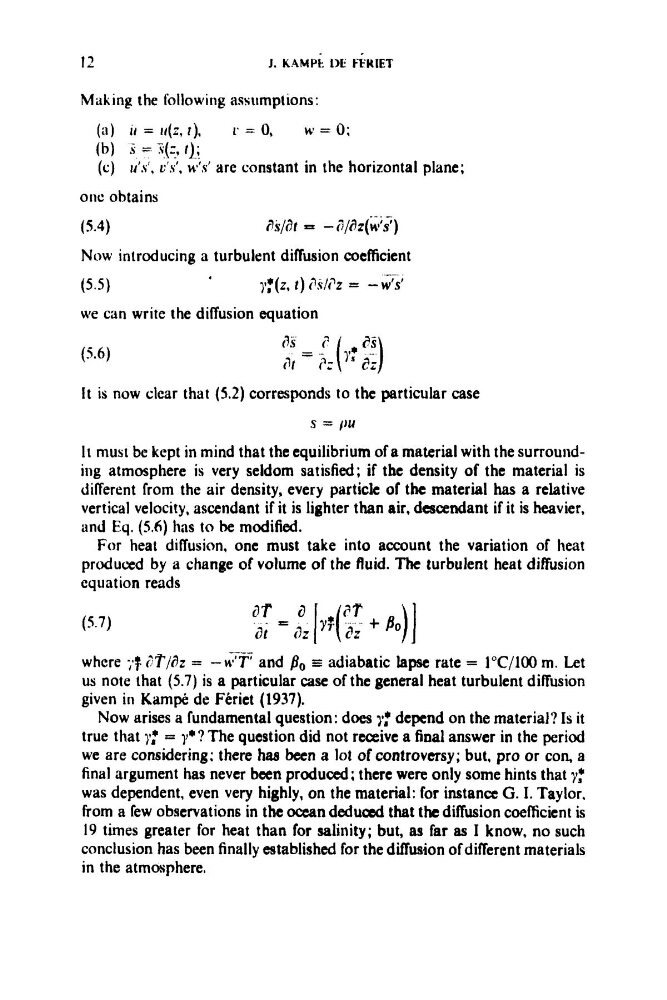
Making the following aswmplions:
(a) if = I f ( & r),
L' = 0,
w = 0;
(b) s F XI;, I);
( c ) N's', 1:'s'. W'S' are constant in the horizontal plane;
onc obtains
(5.4)
as/& = - a / i l Z ( i G )
)'f(z, t ) (7Sh'Z = - w's'
Now introducing a turbulent diffusion coefficient
( 5 . 5 )
we can write the diffusion equation
- .
(5.6)
It is now clear that (5.2) corresponds to the particular case
s = pu
11 must be kept in mind that the equilibrium of a material with the surrounding atmosphere is very seldom satisfied; if the density of the material is
different from the air density, every particle of the material has a relative
vertical velocity, ascendant if it is lighter than air, descendant if it is heavier,
and Eq. (5.6) has to be modified.
For heal diffusion, one must take into account the variation of heat
produced by a change of volume of the fluid. The turbulent heat diffusion
cquation reads
(57)
---where y$ ?T/& = -WIT' and Po = adiabatic lapse rate = l"C/lOO m. Let
us note that (5.7) is a particular case of the general heat turbulent diffusion
given in Kampi: de Fbriet (1937).
Now arises a fundamental question: does 7,' depend on the material? Is it
true that 7: = I)+? The question did not receive a final answer in the period
we are considering; there has been a lot of controversy; but, pro or con, a
final argument has never been produced; there were only some hints that yf
was dependent, even very highly, on the material: for instance G. I. Taylor,
from a few observations in the ocean deduced that the diffusion coefficient is
19 times greater for heat than for salinity; but, as far as I know, no such
conclusion has been finally established for the diffusion of different materials
in the atmosphere.
(a) if = I f ( & r),
L' = 0,
w = 0;
(b) s F XI;, I);
( c ) N's', 1:'s'. W'S' are constant in the horizontal plane;
onc obtains
(5.4)
as/& = - a / i l Z ( i G )
)'f(z, t ) (7Sh'Z = - w's'
Now introducing a turbulent diffusion coefficient
( 5 . 5 )
we can write the diffusion equation
- .
(5.6)
It is now clear that (5.2) corresponds to the particular case
s = pu
11 must be kept in mind that the equilibrium of a material with the surrounding atmosphere is very seldom satisfied; if the density of the material is
different from the air density, every particle of the material has a relative
vertical velocity, ascendant if it is lighter than air, descendant if it is heavier,
and Eq. (5.6) has to be modified.
For heal diffusion, one must take into account the variation of heat
produced by a change of volume of the fluid. The turbulent heat diffusion
cquation reads
(57)
---where y$ ?T/& = -WIT' and Po = adiabatic lapse rate = l"C/lOO m. Let
us note that (5.7) is a particular case of the general heat turbulent diffusion
given in Kampi: de Fbriet (1937).
Now arises a fundamental question: does 7,' depend on the material? Is it
true that 7: = I)+? The question did not receive a final answer in the period
we are considering; there has been a lot of controversy; but, pro or con, a
final argument has never been produced; there were only some hints that yf
was dependent, even very highly, on the material: for instance G. I. Taylor,
from a few observations in the ocean deduced that the diffusion coefficient is
19 times greater for heat than for salinity; but, as far as I know, no such
conclusion has been finally established for the diffusion of different materials
in the atmosphere.