

5.
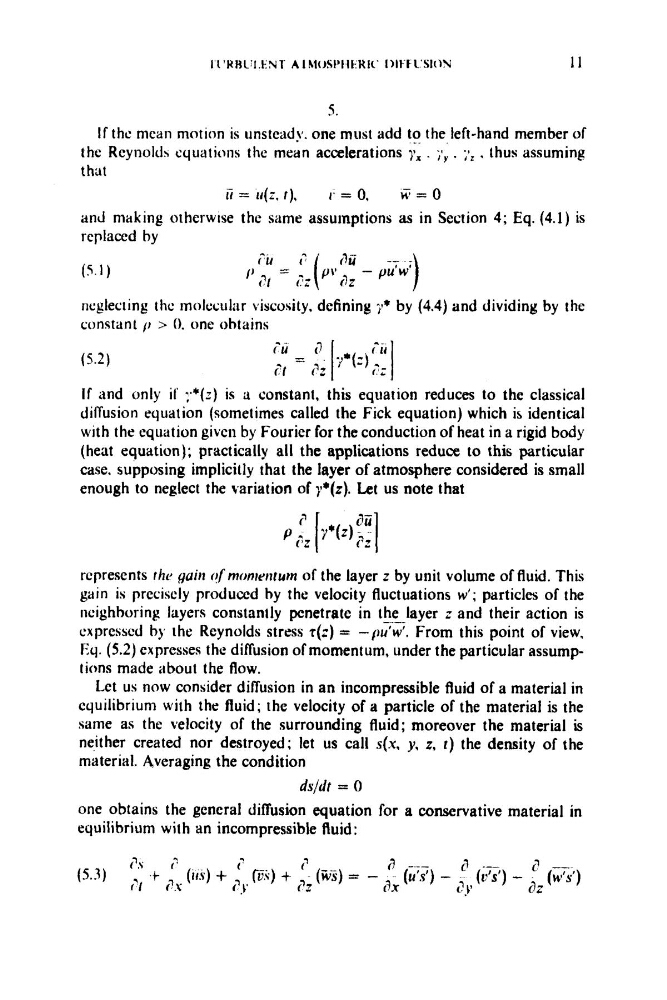
If thc mein motion is unsteady. one must add to the left-hand member of
the Reynold?, cyuations the mean accelerations 1 ;
: . y V . ;lz . thus assuming
that
and making otherwise the same assumptions as in Section 4; Eq. (4.1) is
replaced by
u = U ( Z , r),
I' = 0.
w = 0
(5.1)
ncglecting thc m~leculitr viscosity. defining ?* by (4.4) and dividing by the
constant > 0. one obtains
I f and only if :-*(z) is constant, this equation reduces to the classical
diffusion equation (sometimes called the Fick equation) which is identical
with the equation given by Fourier for the conduction of heat in a rigid body
(heat equation); practically all the applications reduce to this particular
case, supposing implicitly that the layer of atmosphere considered is small
enough to neglect the variation of y*(z). Let
represents rhr gaiii cfmonienturn of the layer
us note that
z by unit volume of fluid. This
gain is precisely produced by the velocity fluctuations w ' ; particles of the
ncighborinp layers constantly penetrate in the layer z and their action is
cxprcsscd by the Reynolds stress T(Z) = -$-7. From this point of view,
Eq. (5.2) expresses the diffusion of momentum, under the particular assumplions made about the flow.
Let us now consider diffusion in an incompressible fluid of a material in
cquilibriuni with the fluid; the velocity of a particle of the material is the
same as the velocity of the surrounding fluid; moreover the material is
neither created nor destroyed; let us call s(s, y, z, r ) the density of the
material. Averaging the condition
ds/dt = 0
one obtains the general diffusion equation for a conservative material in
equilibrium with an incompressible Ruid:
If thc mein motion is unsteady. one must add to the left-hand member of
the Reynold?, cyuations the mean accelerations 1 ;
: . y V . ;lz . thus assuming
that
and making otherwise the same assumptions as in Section 4; Eq. (4.1) is
replaced by
u = U ( Z , r),
I' = 0.
w = 0
(5.1)
ncglecting thc m~leculitr viscosity. defining ?* by (4.4) and dividing by the
constant > 0. one obtains
I f and only if :-*(z) is constant, this equation reduces to the classical
diffusion equation (sometimes called the Fick equation) which is identical
with the equation given by Fourier for the conduction of heat in a rigid body
(heat equation); practically all the applications reduce to this particular
case, supposing implicitly that the layer of atmosphere considered is small
enough to neglect the variation of y*(z). Let
represents rhr gaiii cfmonienturn of the layer
us note that
z by unit volume of fluid. This
gain is precisely produced by the velocity fluctuations w ' ; particles of the
ncighborinp layers constantly penetrate in the layer z and their action is
cxprcsscd by the Reynolds stress T(Z) = -$-7. From this point of view,
Eq. (5.2) expresses the diffusion of momentum, under the particular assumplions made about the flow.
Let us now consider diffusion in an incompressible fluid of a material in
cquilibriuni with the fluid; the velocity of a particle of the material is the
same as the velocity of the surrounding fluid; moreover the material is
neither created nor destroyed; let us call s(s, y, z, r ) the density of the
material. Averaging the condition
ds/dt = 0
one obtains the general diffusion equation for a conservative material in
equilibrium with an incompressible Ruid: