

ol' the Ilow of air was cxccptionally good, the boundary conditions on the
ground bcitip unil'orm over a great distance. The influence of the temperature gradient over the mcm velocity profile was clearly marked. The logarithmic law was well verified when the temperature gradient was
overadiabatic > Po. During the strong temperature inversions occurring
before dawn (due to the intense radiation of the ground), there was no mean
velocity profile at all; the wind velocity at z = 1 m could be much greater.
during several minutes, than the velocity at 2 = 10m. The exchanges
between two contiguous layers being promptly damped, each layer was
flowing independently of the others.
As a rule the experimental values of ; "( : )
are deduced from the observed
mean velocity profile U(;) through (4.5); I know few computations of u;~'
from the recordings of 14' and HI'. In Gihlett (1932) there is quite a number of
results giving the mean value 7: of ~ ' ( z ) for the layer less than 150 ft above
the ground. A statistical table summarizes the average values of y:, tabulated as a function of the mean temperature gradient p and the mean wind
velocity U at 150 ft. For high wind velocities (25-29; mi/hr), y: is not very
sensitive to b; on the contrary for low wind velocities (10-14mi/hr). 7:
decreases in the ratio of 1/50 when changes from superadiabatic to an
invcrsion.
is a fuliction of the velocity fluctuations u', w ' ;
thus it must depend on the scale of turbulence, corresponding to the observed flow: a rather large amount of experimental work is available:
Dobson (1919) diffusion of smoke from a chimney; Roberts (1923) and
Lehtnann (1933) diffusion of acetylene near the ground; Frenkiel (1947)
various chemical pollutants; Taylor (1915a) diffusion of warm air over a
cold sea; Schmidt (1925) pollen scattering; Dobson and Taylor (see Haude.
1933) balloons; etc. Richardson (1920b) has made the most extensive series
of experiments using chimney smokes (even from a ship) and many chemical
fumes (NH,CI, P,H3, etc.). The smallest value of I.'* observed has been
78 cm2 sec- ' at z = 30 cm above lawn in almost still air and the greatest
1.6 x 10' a n 2 sec- I at z = 250 m above a forested hill with a wind velocity
U = 16 m sec' '. From a general discussion of the known results Richardson
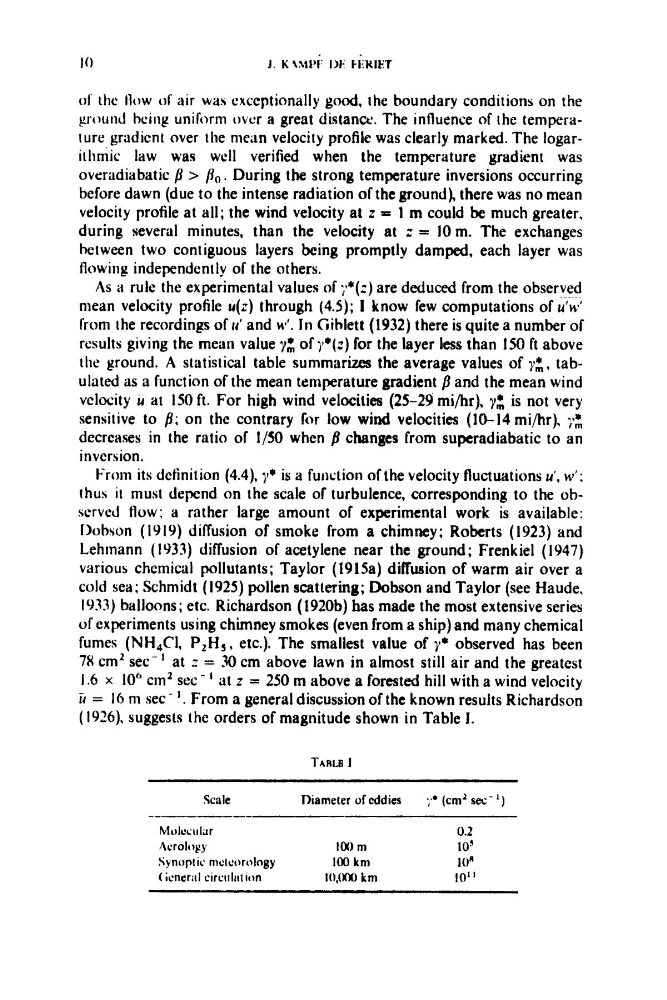
(1926). suggests the orders of magnitude shown in Table I.
From its definition (4.4),
TABLE I
Scale
Diameter of cddics
y* (crn' sa- I )
-___--_
Molecular
0.2
Acrolopy
100 rn
10s
Synoptic. mcIcorology
100 km
loR
( icncrd circiiliii ion
IO,(KlO km
10"
ground bcitip unil'orm over a great distance. The influence of the temperature gradient over the mcm velocity profile was clearly marked. The logarithmic law was well verified when the temperature gradient was
overadiabatic > Po. During the strong temperature inversions occurring
before dawn (due to the intense radiation of the ground), there was no mean
velocity profile at all; the wind velocity at z = 1 m could be much greater.
during several minutes, than the velocity at 2 = 10m. The exchanges
between two contiguous layers being promptly damped, each layer was
flowing independently of the others.
As a rule the experimental values of ; "( : )
are deduced from the observed
mean velocity profile U(;) through (4.5); I know few computations of u;~'
from the recordings of 14' and HI'. In Gihlett (1932) there is quite a number of
results giving the mean value 7: of ~ ' ( z ) for the layer less than 150 ft above
the ground. A statistical table summarizes the average values of y:, tabulated as a function of the mean temperature gradient p and the mean wind
velocity U at 150 ft. For high wind velocities (25-29; mi/hr), y: is not very
sensitive to b; on the contrary for low wind velocities (10-14mi/hr). 7:
decreases in the ratio of 1/50 when changes from superadiabatic to an
invcrsion.
is a fuliction of the velocity fluctuations u', w ' ;
thus it must depend on the scale of turbulence, corresponding to the observed flow: a rather large amount of experimental work is available:
Dobson (1919) diffusion of smoke from a chimney; Roberts (1923) and
Lehtnann (1933) diffusion of acetylene near the ground; Frenkiel (1947)
various chemical pollutants; Taylor (1915a) diffusion of warm air over a
cold sea; Schmidt (1925) pollen scattering; Dobson and Taylor (see Haude.
1933) balloons; etc. Richardson (1920b) has made the most extensive series
of experiments using chimney smokes (even from a ship) and many chemical
fumes (NH,CI, P,H3, etc.). The smallest value of I.'* observed has been
78 cm2 sec- ' at z = 30 cm above lawn in almost still air and the greatest
1.6 x 10' a n 2 sec- I at z = 250 m above a forested hill with a wind velocity
U = 16 m sec' '. From a general discussion of the known results Richardson
(1926). suggests the orders of magnitude shown in Table I.
From its definition (4.4),
TABLE I
Scale
Diameter of cddics
y* (crn' sa- I )
-___--_
Molecular
0.2
Acrolopy
100 rn
10s
Synoptic. mcIcorology
100 km
loR
( icncrd circiiliii ion
IO,(KlO km
10"